Formula One season starts amid shadow of Black Lives Matter movement

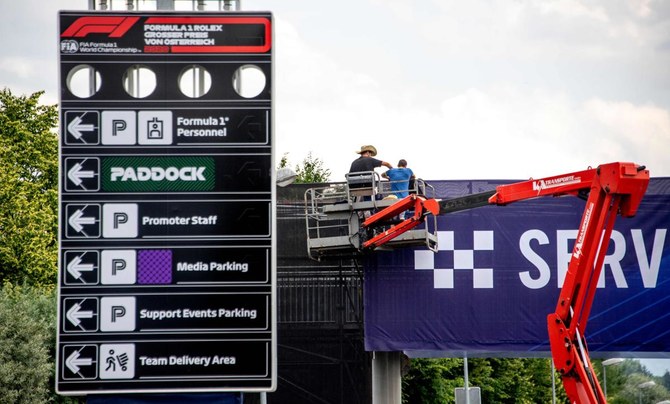
There will be no fans when the Formula One season starts at the Spielberg track in Austria, above, but political statements would be aplenty instead. (AFP)
Short Url
Updated 02 July 2020
Follow

Formula One season starts amid shadow of Black Lives Matter movement

  • ‘It is so important that we seize this moment,’ says Lewis Hamilton, the only Black driver to become F1 champion

SPIELBERG, Austria: Four months after the opening race was called off at the last minute, the Formula One season finally gets underway this weekend on another continent and in a different-looking world.
There will be no fans on hand at the remote Spielberg track in Austria, with the coronavirus still creating uncertainty over how many races can actually be held — and where.
That may not be the only unusual sight, as drivers are discussing whether to take the knee together on the grid before Sunday’s race in support of the Black Lives Matter movement. Defending F1 champion Lewis Hamilton has been an outspoken supporter of the movement and will be competing in an all-black Mercedes car — instead of the usual silver — as a statement against racism.
“It is so important that we seize this moment,” said Hamilton, the only Black driver to become F1 champion.
The truncated campaign kicks off with back-to-back races in Austria, as part of a hastily reworked schedule. It was meant to start nearly 10,000 miles (16,000 kilometers) away in the Australian city of Melbourne.
But the fast-spreading impact of the coronavirus pandemic led to the Australian GP being canceled on March 13, two days before the scheduled race, while people were still queuing for the first practice sessions. Several other races, including the showcase Monaco GP, were also canceled.
A rescue package with eight European races squeezed into 10 weeks, culminating with the Italian GP on Sept. 6, was scrambled together. F1 still hopes to rearrange some of the postponed races in order to finish the season with 15-18 of the scheduled 22.
There will also be two consecutive races at the British GP. If the season continues beyond Europe, it will end with races in Bahrain and Abu Dhabi in December.
“We actually don’t even know the amount of races we are going to do,” McLaren and future Ferrari driver Carlos Sainz Jr. said. “It’s an unprecedented scenario.”
Spielberg’s Red Bull Ring, cut off from major towns or cities, offers a reassuringly secluded feel amid coronavirus fears.
But strict health and safety measures have been put into place.
Everyone entering the track, including a greatly reduced number of media representatives, must have tested negative for Covid-19 and further tests will be carried out every five days. F1 teams are not allowed to mingle with each other — on or off the track — and media have no access to F1’s paddock area.
Drivers would normally have faced a barrage of questions in a news conference room, but health requirements dictate that drivers hold news conferences via video link and with questions sent in advance.
And, of course, Spielberg’s 4.3-kilometer (2.7-mile) circuit will be largely empty. It is normally swarming with tents, camper vans, makeshift barbecues and tens of thousands of orange-shirted Max Verstappen fans.
The Red Bull driver, hugely popular back home in the Netherlands, has won the past two races here.
The track is among the shortest in F1 but also one of the most aggressive. Drivers spend about 72% of the time at full throttle, second only to Italy’s Monza track with 77%.
That’s perfectly suited to Verstappen’s bold and abrasive racing style. Last season he chased down the leading trio before making a typically brazen overtaking move on race leader Charles Leclerc’s Ferrari.
The 22-year-old Verstappen showed last season that he is closing the gap to Hamilton in terms of wheel-to-wheel driving. Red Bull’s car also made a considerable jump in speed, while Ferrari’s faded, and Verstappen is emerging as a major title threat to Hamilton.
The 35-year-old British driver is chasing a record-equaling seventh F1 title to equal Michael Schumacher’s record, and only needs to win eight more races to beat Schumacher’s mark of 91.
Aside from Verstappen and possibly Valtteri Bottas — Hamilton’s improving teammate at Mercedes — the other main challenger is Leclerc.
The 22-year-old Monaco driver is extremely quick and impressed observers in his first season at Ferrari with seven pole positions — two more than Hamilton — and two wins.
He is now Ferrari’s No. 1 ahead of four-time F1 champion Sebastian Vettel, whose star has faded after he wasted mid-season leads in 2017 and 2018 and lost those titles to Hamilton.
The German veteran is leaving at the end of the year after failing to agree on a new contract, and his future in F1 is uncertain.
Like so many other things this season.


MESIF 2026 wraps up in Riyadh with spotlight on legacy, fans and sustainable sports growth

Updated 28 January 2026
Follow

MESIF 2026 wraps up in Riyadh with spotlight on legacy, fans and sustainable sports growth

  • A recurring theme in panel discussions was the importance of moving beyond siloed planning toward connected strategies
  • Abdullah Aldrees: I believe Saudi is a sleeping giant within the football ecosystem because of the high demand that exists

RIYADH: The sixth edition of the Middle East Sports Investment Forum concluded on Jan. 28 in Riyadh, reinforcing the need for long-term legacy planning, integrated infrastructure development and fan-centric strategies as the region’s sports ecosystem continues to mature.

Held over two days — Jan. 27-28 — at the ministry of investment headquarters and the Kingdom Arena, the forum brought together senior government officials, global sports executives, investors and technology leaders to assess how the Middle East — and Saudi Arabia in particular — can translate major event hosting and increased investment into sustainable impact.

A recurring theme in panel discussions was the importance of moving beyond siloed planning toward connected strategies that link infrastructure, finance, fan engagement and legacy from the earliest stages of project development.

Dr. Sakis Batsilas, deputy CEO of FIFA World Cup Qatar 2022, stressed that while international expertise has played a key role in the region’s rapid progress, long-term success depends on knowledge transfer and talent development.

“Yes, we do need experts and consultants and expatriates to help,” he said. “But the main, I would say, focus, is how we ensure that we transfer this knowledge and we build talent … to make sure we have the right talent.”

Drawing on his experience delivering major global events, Batsilas highlighted the need to embed legacy considerations during the bidding phase.

“Talking now from an operational point of view … I think everything starts with a bidding phase,” he said, adding that stronger legacy metrics would encourage greater long-term planning from host nations and rights holders alike.

Fan experience and commercialization also featured prominently, particularly as Saudi Arabia continues to expand its domestic leagues and host major international competitions. David Davies, chief experience officer of Catapult, said the Kingdom’s challenge lies in converting strong digital fandom into sustained in-stadium engagement.

“Saudi Arabia is … ranked consistently in the highest in the world” in terms of football fandom, Davies said. “However, attendance in-stadium is still developing.” He noted that younger, digitally native audiences require tailored engagement strategies. “The days of being able to ask them to come to you have gone,” he said.

From a government and delivery perspective, Abdullah Aldrees, chief of staff at the vice minister’s executive office at the ministry of sport, said MESIF highlighted the scale of opportunity ahead — and the importance of a joined-up approach.

“I believe Saudi is a sleeping giant within the football ecosystem because of the high demand that exists, the government support and the anchor IPs that we’re hosting,” Aldrees said. “So all of this can create a lot of opportunities for football to grow in Saudi.”

He said the Kingdom has entered a critical preparation phase as it gears up for a packed calendar of major events. “We are now living in the preparation phase. We’re preparing for all these IPs, we’re preparing for all these big events coming up,” Aldrees said. “So how do you make sure that you really reap the right benefit from them and have the right legacy?”

Pointing to upcoming milestones such as the AFC Asian Cup Saudi Arabia 2027 and the FIFA World Cup 2034, Aldrees emphasized the need to think beyond hosting.

“Yes, we’re hosting World Cup. We’re hosting Asia 2027, but how do you make sure that they have a long, lasting impact on the ecosystem?” he said.

Echoing a key message from the forum, Aldrees concluded: “The effective strategy is to be looking at these things together. We no longer can be looking at them as silos and test cycles.”

The transformation of Saudi football was also highlighted as a reflection of broader cultural and structural change. Juan Esteban Gomez, a football expert specializing in digitalization and artificial intelligence, said the shift has been tangible in recent years. “The people here are breathing football,” he said, describing the Saudi league as “one of the most enjoyable competitions in the world.”

As MESIF 2026 drew to a close, participants agreed that the next phase of sports investment in the Middle East will be defined by execution — ensuring that capital, policy and innovation align to deliver measurable legacy, deeper fan engagement and resilient ecosystems capable of sustaining growth well beyond headline events.