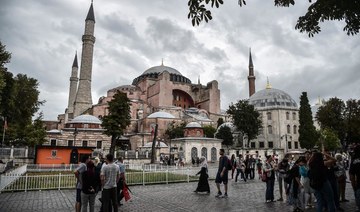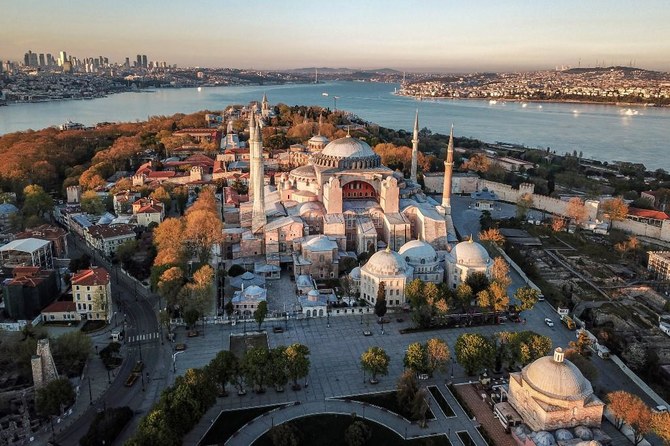
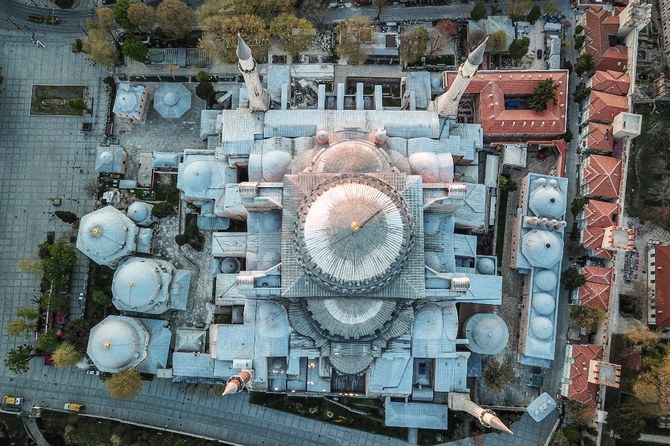
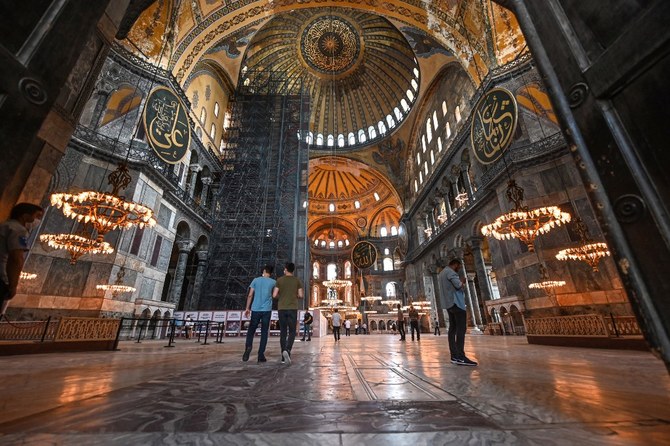
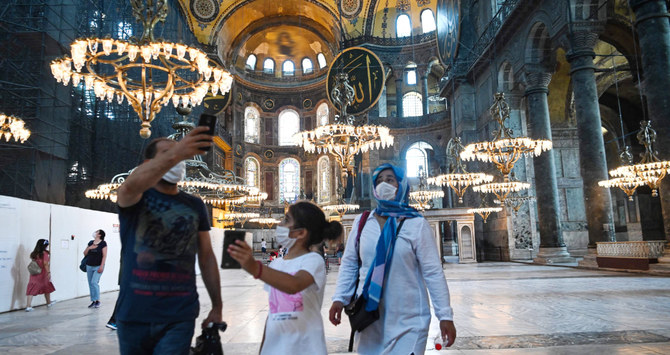
ANKARA: Turkey’s highest administrative body on Thursday delayed its decision about the fate of the Hagia Sophia, the 1,500-year-old cathedral and UNESCO World Heritage site that could be converted into a mosque.
The Council of State will make its ruling within 15 days to decide whether the Byzantine-era monument and tourist hotspot should be converted from a museum into a place for Muslim worship.
The move has been criticized as a tactic to mobilize the religious and conservative voters of the ruling Justice and Development Party (AKP), although debates about the building’s status was a hot topic during AKP election rallies last year. Leaders and constituencies called for its conversion, despite opposition from secular parties and the international community.
Religious services have been banned in the Hagia Sophia since 1934. It was built in the sixth century by the Byzantine Emperor Justinian and has been visited by four popes.
Although Ankara has uneasy relationships with many Western governments, such an ideologically motivated decision about an asset that carries global political and religious meaning is likely to cause a deterioration in relations with key countries, especially the US and Greece.
Greek Culture Minister Lina Mendoni recently accused Turkey of refreshing “fanatical nationalist and religious sentiment,” while UNESCO called for wider approval and a pluralist consensus about the building’s fate before such a major decision was made.
But, when asked last month in a television interview for his opinion about Greek fury over the potential decision, Turkish President Recep Tayyip Erdogan insisted that this issue was strictly a matter for national sovereignty.
“They dare tell us not to transform the Hagia Sophia into a mosque,” he said. “Are you ruling Turkey, or are we?”
Some recent polls suggest decreased support for the AKP if a snap election were to be held. For some people, the insistence on the Hagia Sophia’s status may be linked to this shrinking support. Last year, Erdogan’s statement about converting the Hagia Sophia coincided with the run-up to local elections in March 2019.
A recent survey conducted by the independent firm MetroPOLL showed that 44 percent of Turks believed that the public debates around the Hagia Sophia intended to distract attention away from the economic situation, with pro-government news channels featuring experts claiming that the landmark was originally “a shopping mall.”
“It is not a sign of strength but of weakness when political agendas are mobilized in the context of World Heritage sites,” Ekavi Athanassopoulou, tenured assistant professor of international relations and an expert in Turkish-Greek relations from the University of Athens, told Arab News.
US Secretary of State Mike Pompeo recently warned that any change in the Hagia Sophia’s status would weaken its ability to serve humanity as a “much-needed bridge” between those of differing faith traditions and cultures.
Last week, US Ambassador at Large for International Religious Freedom Sam Brownback called on Ankara to maintain the building as it was.
Ziya Meral, a senior associate fellow at the Royal United Services Institute, said the move was mostly about galvanizing the AKP’s constituency, the majority of whom shared a decades-long ambition to restore its mosque status.
“The fact that Erdogan has not done so for the last two decades until now clearly raises the question of what he sees as a positive return in an issue that is set to attract widespread disappointment in Europe and the wider Christian populations at home and around the world,” he told Arab News.
Meral added that, for Turkey’s Christians, the issue was not that the Hagia Sophia would once again technically be a mosque, or that Muslim prayers would be held there.
“It has already been a mosque for centuries,” he said.
“The issue is a disappointment that nationalist triumphalism negates their heritage and a shared space that can be a sacred site of healing and unity rather than exclusion. A short-sighted emotive sense of victory for the AKP and Erdogan, but to what benefit amid strained relations with Europe and the US, and crumbling tourism and economy beyond affirmation by people who already vote for the AKP is difficult to establish.”