

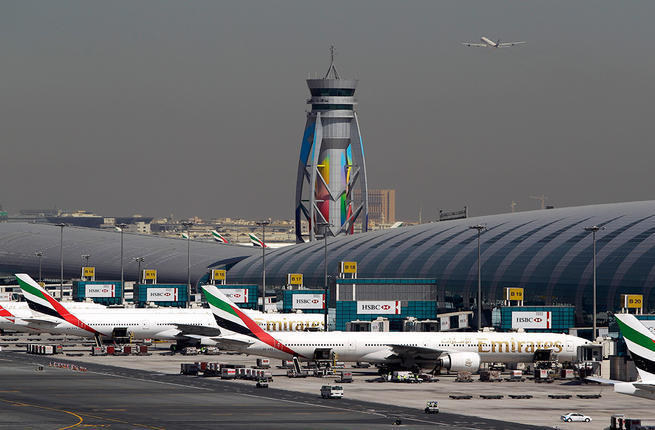
UAE says residents, citizens cannot travel abroad for tourism yet

A spokesman for the National Emergency Crisis and Disaster Management Authority (NCEMA) said travel abroad is only allowed currently for study, medical treatment, diplomatic missions, business and residents who want to visit or return to their home countries. (AFP/File Photo)
Short Url
Updated 01 July 2020
Follow

UAE says residents, citizens cannot travel abroad for tourism yet

  • Essential travel is permitted but will be assessed on case by case basis, NCEMA said

DUBAI: United Arab Emirates authorities on Wednesday said residents and citizens were not yet allowed to travel abroad for tourism and leisure purposes and all travel abroad needed a permit, as part of restrictions aimed at stemming the spread of the new coronavirus.

A spokesman for the National Emergency Crisis and Disaster Management Authority (NCEMA) said travel abroad is only allowed currently for study, medical treatment, diplomatic missions, business and residents who want to visit or return to their home countries.

“Essential travel is permitted ... but will be assessed on a case by case basis according to risk levels,” Saif Al-Dhaheri told a virtual news conference.

He said these were “indicative” guidelines set at a national level and local authorities would announce additional procedures.

The UAE said two weeks ago that citizens and residents would be permitted to travel abroad from June 23 under conditions that were to be announced.

Dubai, one of the seven emirates that make up the UAE federation, has said it will allow foreign visitors to fly in from July 7, but the other emirates have not announced a similar measure.

The UAE halted all passenger flights in March and banned foreign citizens from entering the Gulf Arab state except those holding UAE residency, who required UAE government approval before returning.

Limited outbound repatriation flights have been operating to certain countries.

The UAE has recorded 49,069 cases of the new coronavirus and 316 deaths.


Arab Coalition announces ‘limited’ airstrike targeting two ships that smuggled weapons to Yemen

Updated 14 sec ago
Follow

Arab Coalition announces ‘limited’ airstrike targeting two ships that smuggled weapons to Yemen

RIYADH: The Coalition to Support Legitimacy in Yemen on Tuesday said it conducted a “limited” airstrike targeting two ships that smuggled weapons and other military hardware into Mukalla in southern Yemen.

In a statement carried by the Saudi Press Agency (SPA), the Coalition Forces spokesman, Major General Turki Al-Maliki, said that two ships coming from the port of Fujairah in the United Arab Emirates entered the port of Mukalla without obtaining official permits from the Joint Forces Command of the Coalition. 

“The crews of the two ships disabled the tracking systems of the two ships and unloaded a large quantity of weapons and combat vehicles to support the Southern Transitional Council forces in the eastern governorates of Yemen (Hadramawt, Al-Mahra) with the aim of fueling the conflict. This is a clear violation of imposing a truce and reaching a peaceful solution, as well as a violation of UN Security Council Resolution No. (2216) of 2015 AD,” said the spokesman.

Google map showing the location of Mukalla in southern Yemen

Al-Maliki said the Coalition Forces acted on a request by Rashad Al-Alimi, the president of the Yemeni Presidential Leadership Council, “to take all necessary military measures to protect civilians in the governorates of Hadramawt and Al-Mahra.”

Al-Alimi, the president of the Yemeni Presidential Leadership Council, warned last week that unilateral actions by the STC were pushing the country toward a dangerous tipping point.

“Given the danger and escalation posed by these weapons, which threaten security and stability, the Coalition Air Forces conducted a limited military operation this morning targeting weapons and combat vehicles unloaded from the two ships at the port of Al-Mukalla. This was done after documenting the unloading, and the military operation was carried out in accordance with international humanitarian law and its customary rules, ensuring no collateral damage occurred,”  spokesman Al-Maliki said on Tuesday.


READ MORE: Analysis: The risks of carving up Yemen


He affirmed the Coalition’s "continued commitment to de-escalation and enforcing calm in the governorates of Hadramawt and Al-Mahra, and to prevent any military support from any country to any Yemeni faction without coordination with the legitimate Yemeni government and the Coalition. This is aimed at ensuring the success of the Kingdom and the Coalition’s efforts to achieve security and stability and prevent the conflict from spreading.”

Disregarding previous agreements with the Coalition, the group calling itself Southern Transitional Council, or STC, launched a sweeping military campaign early in December, seizing the governorates of Hadramaut along the Saudi border and the eastern governorate of Al-Mahra in Yemen’s border with Oman.

The UAE-backed STC forces captured the city of Seiyun, including its international airport and the presidential palace. They also took control of the strategic PetroMasila oilfields, which account for a massive portion of Yemen’s remaining oil wealth.

This prompted Saudi Arabia to issue a firm demand for the STC to withdraw and hand over the seized areas to the National Shield Forces, a Saudi-backed unit.

The coalition warned that any military movements undermining de-escalation efforts would be dealt with immediately to protect civilians, according to the Saudi Press Agency.

On Dec. 26, the UAE issued a statement welcoming Saudi Arabia’s efforts to support security and stability in Yemen.

The statement carried by state news agency WAM praised Saudi Arabia’s constructive role in advancing the interests of the Yemeni people and supporting their legitimate aspirations for stability and prosperity.