UK extends immigration rights for 3M eligible Hong Kongers

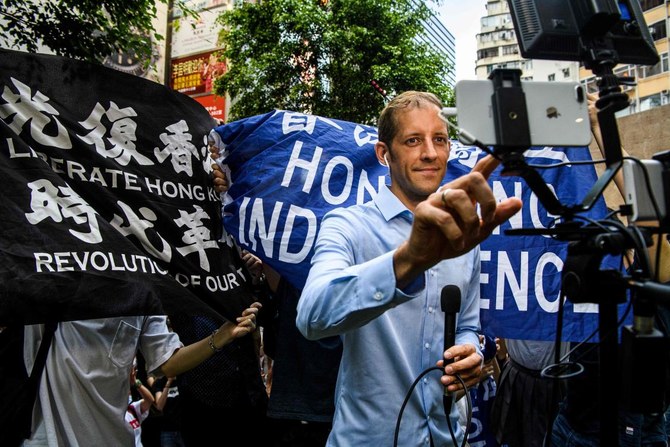
Protesters stand behind a reporter during a rally against a new national security law in Hong Kong on July 1, 2020, on the 23rd anniversary of the city’s handover from Britain to China. (AFP)
Short Url
Updated 01 July 2020
Follow

UK extends immigration rights for 3M eligible Hong Kongers

  • Under the new policy, eligible individuals will have the right to live and work in the country for five years, after that, they will be allowed to apply for settled status and then again for citizenship
  • Hong Kongers who were born after the end of British rule in 1997 are not eligible, meaning that in effect, many of the city’s young student activists cannot take advantage of the British offer

LONDON: Britain announced Wednesday that it was extending residency rights for up to 3 million Hong Kongers eligible for the British National Overseas passport, stressing that it would uphold its historic duty to the former British colony after Beijing imposed a sweeping new national security law in the city.
Foreign Secretary Dominic Raab told lawmakers that amid widespread concerns about Beijing’s tightening grip on Hong Kong, the UK was changing its immigration rules to give people who are connected to Britain by virtue of the city’s status as a former British colony a special route to citizenship.
Eligible individuals from Hong Kong currently can come to the UK for six months without a visa. Under the new policy, they will have the right to live and work in the country for five years. After that, they will be allowed to apply for settled status and then again for citizenship.
Hong Kongers who were born after the end of British rule in 1997 are not eligible, meaning that in effect, many of the city’s young student activists who are most at risk of arrest under the new law cannot take advantage of the British offer.
The announcement came hours after China imposed a sweeping new national security law in Hong Kong that Britain calls a flagrant breach of China’s international obligations and a “clear and serious violation” of the Sino-British Joint Declaration.
That treaty paved the way for Hong Kong’s handover from British to Chinese rule in 1997, and was supposed to guarantee at least 50 years of Western-style rule of law and civil liberties for the city under a “One Country, Two Systems” principle until 2047.
Chinese officials have in the past referred to the document as a “historical document,” a claim that Britain strongly rejects.
“The prime minister and the government are crystal clear that the United Kingdom will keep its word,” Raab said. “We will live up to our responsibilities to the people of Hong Kong.”
The UK introduced a special, limited type of British nationality in the 1980s for people who were a “British dependent territories citizen by connection with Hong Kong.” The passports did not confer nationality or the automatic right to live and work in Britain, but entitled holders to consular assistance from UK diplomatic posts.
Britain’s government estimates there are about 350,000 current holders of the British National Overseas passports, with a total of around 2.9 million people eligible for it. It says the extended residency rules will apply to all of them and their immediate dependents.
No exact date was given for the new rule’s implementation, and Raab said further details will be announced later.
Raab called the security law a “grave and deeply disturbing step,” and said it contained measures that directly threaten the judicial independence and freedoms of speech and protest protected by the Joint Declaration. It was particularly concerning that mainland Chinese authorities can now take jurisdiction over some cases without independent oversight, and try those cases in Chinese courts, he said.
Trust in China’s ability to live up to its international responsibilities took “a big step backwards,” he added.
The security law makes secessionist, subversive, terrorist activities and foreign intervention in Hong Kong’s affairs illegal. The most serious offenders, such as those deemed to be masterminds behind the crimes, could receive a maximum punishment of life imprisonment.
Many critics in the city and abroad say the law effectively ends “One Country, Two Systems” policy and erases the legal firewall between Hong Kong and the mainland’s Communist Party rule.
Hong Kong police arrested nine people under the law Wednesday, the first day it came into effect. They included a man with a Hong Kong independence flag and a woman holding a sign displaying the British flag and calling for Hong Kong’s independence. Others were detained for possessing items advocating independence.


Jesse Jackson, civil rights leader and US presidential hopeful dies at 84, family says

Updated 5 min 35 sec ago
Follow

Jesse Jackson, civil rights leader and US presidential hopeful dies at 84, family says

*
Jackson was inspirational orator and civil rights champion

*
He sought 1984 and 1988 Democratic presidential nomination


Washington: Charismatic US civil rights leader Jesse Jackson, an eloquent Baptist minister raised in the segregated South who became a close associate of Martin Luther King Jr and twice ran for the Democratic presidential nomination, has died at age 84, his family said in a statement on Tuesday.
“Our father was a servant leader — not only to our family, but to the oppressed, the voiceless, and the overlooked around the world,” the Jackson family ​said.
Jackson, an inspirational orator and long-time Chicagoan, was diagnosed with Parkinson’s disease in 2017.
The media-savvy Jackson advocated for the rights of Black Americans and other marginalized communities dating back to the turbulent civil rights movement of the 1960s spearheaded by his mentor King, a Baptist minister and towering social activist.
Jackson weathered a spate of controversies but remained America’s preeminent civil rights figure for decades.
He ran for the Democratic presidential nomination in 1984 and 1988, attracting Black voters and many white liberals in mounting unexpectedly strong campaigns but fell short of becoming the first Black major party White House nominee. Ultimately, he never held elective office.
Jackson founded the Chicago-based civil rights groups Operation PUSH and the National Rainbow Coalition and served as Democratic President Bill Clinton’s special envoy to Africa in the 1990s. Jackson also was instrumental in securing the release of a number of Americans and others held overseas in places including Syria, Cuba, Iraq and Serbia.

MESMERIZING ORATORY
Jackson pursued his political ambitions in the 1980s, relying on his mesmerizing oratory. It was not until fellow Chicagoan Barack Obama’s election as president in 2008 that a Black candidate came ‌as close to ‌securing a major party presidential nomination as Jackson.
In 1984, Jackson won 3.3 million votes in Democratic nominating contests, about 18 percent ​of ‌those cast, ⁠and finished ​third behind ⁠eventual nominee Walter Mondale and Gary Hart in the race for the right to face Republican incumbent Ronald Reagan. His candidacy lost momentum after it became public that Jackson had privately called Jewish people “Hymies” and New York “Hymietown.”
In 1988, Jackson was a more polished and mainstream candidate, coming in a close second in the Democratic race to face Republican George H.W. Bush. Jackson gave eventual Democratic nominee Michael Dukakis a run for his money, winning 11 state primaries and caucuses, including several in the South, and amassing 6.8 million votes in nominating contests, or 29 percent.
Jackson cast himself as a barrier-breaker for people of color, the impoverished and the powerless. He electrified the 1988 Democratic convention with a speech telling his life story and calling on Americans to find common ground.
“America is not a blanket woven from one thread, one color, one cloth,” Jackson told the delegates in Atlanta.
“Wherever you are tonight, you can make it. Hold your head high, stick your chest out. You can ⁠make it. It gets dark sometimes, but the morning comes. Don’t you surrender. Suffering breeds character, character breeds faith. In the end, ‌faith will not disappoint,” Jackson added.
Jackson announced in 2017 at age 76 that he had been diagnosed with Parkinson’s disease, ‌a movement disorder marked by trembling, stiffness and poor balance and coordination, after experiencing symptoms for three years.

SOUTHERN ROOTS
Born ​on Oct. 8, 1941, in Greenville, South Carolina, his mother was a 16-year-old high school ‌student and his father was a 33-year-old married man who lived next door. His mother later married another man who adopted Jackson. He grew up amid the Jim Crow ‌era in the United States, the often brutally enforced web of racist laws and practices born in the South to subjugate Black Americans.
Jackson earned a football scholarship at the University of Illinois, but transferred to a historically Black college because he said he experienced discrimination. He began his civil rights activism while a student at North Carolina Agricultural & Technical College, and was arrested when he sought to enter a “whites-only” public library in South Carolina.
He attended Chicago Theological Seminary and was ordained a Baptist minister in 1968 despite failing to graduate.
Jackson became a lieutenant to civil rights leader Martin Luther King Jr and sometimes traveled with ‌him. On the day King was assassinated by a white man named James Earl Ray on the balcony of the Lorraine Motel in Memphis, Jackson was just a floor below. Jackson infuriated some of King’s other associates when he told reporters he ⁠had cradled the dying King in his arms and ⁠was the last person to whom King spoke, an account they disputed.
King, who headed the Southern Christian Leadership Conference, had installed the energetic Jackson in a leadership role to help create economic opportunities in Black communities.
Jackson later broke with King’s successor at the SCLC, Ralph Abernathy, and set up his own civil rights organization in Chicago, Operation PUSH, in the early 1970s. In 1984, Jackson founded the National Rainbow Coalition, whose broader civil rights mission also included women’s rights and gay rights, and the two organizations merged in 1996. He stepped down as the president of Rainbow-PUSH Coalition in 2023 after more than five decades of leadership and activism.
He met his wife, Jacqueline Brown, during college. They married in 1962 and had five children. His son Jesse Jackson Jr. was elected to the US House of Representatives but resigned and served prison time on a fraud conviction. Jackson also had a daughter out of wedlock in 1999 with a woman who worked at his civil rights groups, which became a scandal.
Jackson was known for personal diplomacy. After he secured the 1984 release by Syria of US naval aviator Robert Goodman Jr., President Ronald Reagan invited Jackson to the White House and expressed gratitude for the “mission of mercy.” Jackson met in 1990 with Iraqi leader Saddam Hussein to gain the release of hundreds of Americans and others after Iraq’s invasion of Kuwait. He won the 1984 release of dozens of Cuban and American prisoners from Cuban jails and the release ​of three US airmen held in Serbia in 1999.
He hosted a weekly show on ​CNN from 1992 to 2000, pressed corporations for Black economic empowerment, and received the highest US civilian honor, the Presidential Medal of Freedom from Clinton in 2000.
Jackson continued his activism later in life, condemning the police killing of George Floyd and other Black Americans in 2020 amid the global racial justice movement.