Health experts alarmed over COVID-19 test fees in Bangladesh

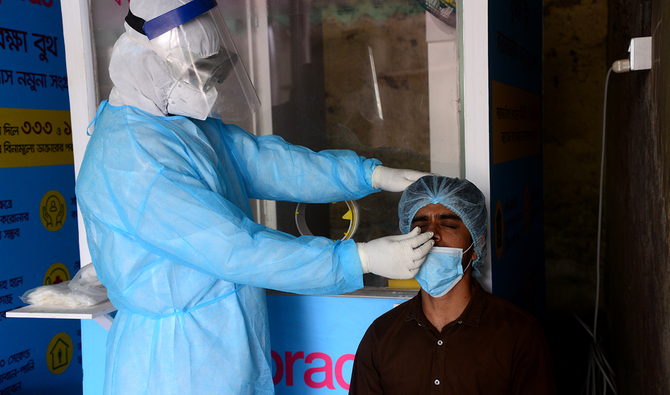
A man gets tested for the COVID-19 coronavirus at the Bangabandhu Sheikh Mujib Medical University in Dhaka, Bangladesh, on June 3, 2020. (Shutterstock)
Short Url
Updated 30 June 2020
Follow

Health experts alarmed over COVID-19 test fees in Bangladesh

  • Decision comes amid surge in coronavirus cases

DHAKA: Health experts in Bangladesh are warning of an increased risk of coronavirus transmission following the government’s decision to introduce fees for COVID-19 tests.

The Health Ministry on Monday decided to charge $2 for testing for the virus at government-run facilities, and $6 if samples are collected at the patient’s home. The fees were introduced with immediate effect, according to the ministry’s notice.

The announcement came amid a surge in coronavirus cases across the country. As of Tuesday, the number of known COVID-19 infections reached 145,000, and at least 1,847 Bangladeshis have succumbed to the disease.

So far, 766,000 tests have been conducted at 68 laboratories in the country of nearly 165 million people.

Dr. Mozaherul Huq, former World Health Organization regional director for East Asia, said the government’s decision will adversely affect its COVID-19 response as the fee will discourage poorer people, even with coronavirus symptoms, from undergoing screening.

“It will affect case detection and thereby contact tracing and isolation as well as quarantine, resulting in more transmission,” he added.

Bangladesh Bureau of Statistics data indicate that around 20 percent of the population live below the poverty line.

“Now many people will remain out of the screening system as they can’t bear the testing fees,” the country’s renowned virologist Dr. Nazrul Islam told Arab News.

“We’ll only get a test result from people of affordable classes, so the data will definitely be incomplete.”

Justifying the government’s decision, Dr. Shahnila Ferdousi, director of the Center for Disease Control, told Arab News that the fees will “discourage” people from undergoing “unnecessary testing.”

She said: “We’ve noticed that many people are conducting tests every week just because it’s free, although they don’t have any COVID-19-like symptoms. The government has some limitations in its resources and ability.”

She added, however, that free tests will be considered for those who cannot afford the fees. “People who are currently under different social safety net programs of the government can be considered for free testing,” she said.


UN refugee agency says up to 3.2 million people in Iran have been displaced by the war

Updated 2 sec ago
Follow

UN refugee agency says up to 3.2 million people in Iran have been displaced by the war

  • It said Thursday that most have fled from Tehran and other major cities toward the north of the country or rural areas
DUBAI: The UN refugee agency says up to 3.2 million people in Iran have been displaced by the ongoing war.
It said Thursday that most have fled from Tehran and other major cities toward the north of the country or rural areas.
THIS IS A BREAKING NEWS UPDATE. AP’s earlier story follows below.
DUBAI, United Arab Emirates: Unrelenting Iranian attacks on shipping traffic and energy infrastructure pushed oil above $100 a barrel on Thursday, as American and Israeli strikes pounded the Islamic Republic with no sign of an end to the war in sight.
Iran hit a container ship off the coast of Dubai, caused a blaze near Bahrain’s international airport, targeted a major Saudi oil field with a drone attack and forced Iraq to halt operations at all the country’s oil terminals after an attack on its port of Basra on the Arabian Gulf.
Iran flouted a United Nations Security Council resolution from the previous day demanding that it halt strikes on its Gulf neighbors with new attacks also reported in Kuwait and the United Arab Emirates.
Sirens wailed before dawn in Jerusalem after Israel said it was working to intercept missiles launched from Iran. The country also announced it had begun a “wide-scale wave of strikes” on Tehran. In Lebanon, where Israel says it is targeting Iran-linked Hezbollah militants, 11 people were killed in two early morning strikes.
Since the United States and Israel sparked with war with a Feb. 28 attack on Iran, Tehran has embarked on a campaign generated at inflicting enough global economic pain to pressure them to relent in their attacks.
In addition to attacking energy infrastructure around the region, Iran has a stranglehold on the Strait of Hormuz, the strategic waterway leading from the Arabian Gulf toward the Indian Ocean through which a fifth of the world’s oil is transported.
With traffic in the Strait effectively stopped, the price of Brent crude oil, the international standard, rose another 9 percent on Thursday to more than $100 a barrel, up some 38 percent over what it cost when the war started.
Iran fires at multiple Gulf Arab countries and hits ship in Arabian Gulf
The UN Security Council voted Wednesday to approve a resolution demanding a halt to Iran’s “egregious attacks” on its Gulf neighbors, but Tehran showed no signs of changing its strategy.
As the day began Thursday, a container ship in the Arabian Gulf was hit with a projectile off the coast of Dubai, sparking a small fire, according to British military’s United Kingdom Maritime Trade Operations Center. It said the crew of the vessel were safe.
In Bahrain, an early Iranian attack sparked a major fire on Muharraq Island, home to the country’s international airport. Authorities urged people to stay indoors and close windows to avoid smoke. The airport has jet fuel tanks, and other tanks in the area serve the kingdom’s oil industry.
Kuwait’s Defense Ministry said an Iranian drone smashed into a residential building, wounding two people, the UAE said it had activated air defenses twice to protect Dubai from attacks, and firefighters extinguished a blaze at a tower in Dubai Creek Harbor after a drone hit.
Saudi Arabia said it had shot down a drone targeting the diplomatic quarter of the capital, Riyadh, and also reported downing drones in kingdom’s east, including at least one trying to target its Shaybah oil field in the Empty Quarter desert.
Following an attack on Iraq’s Basra port that killed at least one person, officials said Thursday that it had been forced to halt operations at all the country’s oil terminals.
Farhan Al-Fartousi, the director-general of the General Company for Ports of Iraq, said the attack targeted a vessel in a ship-to-ship transfer area of the Arabian Gulf port.
Explosions rock Jerusalem while Lebanon and Tehran are hit by Israeli strikes
Sirens wailed and loud explosions were heard shortly after midnight in Jerusalem and other parts of Israel. The Israeli military said it was responding with another “wide-scale wave of strikes” in Tehran.
Overnight missile launches from Iran and Hezbollah also sent Israelis to shelters in multiple other areas, including Tel Aviv and the northern border with Lebanon.
An Israeli strike hit a car Thursday in Ramlet Al-Bayda, a major seaside tourist area of Beirut where dozens of displaced people have been sheltering. Eight people were killed and 31 others were wounded, the Lebanese Health Ministry said. The Israeli military press office told The Associated Press it was “not aware” of a strike at that location.
In Aramoun, a town about 10 kilometers (six miles) south of Beirut, another three people were killed and a child was wounded in another early Israeli attack.
Casualties continue to climb as conflict continues
At least 634 people have been killed in Lebanon since the latest fighting began, the Lebanese Health Ministry said Wednesday.
The UN refugee agency said at least 759,000 people have been internally displaced in Lebanon.
Iranian authorities say more than 1,300 people have been killed there, and Israel has reported 12 people dead. The US has lost seven soldiers while another eight have suffered severe injuries.