

Health experts alarmed over COVID-19 test fees in Bangladesh

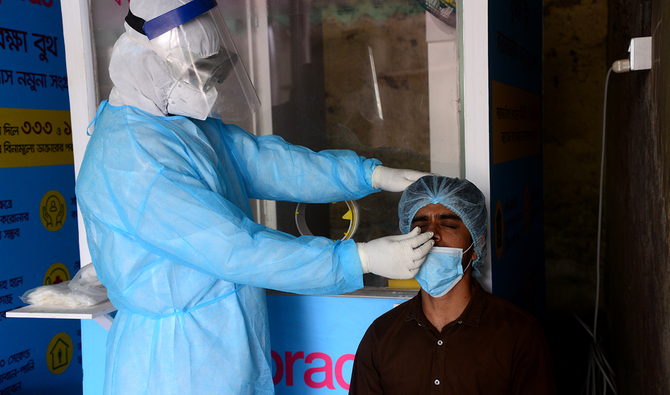
A man gets tested for the COVID-19 coronavirus at the Bangabandhu Sheikh Mujib Medical University in Dhaka, Bangladesh, on June 3, 2020. (Shutterstock)
Short Url
Updated 30 June 2020
Follow

Health experts alarmed over COVID-19 test fees in Bangladesh

  • Decision comes amid surge in coronavirus cases

DHAKA: Health experts in Bangladesh are warning of an increased risk of coronavirus transmission following the government’s decision to introduce fees for COVID-19 tests.

The Health Ministry on Monday decided to charge $2 for testing for the virus at government-run facilities, and $6 if samples are collected at the patient’s home. The fees were introduced with immediate effect, according to the ministry’s notice.

The announcement came amid a surge in coronavirus cases across the country. As of Tuesday, the number of known COVID-19 infections reached 145,000, and at least 1,847 Bangladeshis have succumbed to the disease.

So far, 766,000 tests have been conducted at 68 laboratories in the country of nearly 165 million people.

Dr. Mozaherul Huq, former World Health Organization regional director for East Asia, said the government’s decision will adversely affect its COVID-19 response as the fee will discourage poorer people, even with coronavirus symptoms, from undergoing screening.

“It will affect case detection and thereby contact tracing and isolation as well as quarantine, resulting in more transmission,” he added.

Bangladesh Bureau of Statistics data indicate that around 20 percent of the population live below the poverty line.

“Now many people will remain out of the screening system as they can’t bear the testing fees,” the country’s renowned virologist Dr. Nazrul Islam told Arab News.

“We’ll only get a test result from people of affordable classes, so the data will definitely be incomplete.”

Justifying the government’s decision, Dr. Shahnila Ferdousi, director of the Center for Disease Control, told Arab News that the fees will “discourage” people from undergoing “unnecessary testing.”

She said: “We’ve noticed that many people are conducting tests every week just because it’s free, although they don’t have any COVID-19-like symptoms. The government has some limitations in its resources and ability.”

She added, however, that free tests will be considered for those who cannot afford the fees. “People who are currently under different social safety net programs of the government can be considered for free testing,” she said.


Three Afghan migrants die of cold while trying to cross into Iran

Updated 2 sec ago
Follow

Three Afghan migrants die of cold while trying to cross into Iran

AFGHANISTAN: Three Afghans died from exposure in freezing temperatures in the western province of Herat while trying to illegally enter Iran, a local army official said on Saturday.
“Three people who wanted to illegally cross the Iran-Afghanistan border have died because of the cold weather,” the Afghan army official told AFP on condition of anonymity.
He added that a shepherd was also found dead in the mountainous area of Kohsan from the cold.
The migrants were part of a group that attempted to cross into Iran on Wednesday and was stopped by Afghan border forces.
“Searches took place on Wednesday night, but the bodies were only found on Thursday,” the army official said.
More than 1.8 million Afghans were forced to return to Afghanistan by the Iranian authorities between January and the end of November 2025, according to the latest figures from the United Nations refugee agency (UNHCR), which said that the majority were “forced and coerced returns.”
“These mass returns in adverse circumstances have strained Afghanistan’s already overstretched resources and services” which leads to “risks of onward and new displacement, including return movements back into Pakistan and Iran and onward,” UNHCR posted on its site dedicated to Afghanistan’s situation.
This week, Amnesty International called on countries to stop forcibly returning people to Afghanistan, citing a “real risk of serious harm for returnees.”
Hit by two major earthquakes in recent months and highly vulnerable to climate change, Afghanistan faces multiple challenges.
It is subject to international sanctions particularly due to the exclusion of women from many jobs and public places, described by the UN as “gender apartheid.”
More than 17 million people in the country are facing acute food insecurity, the UN World Food Programme said Tuesday.