Sahel allies have ‘shifted the dynamic’ in fight with extremists: Macron

1 / 4
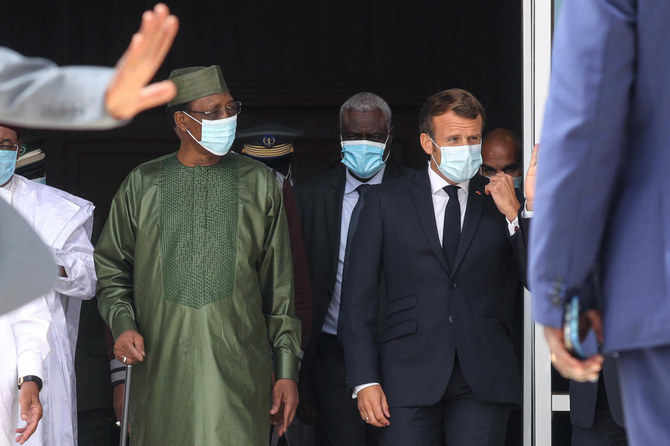
Chad’s President Idriss Deby, Chairperson of the African Union Commission Moussa Faki and French President Emmanuel Macron at the G5 Sahel summit in Nouakchott, Mauritania, June 30, 2020. (Reuters)
2 / 4
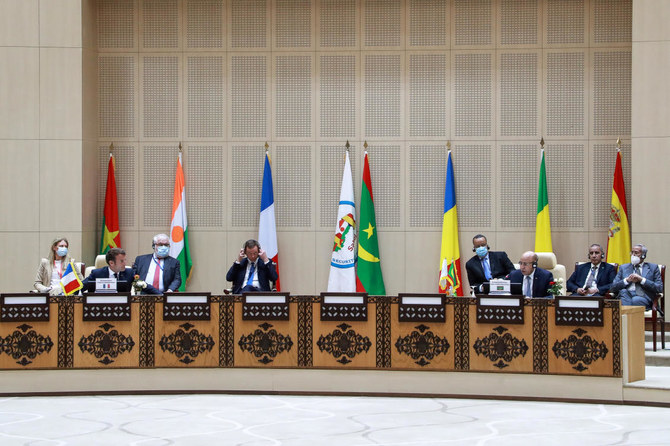
French President Emmanuel Macron listens as Mauritania’s President Mohamed Ould Cheikh El Ghazouani speaks during the G5 Sahel summit in Nouakchott, Mauritania, June 30, 2020. (Reuters)
3 / 4
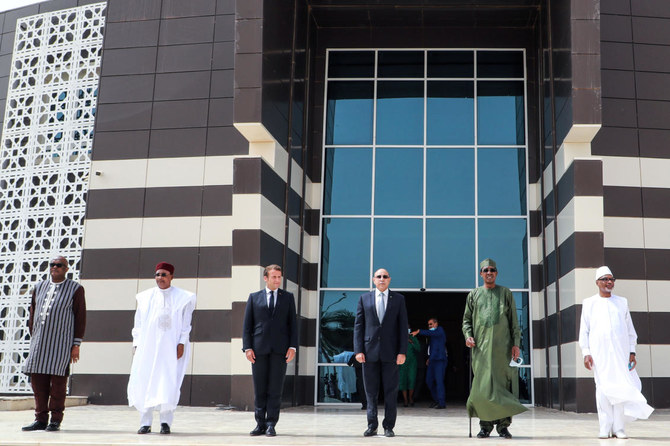
Burkina Faso’s President Roch Marc Kabore, Niger’s President Mahamadou Issoufou, French President Emmanuel Macron, Mauritania’s President Mohamed Ould Ghazouani, Chad’s President Idriss Deby and Mali’s President Ibrahim Boubacar Keita at the G5 Sahel summit in Nouakchott, Mauritania, June 30, 2020. (Reuters)
4 / 4
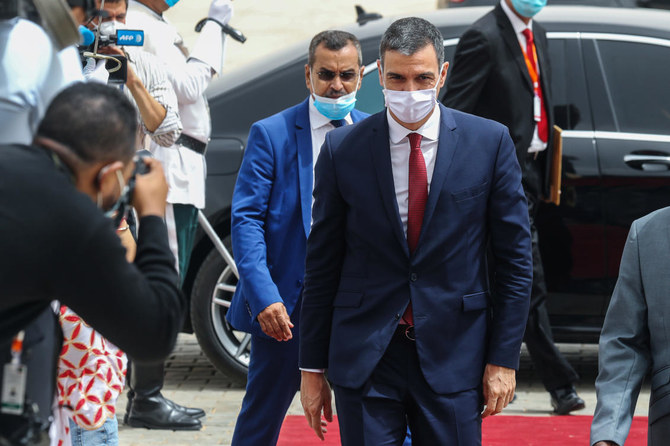
Spanish Prime Minister Pedro Sanchez arrives at the G5 Sahel summit in Nouakchott, Mauritania, June 30, 2020. (Reuters)
Short Url
Updated 30 June 2020
Follow

Sahel allies have ‘shifted the dynamic’ in fight with extremists: Macron

  • Macron: We are convinced that victory is possible in the Sahel, and that it is decisive for stability in Africa and Europe
  • Macron: We now have to consolidate this dynamic and strengthen it... The ground that we have recovered will not be given back

NOUAKCHOTT, Mauritania: Sahel countries and their ally France have “shifted the dynamic” in the fight against an eight-year-old extremist insurgency in the region, French President Emmanuel Macron said after a summit to review a six-month-old strategy.
Speaking at an end-of-meeting press conference, Macron said the change in tactics had yielded “spectacular results.”
“We are convinced that victory is possible in the Sahel, and that it is decisive for stability in Africa and Europe,” he said.
“We are in the process of finding the right path thanks to the efforts that have been made over this last six months.”
The one-day summit in Nouakchott, the Mauritanian capital, gathered the presidents of Burkina Faso, Chad, Mali, Mauritania and Niger, as well as France.
It was called to take stock of a more aggressive strategy in the Sahel, decided in January after a string of setbacks crowned by the loss of 13 French soldiers in a helicopter crash.
Under the change, France deployed an extra 500 troops to its Barkhane anti-extremist force in the Sahel, bringing its complement to 5,100.
Since then, the extremists have continued to carry out attacks almost daily, but they also lost a key leader to a French raid and are fighting internally, according to security sources.
Coalition forces have focussed on extremists in the “three-border region,” a hotspot of extremism where the frontiers of Burkina, Niger and Mali converge.
“Areas have been taken back from the terrorist groups (and) the armies have redeployed,” said Macron, adding that the tactics “have shifted the dynamic.”
“We now have to consolidate this dynamic and strengthen it... The ground that we have recovered will not be given back,” he warned.


Energy independence, transition take center stage at India’s flagship industry forum

Updated 4 sec ago
Follow

Energy independence, transition take center stage at India’s flagship industry forum

  • Modi announces investment opportunities of $500 billion in India’s energy ecosystem
  • India, Canada launch ministerial energy dialogue during India Energy Week 2026

NEW DELHI: Thousands of top industry executives, innovators and policymakers are gathered in Goa for India Energy Week 2026, where they are discussing global energy transition technologies, including hydrogen and future fuels.

Organized under the patronage of India’s Ministry of Petroleum and Natural Gas, the event opened on Tuesday and will run through Jan. 30, featuring 10 country pavilions and exhibitions by more than 700 local and international industry players.

The organizers expect 75,000 people to visit the venue at the ONGC Advanced Training Institute in Goa — a petroleum industry training campus operated by Oil and Natural Gas Corporation, India’s largest state‑owned oil and gas company.

In his opening remarks, Prime Minister Narendra Modi announced investment opportunities of up to $500 billion in oil and gas exploration, refining, and energy infrastructure.

“We are doing reforms to empower domestic hydrocarbons and are creating a transparent and investor-friendly environment for global collaboration. India is now working on the mission of energy independence, moving beyond energy security,” he said.

“We are striving to take investment in our oil and gas sector to $100 billion by the end of this decade.”

The minister of petroleum and natural gas, Hardeep Singh Puri, told participants that India’s share of global energy demand is estimated to be 10 percent by 2050 — about 30 percent more than at present — and it will be backed by conventional and renewable energy sources.

“While renewable and alternative energy sources are expanding at pace, conventional energy will remain essential to meet growing demand. Energy transition, energy security, and system resilience must advance together, and energy addition has emerged as a practical pathway to balance these priorities,” he said.

“India is diversifying its energy journey on a sustainable path. With strong progress across green hydrogen, compressed biogas, CNG (compressed natural gas), and LNG (liquefied natural gas), India continues to address the energy trilemma of availability, affordability and sustainability.”

India depends mainly on Russia, Iraq and Saudi Arabia for crude, and Qatar for LNG.

A new source for both may become Canada, whose Energy Minister Timothy Hodgson launched with Puri the India-Canada Ministerial Energy Dialogue on the sidelines of the Goa event on Tuesday.

Hodgson told India Energy Week participants that Canada could supply crude oil and LNG to India, as well as uranium — which India needs to achieve its target of 100 GW nuclear capacity by 2047.

“Canada used to provide 98 percent of its energy to one customer,” Hodgson said, referring to the US. “We are committed to diversifying our supply. We see the opportunity to work with India.”