French airstrikes and commandos kill 30 extremists in Sahel

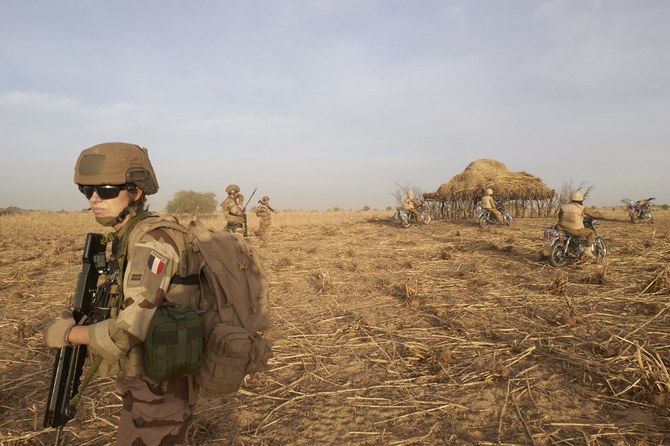
A French soldier patrols a rural area during the Barkhane operation in northern Burkina Faso. (AFP/File photo)
Short Url
Updated 08 February 2020
Follow

French airstrikes and commandos kill 30 extremists in Sahel

  • Two airstrikes Friday involving one of France's first armed drones killed some 20 militants

PARIS: The French military said Saturday operations by French and Malian forces have killed 30 more extremists in Africa's Sahel region in recent days, amid stepped-up efforts to combat jihadist groups in the area.
Two airstrikes Friday involving one of France's first armed drones killed some 20 militants in the restive border zone where Mali, Niger and Burkina Faso meet, according to a French military statement.
Earlier in the week, two French commando operations killed about 10 others in the border zone where extremists groups including Daesh operate, the statement said.
The French military said France's Barkhane force in the Sahel region worked closely with Malian forces on the operations, and did not report any casualties among French or Malian troops.
The military action came after France announced plans Feb. 2 to deploy 600 additional soldiers to its Barkhane force, raising the number of troops there to 5,100. Most of the new troops will be concentrated on the three-border zone, the epicenter of the fight against jihadist groups.
Barkhane has been operating in the region since 2014. French President Emmanuel Macron and the leaders of the G5 Sahel group — Mauritania, Mali, Burkina Faso, Niger and Chad — launched a new plan last month to fight extremists in the area.


Indonesia becomes first Asian country to ban elephant rides

Updated 3 sec ago
Follow

Indonesia becomes first Asian country to ban elephant rides

  • Elephant-ride ban is nationwide, including in popular holiday destination of Bali
  • Animal rights group urges officials in Thailand, Nepal, India to follow Indonesia

JAKARTA: Indonesia has banned elephant rides, becoming the first Asian nation to outlaw the popular tourist activity on animal welfare grounds.

Indonesia, home to the critically endangered Sumatran elephant and the endangered Bornean elephant, first announced the nationwide ban in December, with authorities gradually monitoring compliance since the start of this year.

The move followed widespread calls to ban elephant rides, with many Indonesians now using social media to alert authorities on sites still offering such activities especially in Bali, the country’s most popular holiday island.

All of Bali’s conservation sites, including Bali Zoo and Mason Elephant Park & Lodge, have officially banned elephant rides by the end of January, according to the Bali Natural Resources Conservation Agency.

“Based on our most recent monitoring, all five of the conservation sites in Bali have complied and are no longer offering elephant rides for visitors,” Ratna Hendratmoko, who heads the agency, told Arab News on Tuesday.

Elephant rides were a popular tourist attraction in Bali, which last year welcomed nearly 7 million foreign visitors.

“There was demand from visitors, tourists, who are enthusiastic and attracted to elephant rides, even if it’s just for 10 to 15 minutes.

“But maybe for them, it’s an opportunity to show off on social media, showing that they’re doing something that they think it’s cool, something that not many others can do,” Hendratmoko said.

“I’m thankful to online friends who have been raising their concerns and reminding us to continue our monitoring. We are giving our best to do our job.” 

Indonesian authorities are urging conservation sites to prioritize animal welfare, offer educational activities for visitors and shift to “innovative and non-exploitative” attractions, such as wildlife observation without direct physical contact.

In November, an investigation by the rights group People for the Ethical Treatment of Animals, showed that elephants in Bali are routinely chained and beaten with sharp bullhooks to force them to obey for tourist rides.

The action that followed “puts Indonesia at the forefront of elephant welfare,” and makes it “the first country in Asia to ban elephant rides nationwide,” said Jason Baker, president of PETA in Asia.

The ban is “a huge step toward improving the treatment of elephants,” PETA Asia said in a statement to Arab News.

“We are optimistic that the new guidelines will provide a framework for phasing out all harmful practices in the future.”

Elephant camps are also major tourist attractions in other parts of Asia, with Thailand being their largest promoter.

“We urge the Thai government and other countries, including Nepal, Laos and India to follow Indonesia’s lead,” PETA said.