



DUBAI: Yemeni Prime Minister Maeen Abdulmalik Saeed slammed the Houthis on Monday for preventing UN experts from accessing a decaying Yemeni oil tanker that could explode in the Red Sea.
The FSO Safer, a 45-year-old supertanker loaded with more than one million barrels of crude oil has been caught between the warring sides since the start of the conflict and left to decay.
Officials warn that the Safer could hemorrhage its cargo into the sea at any time, with devastating consequences for nature and the people of Yemen.
Yemen’s government says the Safer is in a “bad and deteriorating” condition.
Saeed warned of the potentially catastrophic risks caused by the Houthis actions that could lead to a major oil spill.
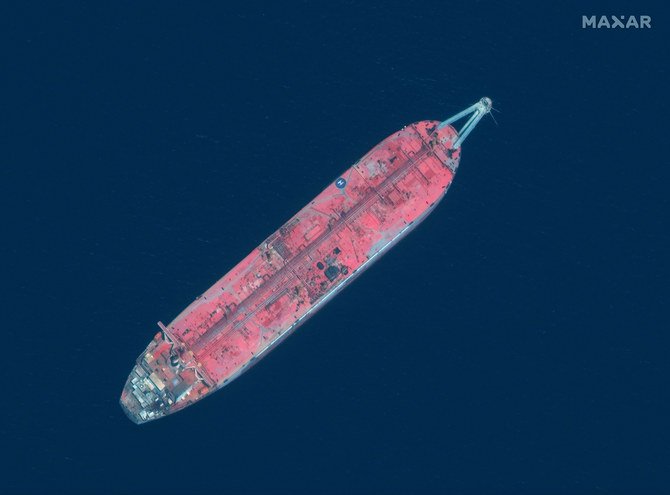
This satellite image provided by Maxar Technologies taken June 17, 2020, shows the FSO Safer tanker moored off Ras Issa port, in Yemen. (Maxar Technologies/AP)
The Safer fell under the control of Yemen's Iranian-allied Houthis in 2015. Since then the majority of the crew of the state-owned tanker had left and access has been barred by the Houthis.
Without routine maintenance to prevent corrosion over the last five years, the supertanker is starting to fall apart.
The Yemeni prime minister also claimed that the Houthis plundered the revenues of the central bank in Hodeidah. This came during a meeting with the UK Ambassador to Yemen Michael Aron, where the discussion included the ongoing efforts to implement the Riyadh Agreement signed in November last year between the Southern Transitional Council and the Yemeni government.
Meanwhile, Information Minister Muammar Al-Iryani warned of the repercussions of the Houthis false creation of an oil derivatives crisis in areas under their control.
The Minister of Information said in a press statement: ”A number of recently circulated video clips documented hundreds of oil derivatives held in one of the security points of the Houthi militia, while millions of citizens in the capital Sana'a and militia-controlled areas suffer from the lack of oil derivatives.
Iryani claimed that this has caused for 20 liters of petroleum to be sold for 25,000 Yemeni riyals (almost $100) in the black market.
“The fabrication of the oil derivatives crisis by Iran's mercenaries (the Houthis) aims to blackmail the international community for political gains, plundering the savings of citizens in their areas of control, and reviving the black market,” he added.
Al-Iryani called on the international community and the United Nations to stop these Houthi practices that create impoverishment and starvation of civilians in Sanaa and areas under their control, and to pressure the militia to allow the flow of food supplies and oil derivatives.


