

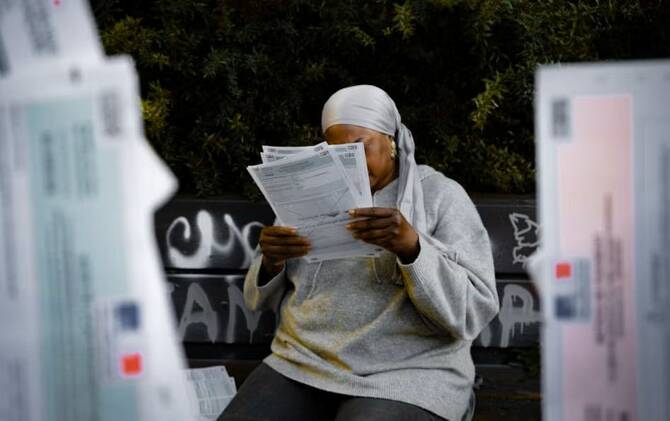

LONDON: Police in France are exploiting broad powers to issue spot fines against Arab youth as a new form of racial profiling, a new report has warned.
Published on Wednesday by Human Rights Watch, (RE)CLAIM and Maison Communautaire pour un Developpement Solidaire, the 60-page report documents a consistent theme of boys and young men from poor households receiving discriminatory fines for alleged offenses such as noise nuisance, littering and illegal discharge of sanitary liquids.
The on-the-spot fixed-penalty criminal fines are often issued when the young men, many of Arab extraction, are socializing outside their homes or playing sports with friends in local parks.
The recipients of such fines lack basic fair-trial guarantees, and the monetary amount is issued based on the subjective observations of police officers, the report said.
MCDS President Omer Mas Capitolin said: “These abusive fines have intensified discriminatory police harassment that drives children and young people out of public spaces by criminalizing them for their mere presence.
“These practices treat them as ‘undesirables’ rather than full citizens, pushing them toward a social death that jeopardizes their futures, undermines their participation in society, fuels distrust in institutions and destroys their sense of belonging in society.”
For the report, the three rights organizations interviewed 42 boys and young men, as well as their parents, social workers and police officers, from three major French cities, including Paris.
Financial records viewed for the report corroborated the accounts of the young men who were issued criminal penalties.
The findings “demonstrate the intrinsic links between discriminatory and abusive fining practices and discriminatory police identity checks, frisks, and searches that Human Rights Watch documented in 2012 and 2020, and that have been amply scrutinized and condemned at international, regional and national level,” HRW said.
In some cases, young men had up to $57,000 in debt due to the fines, unpaid dues and collection fees.
Some reported choosing between paying fines and for food, rent, electricity and other basic expenses.
As a result, some had abandoned formal employment, closed bank accounts or worked in the illicit economy to escape state debt collection.
This created a pattern of wider withdrawal from communal and public life out of fear of receiving more fines, the report said.
“Racial profiling in France is pervasive and persistent and yet police were granted new powers allowing them to harass racialized youth without any oversight and accountability,” said Benedicte Jeannerod, France director at HRW.
“French authorities should immediately take necessary steps to end racial profiling instead of expanding police powers that trap young people in what can be tens of thousands of euros in debt that risks ruining their lives.”
The fines “result in serious violations of France’s obligations under international and regional human rights law,” the report said.
Lanna Hollo, co-founder of (RE)CLAIM, said the trend could be attributed to the transfer of judicial powers to police and the elimination of safeguards that protect people against wrongful convictions.
She added: “The fixed-penalty fining system creates a pernicious tool for harassment that has been weaponized to implement policies to ‘evict’ people deemed ‘undesirable’ in public space, with major impacts on people targeted and their families.”


