

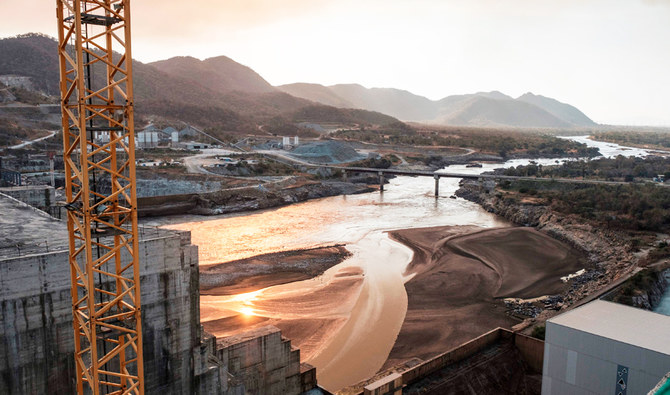

ADDIS ABABA: Last week, Ethiopian Prime Minister Abiy Ahmed’s press secretary took a break from official statements to post something different to her Twitter feed: A 37-line poem defending her country’s massive dam on the Blue Nile River.
“My mothers seek respite/From years of abject poverty/Their sons a bright future/And the right to pursue prosperity,” Billene Seyoum wrote in her poem, entitled “Ethiopia Speaks.”
As the lines indicate, Ethiopia sees the $4.6 billion (€4billion) Grand Ethiopian Renaissance Dam as crucial for its electrification and development.
But the project, set to become Africa’s largest hydroelectric installation, has sparked an intensifying row with downstream neighbors Egypt and Sudan, which worry that it will restrict vital water supplies.
Addis Ababa plans to start filling next month, despite demands from Cairo and Khartoum for a deal on the dam’s operations to avoid depletion of the Nile.
The African Union is assuming a leading role in talks to resolve outstanding legal and technical issues, and the UN Security Council could take up the issue Monday.
With global attention to the dam on the rise, its defenders are finding creative ways to show support — in verse, in Billene’s case, through other art forms and, most commonly, in social media posts demanding the government finish construction.
To some observers, the dam offers a rare point of unity in an ethnically diverse country undergoing a fraught democratic transition and awaiting elections delayed by the coronavirus pandemic.
FASTFACT
The African Union is assuming a leading role in talks to resolve outstanding legal and technical issues.
Abebe Yirga, a university lecturer and expert in water management, compared the effort to finish the dam to Ethiopia’s fight against Italian would-be colonizers in the late 19th century.
“During that time, Ethiopians irrespective of religion and different backgrounds came together to fight against the colonial power,” he said.
“Now, in the 21st century, the dam is reuniting Ethiopians who have been politically and ethnically divided.”
Ethiopia broke ground on the dam in 2011 under then-Prime Minister Meles Zenawi, who pitched it as a catalyst for poverty eradication.
Civil servants contributed one month’s salary towards the project that year, and the government has since issued dam bonds targeting Ethiopians at home and abroad.
Nearly a decade later, the dam remains a source of hope for a country where more than half the population of 110 million lives without electricity.
With Meles dead nearly eight years, perhaps the most prominent face of the project these days is water minister Seleshi Bekele, a former academic whose publications include articles with titles like “Estimation of flow in ungauged catchments by coupling a hydrological model and neural networks: Case study”.
As a government minister, though, Seleshi has demonstrated an ear for the catchy soundbite.
At a January press conference in Addis Ababa, he fielded a question from a journalist wondering whether countries besides Ethiopia might play a role in operating the dam.
With an amused expression on his face, Seleshi looked the journalist dead in the eye and responded simply, “It’s my dam.”
In those five seconds, a hashtag was born.
Coverage of the exchange went viral, and today a Twitter search for #ItsMyDam turns up seemingly endless posts hailing the project.
At recent events officials have even distributed T-shirts bearing the slogan to Ethiopian journalists, who proudly wear them around town.
Some non-Ethiopians have also gotten in on #ItsMyDam fever.
Anna Chojnicka spent four years living in Ethiopia working for an organisation supporting social entrepreneurs, though she recently moved to London.


