

Iran’s arms shipments to Houthis fuel war in Yemen, experts say

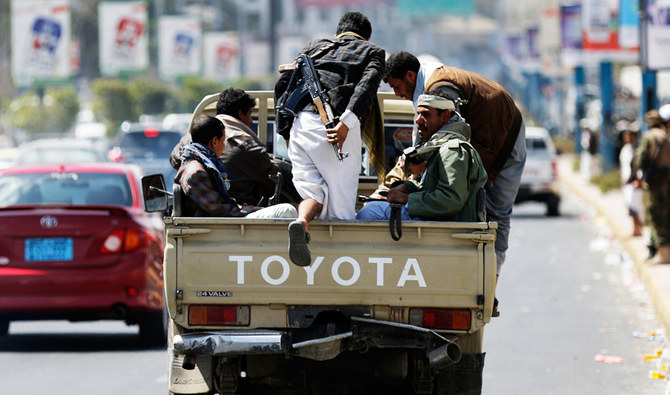
Houthi fighters ride a patrol truck in Sanaa, in this file photo taken on March 5, 2015. (REUTERS)
Short Url
Updated 30 June 2020
Follow

Iran’s arms shipments to Houthis fuel war in Yemen, experts say

  • The Yemeni government has swiftly demanded that the international community put an end to Iranian meddling in Yemen in their sending arms shipments that fuel the war to the Houthis

AL-MUKALLA, YEMEN: The latest Saudi-led-coalition seizure of an Iranian arms shipment destined for the Houthis is further evidence of Iran’s destabilizing role in war-torn Yemen, according to government officials and experts.
“This is concrete proof of Iran’s involvement in Yemen,” Salem Al-Khanbashi, the deputy prime minister of Yemen, told Arab News.
At a press conference in the Saudi capital, Riyadh, on Monday, the Saudi-led coalition announced intercepting a dhow carrying hundreds of weapons, made in Iran, early this month, including missiles, sniper rifles and ammunition. The dhow was seized off the Yemeni coastal town of Mocha on the Red Sea and was heading to the Houthis, the coalition said.
The Yemeni government has swiftly demanded that the international community put an end to Iranian meddling in Yemen in their sending arms shipments that fuel the war to the Houthis.
“There must be strong punishments against this country that supplies Houthis with those advanced weapons,” Al-Khanbashi said.
Even before the start of the war 5 years ago, consecutive Yemeni governments accused Iran of smuggling arms to the Houthis, enabling them to keep fighting despite coming under heavy attacks by government and Saudi-led coalition forces. The Yemeni coast guard has intercepted many similar arms shipments off the Yemeni coast over the past several years.

This is concrete proof of Iran’s involvement in Yemen.

Salem Al-Khanbashi, deputy prime minister of Yemen

“There is a continuous smuggling process that resupplies Houthis with advanced weapons. The national army forces have seized many Iranian weapons from Houthis during fighting,” Al-Khanbashi said.
Gerald Feierstein, the former US ambassador to Yemen, said that the Iranians supported the Houthis with weapons and trained them in using them long before the start of the Saudi-led military operation in Yemen.
“The Iranian engagement began long before the outbreak of the civil war or the Saudi coalition’s intervention. It’s clear that the Iranians saw the Houthi movement as an opportunity to put pressure on Saudi Arabia and to threaten its southern border,” he told Arab News in an interview in March.
The Yemeni government and military officials believe that the Houthis are bringing in shipments of Iranian weapons through coastal areas under their control on the Red Sea.
The Houthis remain in control of strategic seaports on the Red Sea, including Hodeidah. The impact of the undisrupted supplies of the advanced Iranian weapons to the Houthis can been seen on the battlefield. Yemeni military commanders have recently told Arab News that the Houthi bombardment has become more destructive and precise, killing more soldiers and civilians. This shows that Houthis resupplied their depleted arsenal of weapons that were destroyed during fighting with advanced weapons that sometime gave them superiority on the battlefield, army commanders say.
Experts argue that the continuing supplies of weapons from Iran has not only extended the conflict in Yemen, but also allowed them to target Saudi Arabia through ballistic missiles and drones.
“The Iranian support to the Houthis has not only prolonged the war, but also enabled the Houthis to target civilian areas in neighboring Saudi Arabia, as well as oil shipments, and to threaten international navigation through the Bab Al-Mandab,” Saleh Al-Baydhani, a Yemeni political analyst, told Arab News.
To stem the flow of Iranian weapons to Yemen, military experts suggest increasing sea patrol vessels near the Yemeni coast and liberating the remaining Yemeni coastal areas under Houthi control.
“Each time an arms shipment is intercepted, an attack inside Yemen or on Saudi Arabia is foiled. So I see the latest interception as a success,” Brig. Khaled Al-Nasi, a Yemeni military analyst, told Arab News.
“Tightening the screws on the smuggling of arms would accelerate the fall of this group,” Al-Nasi said.


Israeli soldiers fired 900 bullets during massacre of Palestinian aid workers, investigation finds

Updated 12 sec ago
Follow

Israeli soldiers fired 900 bullets during massacre of Palestinian aid workers, investigation finds

  • Researchers use visual and audio analysis to reconstruct Gaza ambush of emergency vehicles that left 15 people dead
  • Israeli troops executed some victims at close range, according to recordings and witnesses

LONDON: Israeli soldiers fired more than 900 bullets during a massacre of Palestinian aid workers that included “execution-style” killings, a detailed reconstruction of one of the worst atrocities of the Gaza war has found.

The investigation recreated a 3D digital version of the scene of the killings and used audio analysis of recordings to pinpoint how the attack unfolded in March last year.

Fifteen Palestinian aid workers were killed when Israel troops ambushed their vehicles in Tel Al-Sultan, near Rafah, southern Gaza. The victims included ambulance crews from the Palestinian Red Crescent Society, rescue teams from the Palestinian Civil Defense sent to help, and a member of the UN agency for Palestinian refugees UNRWA.

Israel tried to hide evidence of the killings by crushing the vehicles left at the scene and burying them in the sand, along with the victims’ bodies.

The joint investigation published on Monday was carried out by London-based researchers Forensic Architecture and Earshot, an audio analysis agency.

Israeli soldiers “subjected Palestinian aid workers to continuous assault by gunfire for over two hours” in an attack that started shortly after 5 a.m. on March 23, the study found.

The position of each vehicle in the convoy as the shooting began. (Forensic Architecture)

Contrary to Israel’s initial claims that events unfolded in a combat zone, “there was no exchange of fire in the area, and no tangible threat to the safety of those soldiers,” the report said. 

The researchers documented at least 910 gunshots from three recordings from the scene. At least 844 shots were recorded within a five-and-a-half-minute period in video taken by paramedic Refaat Radwan, one of the victims.

More than 90 percent of the bullets were fired directly toward the emergency vehicles and aid workers during the initial period of the attack, with at least five soldiers firing simultaneously.

The investigation concluded that the emergency lights and markings of the vehicles ambushed would have been clearly visible to the soldiers.

Israeli troops continued shooting as they advanced on the vehicles before carrying out perhaps the most disturbing act of the attack.

“Upon reaching them, they moved through the vehicles and shot several of the aid workers at close range,” the report said.

One of the shots was fired between one and four meters away from paramedic Ashraf Abu Libda and coincided with the last time his voice was heard on recordings, “suggesting that these were the shots that killed him.”

A 3D reconstruction of Asaad Al-Nasasra and Muhammad al-Hila embracing while under Israeli fire. Muhammad was shot and killed while in this position while Asaad survived, researchers found. (Forensic Architecture)

The initial attack started at about 4 a.m. when Israeli forces opened fire on an ambulance sent to the scene of an Israeli airstrike, killing the two crew members inside.

Three more ambulances were sent to search for the missing crew. Once they found the vehicle, they were joined by a Palestinian Civil Defense ambulance and a fire truck.

“All vehicles were clearly marked and had their emergency lights on,” the report said.

Within minutes of the five vehicles arriving at the scene, and as the aid workers approached their fallen colleagues, the Israeli soldiers opened fire.

The driver of a UN Toyota truck that passed the site about an hour later was also killed.

Researchers were able to map the positions and movements of the Israeli troops throughout the attack with the help of echolocation and audio-ballistic analysis.

Opinion

This section contains relevant reference points, placed in (Opinion field)

This enabled them to work out the distance and the direction of the source of the gunshots from the devices making the recordings.

Researchers also detailed the extent of the Israeli military’s efforts to “conceal and disrupt evidence of the attack.”

This included burying the victims’ bodies, burying mobile phones, and crushing and partially burying the victims’ vehicles. 

Analysis of satellite images revealed how Israel transformed the site with earth-moving machinery in the hours following the attack.

One of the two survivors of the ambush was detained for more than a month, tortured, and interrogated.

The bodies of 14 of the victims were found in a mass grave near the site on March 30, while the remains of another victim were found a few days earlier nearby.

A forensic doctor who examined some of the bodies told The Guardian newspaper that there was evidence of execution-style killing given the location of the wounds. 

Coming during the height of Israel’s two-year war on Gaza that has killed more than 72,000 Palestinians, the massacre of aid workers sparked international outcry.

In the aftermath, Israel gave varying accounts of what happened, initially claiming that its troops thought they were facing an attack.

On April 20, the Israeli military said an inquiry into the attack had identified “several professional failures, breaches of orders, and a failure to fully report the incident.”

A duty commander was dismissed for “providing an incomplete and inaccurate report during the debrief,” but there have been no further measures against those who carried out the attack.