

Iran’s arms shipments to Houthis fuel war in Yemen, experts say

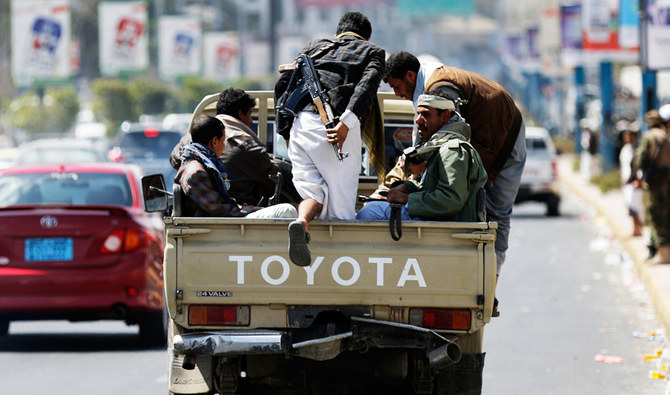
Houthi fighters ride a patrol truck in Sanaa, in this file photo taken on March 5, 2015. (REUTERS)
Short Url
Updated 30 June 2020
Follow

Iran’s arms shipments to Houthis fuel war in Yemen, experts say

  • The Yemeni government has swiftly demanded that the international community put an end to Iranian meddling in Yemen in their sending arms shipments that fuel the war to the Houthis

AL-MUKALLA, YEMEN: The latest Saudi-led-coalition seizure of an Iranian arms shipment destined for the Houthis is further evidence of Iran’s destabilizing role in war-torn Yemen, according to government officials and experts.
“This is concrete proof of Iran’s involvement in Yemen,” Salem Al-Khanbashi, the deputy prime minister of Yemen, told Arab News.
At a press conference in the Saudi capital, Riyadh, on Monday, the Saudi-led coalition announced intercepting a dhow carrying hundreds of weapons, made in Iran, early this month, including missiles, sniper rifles and ammunition. The dhow was seized off the Yemeni coastal town of Mocha on the Red Sea and was heading to the Houthis, the coalition said.
The Yemeni government has swiftly demanded that the international community put an end to Iranian meddling in Yemen in their sending arms shipments that fuel the war to the Houthis.
“There must be strong punishments against this country that supplies Houthis with those advanced weapons,” Al-Khanbashi said.
Even before the start of the war 5 years ago, consecutive Yemeni governments accused Iran of smuggling arms to the Houthis, enabling them to keep fighting despite coming under heavy attacks by government and Saudi-led coalition forces. The Yemeni coast guard has intercepted many similar arms shipments off the Yemeni coast over the past several years.

This is concrete proof of Iran’s involvement in Yemen.

Salem Al-Khanbashi, deputy prime minister of Yemen

“There is a continuous smuggling process that resupplies Houthis with advanced weapons. The national army forces have seized many Iranian weapons from Houthis during fighting,” Al-Khanbashi said.
Gerald Feierstein, the former US ambassador to Yemen, said that the Iranians supported the Houthis with weapons and trained them in using them long before the start of the Saudi-led military operation in Yemen.
“The Iranian engagement began long before the outbreak of the civil war or the Saudi coalition’s intervention. It’s clear that the Iranians saw the Houthi movement as an opportunity to put pressure on Saudi Arabia and to threaten its southern border,” he told Arab News in an interview in March.
The Yemeni government and military officials believe that the Houthis are bringing in shipments of Iranian weapons through coastal areas under their control on the Red Sea.
The Houthis remain in control of strategic seaports on the Red Sea, including Hodeidah. The impact of the undisrupted supplies of the advanced Iranian weapons to the Houthis can been seen on the battlefield. Yemeni military commanders have recently told Arab News that the Houthi bombardment has become more destructive and precise, killing more soldiers and civilians. This shows that Houthis resupplied their depleted arsenal of weapons that were destroyed during fighting with advanced weapons that sometime gave them superiority on the battlefield, army commanders say.
Experts argue that the continuing supplies of weapons from Iran has not only extended the conflict in Yemen, but also allowed them to target Saudi Arabia through ballistic missiles and drones.
“The Iranian support to the Houthis has not only prolonged the war, but also enabled the Houthis to target civilian areas in neighboring Saudi Arabia, as well as oil shipments, and to threaten international navigation through the Bab Al-Mandab,” Saleh Al-Baydhani, a Yemeni political analyst, told Arab News.
To stem the flow of Iranian weapons to Yemen, military experts suggest increasing sea patrol vessels near the Yemeni coast and liberating the remaining Yemeni coastal areas under Houthi control.
“Each time an arms shipment is intercepted, an attack inside Yemen or on Saudi Arabia is foiled. So I see the latest interception as a success,” Brig. Khaled Al-Nasi, a Yemeni military analyst, told Arab News.
“Tightening the screws on the smuggling of arms would accelerate the fall of this group,” Al-Nasi said.


Gazans long for reopening of ‘lifeline’ Rafah crossing

Updated 7 sec ago
Follow

Gazans long for reopening of ‘lifeline’ Rafah crossing

  • The border crossing between Gaza and Egypt is the Palestinian territory’s only gateway to the outside world
  • If Rafah opens in coming days, residents of the territory are hoping to reunite with family, or are looking to leave themselves
GAZA CITY: With Gaza’s vital Rafah border crossing expected to soon reopen, residents of the war-shattered territory are hoping to reunite with family members, or are looking to leave themselves.
The Rafah crossing between Gaza and Egypt is the Palestinian territory’s only gateway to the outside world that does not lead to Israel and is a key entry point for both people and goods.
It has been closed since Israeli forces took control of it in May 2024, except for a limited reopening in early 2025, and other bids to reopen failed to materialize.
Following a US-brokered ceasefire that took effect in October, Rafah is expected to reopen for pedestrians, after visiting US envoys reportedly pressed Israeli officials to reopen the crossing.
“Opening the Rafah crossing means opening the door to life for me. I haven’t seen my wife and children for two years since they left at the beginning of the war and I was prevented from traveling,” said 48-year-old Mahmud Al-Natour, who hails from Gaza City.
“My children are growing up far away from me, and the years are passing by as if we are cut off from the world and life itself,” he told AFP.
Randa Samih, 48, also called the crossing “the lifeline of Gaza,” but is worried about whether she would be able to leave.
She had applied for an exit permit to get treatment for her injured back, which she fears might not be serious enough to be allowed out.
“There are tens of thousands of injuries in Gaza, most of them more serious than mine,” she said.
“We’ll die or our health will decline before we get to travel.”

- ‘Limited reopening’ -

Gaza, a tiny territory surrounded by Israel, Egypt and the Mediterranean Sea, has been under Israeli blockade even before Hamas’s attack sparked the war.
Palestinian militants took 251 people hostage on October 7, 2023, in an attack that killed 1,221 others, most of them civilians.
Israel’s retaliatory offensive has killed at least 71,662 Palestinians, according to figures from the health ministry in Hamas-run Gaza that the United Nations considers reliable. The ministry does not say how many of the dead were fighters, though its data shows that more than half were women and children.
Ali Shaath heads the National Committee for the Administration of Gaza (NCAG), created as part of the ceasefire agreement. He announced last week that Rafah would reopen in both directions.
Israel said it would only allow pedestrians to travel through the crossing as part of its “limited reopening” once it had recovered the remains of the last hostage, Ran Gvili.
His remains were brought back to Israel later on Monday.
A Palestinian official told AFP on condition of anonymity that “estimates indicate that the Rafah crossing could be opened in both directions by the end of this week or early next week.”
A member of the NCAG told AFP that the technocratic committee would be responsible for sending lists of travelers’ names to the Israeli authorities for approval.
Outward travel will intially be limited to patients, the injured, students with university admission and visas, and holders of Egyptian citizenship or other nationalities and residency permits, the source said.

- ‘Burning with anticipation’ -

Gharam Al-Jamla, a displaced Palestinian living in a tent in southern Gaza, told AFP she counted on the crossing’s opening for her future.
“My dreams lie beyond the Rafah crossing. I applied for several scholarships to study journalism in English at universities in Turkiye. I received initial acceptance from two universities there,” the 18-year-old said.
She added she would then want to return to Gaza “to be one of its voices to convey the truth to the world.”
Gaza’s civil defense agency spokesman, Mahmud Bassal, appealed for the full reopening of Rafah to allow the entry of unlimited aid and equipment for reconstruction.
“There are thousands of bodies under the rubble, including children, women and people with disabilities, which have not been recovered since the beginning of the war,” he said.
The civil defense is a rescue force operating under Hamas authority.
Mohammed Khaled, 18, said he wanted to move on from the war.
“I’m burning with anticipation,” he told AFP.
“I haven’t seen my mother and sisters for two years. My mother traveled for medical treatment, and they only allowed my sisters to accompany her.”
Khaled said he also hoped to be able to travel to have surgery for a shrapnel injury sustained during the war.