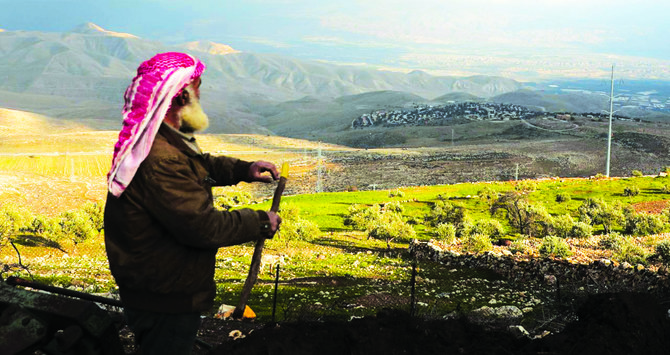
GAZA CITY: Palestinian farmer Hamza Abu Thabet is becoming more and more worried about Israel’s plans to annex parts of the West Bank and the Jordan Valley, on the borders between the West Bank and Jordan.
He has lived in his village, Froosh Beit Dajan, in the Jordan Valley for three decades. But he is increasingly anxious over his and his family’s future, which he feels is under threat and shrouded in uncertainty.
Israel’s annexation project has been given the green light by the US as part of President Donald Trump’s Vision for Peace plan. It could start as early as July 1 and incorporate up to 30 percent of the West Bank into Israel. Much of this land is already host to Israeli settlements considered illegal under international law, but is claimed by Palestinians for a future independent state of their own.
Abu Thabet follows everything related to the annexation plan with great interest and on a daily basis. Six families work on his 20 dunums (20,000 sq. meters) of agricultural land.
“I hear everyday the news and updates of the plan, but the most important thing is that I and the Jordan Valley residents do not know what will happen to us,” he told Arab News.
There are about 12,000 people in the Jordan Valley and most of them depend on agricultural work.
“Our lives are in the Jordan Valley and I cannot imagine living anywhere else,” said Abu Thabet, who inherited his trade from his father and grandfathers. “Over the years we have stood up in our homes and lands, despite the oppression, the Israeli aggressions, and the restrictions on us in all aspects of life. But today the matter has become vague and unknown, and we do not know what they are planning for us.”
He believed that the Palestinian Authority (PA) had a lot to do in order to strengthen the resilience of residents and farmers in the Jordan Valley in order to face the annexation plan, even though political agreements say that Israel controls the area and is responsible for its security.
On Wednesday, Palestinian Prime Minister Muhammad Shtayeh approved steps to support farmers in the Jordan Valley by paying their debts, pumping water from PA-owned wells and providing investors with easy loans.
Abu Thabet said that the PA should help Jordan Valley residents by developing infrastructure, water and electricity networks.
The Jordan Valley, an area of 450 square kilometers, constitutes 25 percent of the West Bank’s total area. It suffers from severe Israeli restrictions that hinder development and prevent the construction of homes and schools.
This tough reality was summed up by another farmer, Ameed Hajj Muhammad. “The Jordan Valley has been effectively annexed and completely controlled by Israel since the 1967 defeat,” he told Arab News. “Israel controls every detail of our daily life.”
Hajj Muhammad said that dozens of Israeli settlements, camps and checkpoints were spreading in the Jordan Valley and ruining their lives.
He owns a 15-dunum area of agricultural land where he grows vegetables and flowers, but struggles with irrigation and also has difficulties marketing his crop.
The Jordan Valley farmers depend on sourcing water from wells dating back decades as Israel prevents them from drilling new ones.
Hajj Mohamed said it was not just the PA who had a responsibility to help farmers out.
“Palestinians need to support us by consuming our products, such as vegetables, flowers and melons, so that the farmers can withstand the high costs resulting from the Israeli restrictions.”
Israel already controls 95 percent of the Jordan Valley area, according to Azim al-Hajj, who is director of the Agricultural Relief Association. Palestinian residents currently only benefit from 5 percent of the estimated 50,000 dunums of agricultural land.
Al-Hajj said that Israel’s most dangerous act against farmers and residents was denying them access to the 87 percent of water sources that it controlled.
Since the June 1967 war, Israel has issued 2,500 military laws to restrict Palestinian residents, and because of that, the population of Palestinians in the Jordan Valley has decreased from 250,000 to 12,000 over time.
The Jordan Valley has 36 Israeli settlements with a total population of 9,500 settlers, and most of these people work in agriculture.
Since 1967 the Israeli occupation has displaced more than 50,000 Palestinian residents from the Jordan Valley, sometimes entire communities, claiming that they live on military training grounds.
The annexation plan targets an area 10 to 15 km west of the Jordan River and includes dozens of villages and areas, according to Al-Hajj.
“What is required from the PA are real programs and a package of projects in the fields of agriculture, health and education. The results could be felt by residents in their daily life.”


![]()
![]()

Jordan Valley farmers fear for the future as Israel’s West Bank annexation looms

Short Url
https://arab.news/w9ndd
Jordan Valley farmers fear for the future as Israel’s West Bank annexation looms
- Palestinian prime minister approves steps to support farmers in Jordan Valley by paying their debts


Latest updates





© 2026 SAUDI RESEARCH & PUBLISHING COMPANY, All Rights Reserved And subject to Terms of Use Agreement.