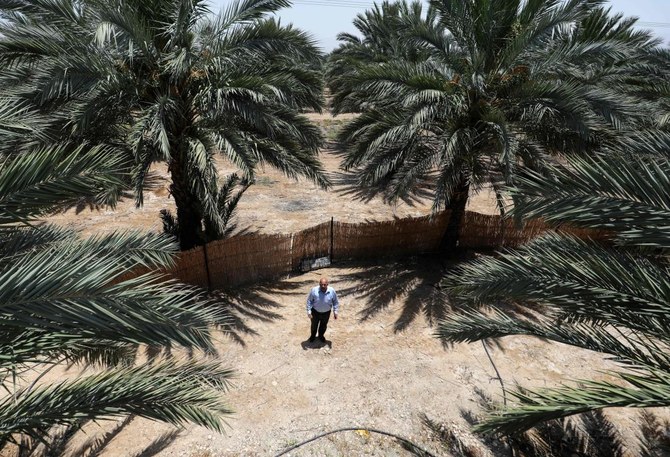
JERICHO, Palestine: Mamoun Jasr has grown hundreds of date palms near Jericho, but now the farmer fears being marooned on a scrap of Palestinian land if Israel forges ahead with its plans to annex the Jordan Valley.
A qualified accountant, Jasr has spent the past decade on an ambitious mission to learn how to cultivate his fields as an “act of resistance” against Israel’s occupation of the West Bank.
His palm grove now boasts 1,300 trees planted near the oasis city of Jericho, home to 20,000 Palestinians.
But the nearby area is also dotted with Israeli settlements, which Prime Minister Benjamin Netanyahu says will be annexed along with the fertile Jordan Valley.
When Netanyahu unveiled a map of his plans in September, the premier pointed to a long blue zone to be annexed, leaving a brown speck in the middle: Jericho.
The idea of leaving the city under Palestinian rule, while the surrounding territory becomes Israeli, was also included in a broader US peace plan published in January.
Israel has occupied the West Bank since the 1967 Six-Day War and more than 450,000 settlers now live alongside 2.8 million Palestinians.
Netanyahu said the government could put the annexation plans in motion from July 1, despite vocal opposition from a host of countries and the United Nations.
“Jericho will become an enclave,” said Jasr, inspecting his palm trees as they cast shadows across the plain, worried like many Palestinians that the Israeli proposals will leave him stranded.
The 50-year-old currently divides his time between his office in the city of Qalqilya, in the northern West Bank, and his farmland near the Jordanian border.
“Who knows if I will be able to leave to sell my dates? And who knows if I will be able to return to the ‘island of Jericho’ if I need to go to Qalqilya?” he asked.
The full details of Israel’s annexation plans remain unknown, with some observers predicting that Netanyahu could first annex only a few settlements and hold off initially on the wider Jordan Valley.
Even so, the uncertainty and fears that Jericho will become isolated are unsettling farmers here.
“What will happen to residents whose land is located outside? What type of permit will Israel give them to go and cultivate it?” said Judeh Aseed, from Jericho’s agricultural union.
“If we leave our fields for even one or two days without anyone taking care of them, they will become unworkable,” he added.
The land needs regular irrigation, Aseed said, raising concerns Israel could prevent Palestinian farmers from watering or fertilizing their land.
Jericho’s mayor, Salem Ghrouf, predicated annexation would trigger a “major economic problem” as many residents would lose their work.
“Jericho is the heart of the Jordan Valley and depends on surrounding villages, whose residents come and do their shopping and work,” he said.
For Ghrouf, trying to do a deal to grant Palestinian farmers access to their land after annexation would amount to capitulation to Israel.
“Jericho is part of Palestine and cannot be separated under any circumstances,” he said.
Meanwhile, Jasr remains uneasy and expects Israeli soldiers to arrive on his land imminently — and not for the first time.
Five years ago, he was served an expulsion notice by the Israeli army which claimed his date palms stood on Israeli land.
Jasr challenged the order in Israel’s supreme court and won, but he worries he will be unable to withstand annexation.
“If the army comes back, this time I have no chance,” he said. “I put all my money into this farm and now I’m scared of losing everything.”

Jericho Palestinians fear isolation in Israeli annexation
Short Url
https://arab.news/r8npy
Jericho Palestinians fear isolation in Israeli annexation
- Netanyahu said the government could put the annexation plans in motion from July 1
- Israel has occupied the West Bank since the 1967 Six-Day War and more than 450,000 settlers now live alongside 2.8 million Palestinians
January settler attacks cause record West Bank displacement since Oct 2023: UN
RAMALLAH: Israeli settler violence and harassment in the occupied West Bank displaced nearly 700 Palestinians in January, the United Nations said Thursday, the highest rate since the Gaza war erupted in October 2023.
At least 694 Palestinians were forcefully driven from their homes last month, according to figures from the UN’s humanitarian agency OCHA, which compiles data from various United Nations agencies.
The UN Human Rights Office (OHCHR) said in late January that settler violence has become a key driver of forced displacement in the West Bank.
January’s displacement numbers were particularly high in part due to the displacement of an entire herding community in the Jordan Valley, Ras Ein Al-Auja, whose 130 families left after months of harassment.
“What is happening today is the complete collapse of the community as a result of the settlers’ continuous and repeated attacks, day and night, for the past two years,” Farhan Jahaleen, a Bedouin resident, told AFP at the time.
Settlers in the West Bank, which Israel has occupied since 1967, use herding to establish a presence on agricultural lands used by Palestinian communities and gradually deny them access to these areas, according to a 2025 report by Israeli NGO Peace Now.
To force Palestinians out, settlers resort to harassment, intimidation and violence, “with the backing of the Israeli government and military,” the settlement watchdog said.
“No one is putting the pressure on Israel or on the Israeli authorities to stop this and so the settlers feel it, they feel the complete impunity that they’re just free to continue to do this,” said Allegra Pacheco, director of the West Bank Protection Consortium, a group of NGOS working to support Palestinian communities against displacement.
She pointed to a lack of attention on the West Bank as another driving factor.
“All eyes are focused on Gaza when it comes to Palestine, while we have an ongoing ethnic cleansing in the West Bank and nobody’s paying attention,” she told AFP.
West Bank Palestinians are also displaced when Israel’s military destroys structures and dwellings it says are built without permits.
In January, 182 more Palestinians were displaced due to home demolitions, according to OCHA.
Excluding Israeli-annexed east Jerusalem, the West Bank is home to more than 500,000 Israelis living in settlements and outposts considered illegal under international law.
Around three million Palestinians live in the West Bank.
At least 694 Palestinians were forcefully driven from their homes last month, according to figures from the UN’s humanitarian agency OCHA, which compiles data from various United Nations agencies.
The UN Human Rights Office (OHCHR) said in late January that settler violence has become a key driver of forced displacement in the West Bank.
January’s displacement numbers were particularly high in part due to the displacement of an entire herding community in the Jordan Valley, Ras Ein Al-Auja, whose 130 families left after months of harassment.
“What is happening today is the complete collapse of the community as a result of the settlers’ continuous and repeated attacks, day and night, for the past two years,” Farhan Jahaleen, a Bedouin resident, told AFP at the time.
Settlers in the West Bank, which Israel has occupied since 1967, use herding to establish a presence on agricultural lands used by Palestinian communities and gradually deny them access to these areas, according to a 2025 report by Israeli NGO Peace Now.
To force Palestinians out, settlers resort to harassment, intimidation and violence, “with the backing of the Israeli government and military,” the settlement watchdog said.
“No one is putting the pressure on Israel or on the Israeli authorities to stop this and so the settlers feel it, they feel the complete impunity that they’re just free to continue to do this,” said Allegra Pacheco, director of the West Bank Protection Consortium, a group of NGOS working to support Palestinian communities against displacement.
She pointed to a lack of attention on the West Bank as another driving factor.
“All eyes are focused on Gaza when it comes to Palestine, while we have an ongoing ethnic cleansing in the West Bank and nobody’s paying attention,” she told AFP.
West Bank Palestinians are also displaced when Israel’s military destroys structures and dwellings it says are built without permits.
In January, 182 more Palestinians were displaced due to home demolitions, according to OCHA.
Excluding Israeli-annexed east Jerusalem, the West Bank is home to more than 500,000 Israelis living in settlements and outposts considered illegal under international law.
Around three million Palestinians live in the West Bank.
© 2026 SAUDI RESEARCH & PUBLISHING COMPANY, All Rights Reserved And subject to Terms of Use Agreement.


