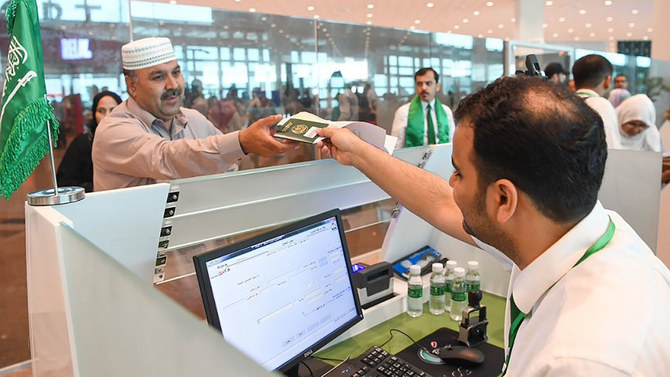
ISLAMABAD: Pakistan’s Ministry of Religious Affairs will refund all Hajj pilgrims under the government scheme, following Saudi Arabia’s decision to limit the annual pilgrimage to a few people this year due to the COVID-19 outbreak, authorities said in a statement released on Tuesday.
The decision follows an emergency meeting chaired by the ministry in Islamabad last night wherein it added that “a procedure would be finalized soon to return the payments to intending pilgrims who would be informed via text messages.”
A total of 180,000 Pakistanis were scheduled to perform Hajj this year, out of which 107,526 had registered for the pilgrimage under the government program.
The move follows an announcement by Saudi authorities on Monday said that this year’s Hajj would be limited to 1,000 people to safeguard public health as part of anti-virus measures to limit the spread of the deadly disease.
Pakistan and other Muslim countries welcomed the Kingdom’s decision, saying it was in line with the principles of Shariah.
Last year, for the first time, Pakistan was included in Saudi Arabia’s ‘Road to Makkah’ project which is aimed at facilitating Hajj pilgrims from across the Muslim world.
This was after Prime Minister Imran Khan requested Saudi Arabia to include Pakistan in the project during Crown Prince Mohammad bin Salman’s visit to Islamabad in February last year.

Pakistan to refund pilgrims after Hajj 2020 limited to Saudi residents only
https://arab.news/zth8f
Pakistan to refund pilgrims after Hajj 2020 limited to Saudi residents only
- Ministry in charge to finalize return of payments soon
- Kingdom’s decision part of anti-virus measures to limit COVID-19 outbreak
Pakistan says operation against Afghan forces to continue until objectives are achieved
- Fighting started this week after Afghan forces attacked Pakistani military installations in retaliation for earlier strikes
- Afghan government spokesperson says air defense attacks were carried out Pakistan aircraft in Kabul on Sunday morning
ISLAMABAD: Pakistan military’s operation against Afghanistan forces along the border is still underway and will continue until all objectives are achieved, state media reported on Sunday citing security sources.
The latest round of clashes between the two sides began on Thursday night after Afghanistan’s forces attacked Pakistani military installations along their shared border.
The worst fighting between the neighbors in several years began after Pakistani airstrikes targeted what Islamabad described as militant hideouts inside Afghanistan earlier this month, triggering retaliatory fire along the frontier and sharply escalating long-running tensions. Islamabad accuses Kabul of sheltering Pakistani Taliban militants responsible for attacks inside Pakistan, an allegation that Afghanistan denies.
Pakistan’s Information Minister Attaullah Tarar said on Saturday that 352 Afghan Taliban fighters had been killed and more than 535 wounded since the latest phase of hostilities began.
“The security sources said Operation Ghazb Lil-Haq is still underway and will continue until objectives are achieved,” state broadcaster Radio Pakistan reported.
The state media said Pakistan’s army has taken control of an Afghan Taliban military post at the border in northwestern Pakistan.
It shared a video of what it said were Pakistani soldiers crossing into Afghanistan from the northwestern North Waziristan area to capture the Afghan post on the other side of the border.
Arab News could not independently verify the claims.
Earlier during the day, gunshots and explosions were reported in Kabul. Afghan government spokesperson Zabihullah Mujahid said the sounds were the result of Afghan forces targeting Pakistani aircraft over the capital.
“Air defense attacks were carried out in Kabul against Pakistani aircraft,” Mujahid wrote on X. “Kabul residents should not be concerned.”
Since the conflict began this week, diplomatic efforts have intensified with several countries, including global bodies such as the European Union and United Nations, urging restraint and calling for talks.