

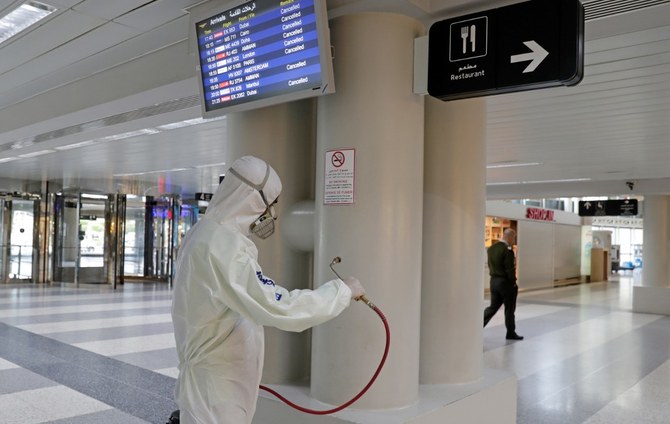
Lebanon opens its airport, but will accept only 2,000 travelers per day

Passengers will conduct a PCR upon their arrival at the Rafik Hariri International Airport “at the airline’s expense.” (File/AFP)
Short Url
Updated 24 June 2020
Follow

Lebanon opens its airport, but will accept only 2,000 travelers per day

  • Sri Lanka evacuates 167 of its nationals, but 25,000 remain in Lebanon

BEIRUT: Lebanon is preparing to reopen the Rafic Hariri International Airport in Beirut on July 1 for the first time in more than three months.

It is reducing the number of flights from countries where the polymerase chain reaction (PCR) test for the virus is not available to passengers to 20 percent of pre-pandemic levels. Flights from countries that do have the test will be at 80 percent of previous levels.

A source at Lebanese Middle East Airlines (MEA) said that “not many reservations have been made by Lebanese to leave Lebanon when the airport opens. Europe is still closed to the Lebanese, as are the Gulf states. The only countries that are accepting flights from Lebanon are Greece, Cyprus and Turkey. Spain may soon do so. Lebanese who hold Schengen visas are not allowed to enter European countries.”

The source said: “Beirut airport will not accept more than 2,000 passengers per day.”

Face masks will be mandatory for passengers and aircrews inside the terminal and on the plane. All travelers are required to bring with them a sufficient number of masks to use and to change them every four hours. They must also bring their own hand sanitizer.

The Minister of Health, Hamad Hassan, said that “the criterion is no longer the number of COVID-19 infections. Rather, it is the gradual societal immunity. The country was opened because the economic situation is deteriorating and we will gain societal immunity.”

The MEA announced the conditions set by the Lebanese authorities for travelers entering Lebanon. One is that travelers coming from countries that have PCR tests should take the test in laboratories licensed by the local authorities at most four days before the departure date, and must show the result of the test at check-in counters. Travelers will have to take another PCR test, at the expense of the airline, on their arrival at Beirut airport.

Travelers who come from countries where PCR tests are not available will take a PCR test on arrival at Beirut airport at the expense of the airline. They must take a second PCR test after 72 hours at their own expense.

Travelers coming to Lebanon must possess a health insurance policy that is valid for the duration of their stay, covering all costs of treatment for COVID-19 on Lebanese soil. Lebanese nationals must also have insurance but enjoy the right to medical treatment in their country.

Sri Lanka’s ambassador to Lebanon, Shani Calyaneratne, has announced that 167 Sri Lankan nationals are being evacuated by plane from Lebanon today, leaving “about 25,000 workers who came in the 1980s, 1990s and the beginning of this century and wish to stay will remain in Lebanon as long as the employers approve this.”


Katz orders West Bank raid after deadly attack in Israel

Israeli soldiers walk during a raid in the occupied-West Bank city of Qabatiya, north of Jenin, on February 23, 2025. (AFP)
Updated 26 December 2025
Follow

Katz orders West Bank raid after deadly attack in Israel

  • Friday’s stabbing and car-ramming attack in northern Israel triggered the minister’s action

JERUSALEM: Israel’s Defense Minister Israel Katz on Friday ordered the military to launch an operation in the village of Qabatiya in the occupied West Bank after it emerged that a Palestinian who killed two people came from there.
The minister instructed the Israeli forces to “act forcefully and immediately against the village of Qabatiya, from which the murderous terrorist emerged, in order to locate and thwart every terrorist and strike the village’s terror infrastructure,” Katz’s office said in a statement.
“Anyone who aids terrorism or sponsors and backs it will pay the full price,” it added.

BACKGROUND

Friday’s attack comes just days after Israeli soldiers shot dead a Palestinian teenager in the Qabatiya area.

The military said in a separate statement that it was preparing to begin an operation in Qabatiya in the northern West Bank, which has seen repeated violent incidents.
Friday’s stabbing and car-ramming attack in northern Israel triggered the minister’s action.
The assault came a day after an Israeli military reservist dressed in civilian clothes rammed his vehicle into a Palestinian man in the West Bank, where violence has surged since the war in Gaza began.
“Preliminary investigation indicates this was a rolling terror attack that began in the city of Beit Shean, where a pedestrian was run over,” Israeli police said in a statement about Friday’s attack, adding that the victim was a 68-year-old man.
“Later, a young woman was stabbed near Road 71, and the suspect was ultimately engaged with gunfire near Maonot Junction in Afula following intervention by a civilian bystander,” it said, adding that the attacker was taken to hospital.
Both victims succumbed to the injuries, Israel’s Magen David Adom emergency services said in a statement.
MDA also reported that a 16-year-old was slightly injured when “hit by a vehicle.
The Israeli military said the attacker had “infiltrated into Israeli territory several days ago.”
President Isaac Herzog condemned the attack.
Friday’s attack comes just days after Israeli soldiers shot dead a Palestinian teenager in the Qabatiya area.
The military has launched an investigation into the incident after footage emerged showing the teenager not posing any threat or throwing anything at soldiers who shot him.
The attack on Friday also came a day after an Israeli military reservist dressed in civilian clothes rammed his vehicle into a Palestinian man in the 
West Bank.
In videos on social media purporting to show that incident, the victim is seen praying by the roadside when the soldier rams him with his vehicle.