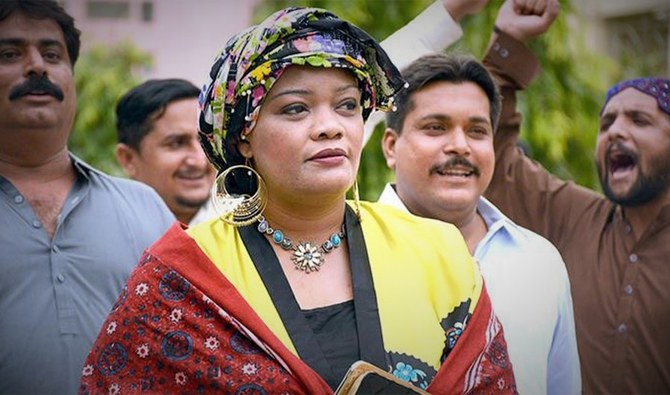
KARACHI: Pakistan’s first lawmaker from the Sheedi minority is on a mission to fight centuries-old discrimination against her community of African descent, saying it has been held back by entrenched racism.
“Being penalized for something that is beyond our control — our black skin — is a reality all Black people face every day in big and small measures in every country,” said Tanzeela Ume Habiba Qambrani, a member of the Sindh provincial legislature.
“The majority brown skin community considers itself the white community of America and superior to us,” she told the Thomson Reuters Foundation by phone from the southern Badin district, where many Sheedis live.
Many of Pakistan’s Sheedi people — whose numbers are unclear due to widely differing estimates — are descendants of East Africans who were brought to South Asia as slaves or soldiers by Arab traders.
Qambrani, 41, who traces her own roots back to Tanzania, lodged a protest resolution in the provincial assembly against a “wave of racism,” condemning last month’s killing of Black American George Floyd in Minneapolis police custody.
“This House strives to nip the scourge of racism in the bud through this resolution and aims at seeing our society free of such inhuman tendencies,” her letter read.
Persistent negative stereotypes about the Sheedis in Pakistan limit the community’s educational and employment prospects, keeping many in poverty, Qambrani said.
“We are considered ‘jahil’ (ignorant) and ‘jungli’ (wild) and assumed to be involved in criminal activity. This stereotype has kept our community from progressing,” she said, and called for educational funds to be allocated for young Sheedis.
“Education is our way out of poverty,” she said, noting the prejudice that many young Sheedis face at school.
“Most young people from our community are bullied and ridiculed in school, not just by their peers, but teachers as well, who tell them they are good for nothing,” said Qambrani, daughter of a lawyer and a headteacher.
The mother-of-three said Sheedi women often face a double discrimination due to South Asian beauty ideals that make it harder for them to find a spouse.
“The (Sheedi) men want to marry outside to dilute the skin tone of their offspring, leaving Sheedi women with no option as the wider Pakistani community is also looking for fairer skins for their spouses,” she said.
Qambrani’s appointment to the Sindh parliament in 2018, by Bilawal Bhutto, the leader of the Pakistan People’s Party (PPP) and son of former Prime Minister Benazir Bhutto, was hailed as a huge victory by Pakistan’s marginalized communities.
Now a well-known voice for her community, Qambrani said for many years her comfortable middle-class upbringing had shielded her from deep-seated prejudice against Sheedi people.
“I lived in a bubble and never realized what all my community suffered,” she said. (Reporting by Zofeen T. Ebrahim; Editing by Helen Popper. Please credit the Thomson Reuters Foundation, the charitable arm of Thomson Reuters, that covers the lives of people around the world who struggle to live freely or fairly.


Pakistan’s first Sheedi lawmaker targets ‘scourge of racism’
https://arab.news/8vhu4
Pakistan’s first Sheedi lawmaker targets ‘scourge of racism’

- Lodges protest resolution in the provincial assembly against a “wave of racism“
- Sheedis are descendants of East Africans who were brought to South Asia as slaves or soldiers by Arab traders

Peace can only prevail if Afghanistan renounces support for ‘terrorism’— Pakistan defense chief
- Pakistan’s chief of defense forces visits South Waziristan district bordering Afghanistan
- Pakistan says has killed 481 Afghan Taliban operatives since clashes began last Thursday
ISLAMABAD: Pakistan’s Chief of Defense Forces Field Marshal Syed Asim Munir said on Wednesday that peace with Afghanistan can only prevail if Kabul renounces support for “terrorism” and “terrorist” organizations, the military’s media wing said as the two countries remain locked in conflict.
Fighting between the two neighbors, the worst in decades, broke out last Thursday night after Afghan forces attacked Pakistan’s military installations along their shared border. Afghanistan said its attacks were in response to earlier airstrikes by Pakistan against alleged militant hideouts in its country.
Pakistan accuses Afghanistan of sheltering militant outfits such as the Tehreek-e-Taliban Pakistan (TTP) on its soil who have launched attacks against Pakistani civilians and security forces in recent years. Kabul denies the allegations.
Munir visited Wana town in Pakistan’s South Waziristan district to review the security situation and troops’ operational preparedness at the Afghan border, the Pakistani military’s media wing said in a statement.
“The Field Marshal reiterated that peace could only prevail between both sides if the Afghan Taliban renounced their support for terrorism and terrorist organizations,” the Inter-Services Public Relations (ISPR) said.
The military chief said the use of Afghan soil by militant outfits to launch attacks against Pakistan was unacceptable, vowing that “all necessary measures” would be taken to neutralize cross-border threats.
During the visit, Munir was briefed by military commanders about ongoing intelligence-based operations and measures being taken by the military to manage the border with Afghanistan.
He was also briefed about “Operation Ghazab Lil Haq” or “Wrath for the Truth,” the name Pakistan has given to its military operation against Afghan forces, the ISPR said.
The Pakistani military chief spoke to troops deployed in the area, praising their vigilance, professional conduct and high morale, the ISPR said.
Pakistan’s Information Minister Attaullah Tarar said on Wednesday that the military has killed 481 Taliban operatives, injured more than 690 and destroyed 226 Afghan checkposts since clashes began.
Arab News has been unable to verify claims by both sides about the damages they claim to have inflicted on each other.
Afghanistan has signaled it is open for dialogue but Pakistan rejected the offer, saying it would continue its military operations till its objectives were achieved.
Since the conflict began, diplomatic efforts have intensified with several countries, including global bodies such as the European Union and United Nations, urging restraint and calling for talks.
Turkish President Recep Tayyip Erdogan told Pakistani Prime Minister Shehbaz Sharif that Ankara would help reinstate a ceasefire, the Turkish Presidency said on Tuesday, as other countries that had offered to mediate have since been hit by the conflict in the Gulf.


