Syrian exile reveals family’s arduous journey to freedom to mark World Refugee Day

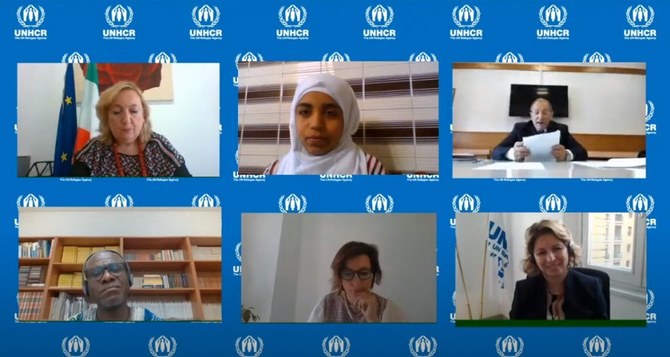
Above center, Douaa Alkoka during the virtual press conference in Italy of the presentation of the UNHCR report Global Trends. (Photo: ANSA/UNHCR)
Short Url
Updated 23 June 2020
Follow

Syrian exile reveals family’s arduous journey to freedom to mark World Refugee Day

  • ‘Italy has given us a new life, we have found peace at last’: Douaa Alkoka

ROME: She left Damascus as a young girl, in search of a future with her family and medical treatment for her father.

Today, Douaa Alkoka, 19, lives, works and studies in Camini, a small town in the southern Italian region of Calabria.

After a long and difficult journey from Syria to Lebanon, Alkoka then managed to reach Italy with her family, where she finally found the peace she had been seeking.

“I’ve been in Italy for four years now, but I left my country many years before for various reasons,” she said. “The first was the war, and then for my father’s health problems. In Syria, it was difficult to find a solution, and we had to leave to find a special operation for my father,” Alkoka said at an event organized in Rome by UNHCR, the UN High Commission for Refugees, to mark World Refugee Day on June 20.

“I left Syria as a little girl, when I was nearly nine years old. With my family we went to Lebanon, where we encountered many difficulties. We ended up in a place where they don’t want people like us,” she said without elaborating. “It was just hard, that’s all.”

Alkoka said: “Only after a lot of struggle did we manage to find a room where we could stay. There were seven of us, the place was tiny and we stayed there for three years. Those were the hardest years of my life. We didn’t manage to attend school that often. They treated us badly over there.

“We really had a lot of problems, and my father was really sick. At some point, I don’t know how we found out that we could do my father’s operation in Italy. They called us to come here in Italy,” she said. 

“When the family learned the news that we could go to Italy, we felt sad and happy at the same time. We were happy for my father, because it’s difficult to see a father who is ill without being able to do anything about it. But we were sad because after we had to leave our country we were going really far away, without knowing if we would go back one day.

“When we arrived in Calabria, at the beginning it was difficult because everyone spoke Italian and we didn’t understand what they were saying,” she said.

In Lamezia Terme, the Syrian family met Rosario Zurzolo, president of the Eurocoop Servizi company, who runs a project to provide refugees with accommodation.

“He took us to Camini. At the beginning we weren’t happy. We felt that we were far away from our country, finding ourselves in a place where we didn’t know if we would be OK or not,” she said.

“But when we started to speak Italian, to go to school, we felt happy. We realized we had found a place where people cared about us. We found peace, which we hadn’t had for a long time,” she said.

Now Alkoka is the local representative of the Pro Loco tourist information office in Camini and is finding time to continue her studiesm — something that had been impossible both in Syria and Lebanon.

“I am happy to have come to Italy, above all to Camini. People are special here,” she said.​

For the World Refugee Day, UNHCR launched a free app, Workeen, to help migrants, refugees, and asylum seekers find work.

The app provides a checklist of documents needed to work in the host country, including ID card, language certification, work experience certification and previous education, and is available in Italian, English, Arabic and Farsi, as well as other European languages.

Epstein files reveal links to cash, women, power in Africa

Updated 26 February 2026
Follow

Epstein files reveal links to cash, women, power in Africa

  • Documents attest to Epstein’sclose ties with Karim Wade, son of former Senegalese president Abdoulaye Wade
  • They also reveal his ties to Nina Keita, niece of Ivorian president Alassane Ouattara

PARIS: Jeffrey Epstein built close ties with powerful figures in Senegal and Ivory Coast, files released by the US government last month show, detailing the late sex offender’s influence network across Africa.
Emails, scheduled meetings, investment projects, and loans reviewed by AFP attest to the disgraced New York financier’s close relationship with Karim Wade, son of former Senegalese president Abdoulaye Wade.
They also reveal his ties to Nina Keita, niece of Ivorian president Alassane Ouattara.
Wade and Epstein met in 2010 through Emirati businessman Sultan Ahmed bin Sulayem, who recently resigned as CEO of port giant DP World after mounting pressure over his close friendship with Epstein.
The pair quickly struck up a rapport.
“Thanks for coming. I think there are many things to consider... I feel confident that we will have fun,” Epstein wrote to Wade on November 15, 2010 after their first meeting in Paris.
“Have a safe trip back to your paradise Island,” Wade replied.
While Wade’s exchanges show no link to Epstein-related sex trafficking crimes, they do reveal conversations on potential business ventures in various sectors, such as finance and energy.
Nicknamed the “Minister of Heaven and Earth” for the multiple portfolios he held including international cooperation, energy, and air transport, Wade was a powerful figure in Senegal until April 2012, when his father’s bid for a third term sparked deadly riots.
Epstein saw him as “one of the most important players in africa” and invited him to meet close contacts such as Ehud Barak, then Israel’s defense minister.
He also put him in touch with Chinese businessman Desmond Shum to discuss “offshore banking.”
The US Department of Justice documents show Shum and Wade met in Beijing on May 9, 2011.
That same month, Wade planned an African tour through Senegal, Mali, and Gabon for Epstein.

‘You will not suffer’ 

Epstein and Wade’s relationship became even more apparent after the latter’s fortunes reversed when his father left office in 2012.
That autumn, Epstein proposed that his “friend” — under the Dakar authorities’ scrutiny over his assets — use his house in Florida.
“You and your family are welcome to use my house in palm beach, staff is there, pool etc. you will not suffer,” Epstein wrote.
“Txs a lot Brother for the advise,” Wade replied a few weeks later to another email, in which Epstein urged him to “stay mentally strong.”
Numerous files suggest Epstein became financially involved on Karim Wade’s behalf after his arrest in 2013 and his 2015 sentencing to six years in prison for corruption.
Karim Wade’s lawyer, Mohamed Seydou Diagne, sent two invoices in May 2014 and July 2015 of $500,000 to one of Epstein’s companies.
Contacted by AFP on Monday, Diagne said he “did not consider it useful to comment.”
Other archives suggest that Epstein covered at least $50,000 in fees for the US lobbying firm Nelson Mullins, hired by Wade’s entourage to secure his release.
Epstein regularly exchanged emails with Robert Crowe, a partner at the firm who kept him informed of their efforts in the US and Senegal.
In a June 16, 2016 email thread where Epstein and Crowe discussed whether then Senegalese president Macky Sall would pardon Wade, Crowe writes: “He has told my friends high up at State that he was going to do it. They have been putting pressure on him!“
Karim Wade was released from prison eight days later, on June 24, and went into exile in Qatar, which he credited for efforts toward his release.
Jeffrey Epstein was told by Sultan Ahmed bin Sulayem and Nina Keita.

‘A very interesting person!’

The DOJ documents show Nina Keita was close to both Epstein and Karim Wade and that she acted as a regular intermediary while Wade was in prison.
Keita also helped put Epstein in contact with her uncle, president of Ivory Coast since May 2011, and his team.
“He thought you were a very interesting person! ... they were all very happy to have you here,” she wrote on January 20, 2012, after the financier’s visit to Abidjan.
She had booked him the “ministerial suite” of the luxury Hotel Ivoire for that trip.
Ahead of the visit, Epstein had said he hoped to see “very pretty girls there, as well as interesting places.”
“You will!” Keita replied.
Emails show Keita, a former model, at least once sent photos and the phone number of a young woman to Epstein.
He then met this woman at the Ritz hotel in Paris on August 31, 2011.
“ask sadia to send pictures of her sister. i prefer under 25,” Epstein wrote to Keita after the meeting.
Now the deputy general director of Ivorian petroleum stocks company GESTOCI, Keita also appears in a February 2019 will in which Epstein requested that debts owed to him by a number of people be canceled upon his death.
AFP received no response to its requests for comment from both Keita and the Ivorian presidency, or from Karim Wade, who was contacted through his entourage.
The mere mention of a person’s name in the Epstein files does not in itself imply wrongdoing.