

Erdogan continues to muzzle voices critical of his government

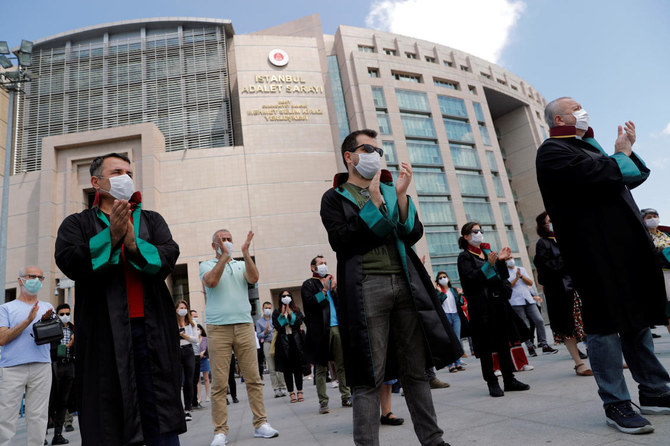
Lawyers gather in front of the Justice Palace to demonstrate against the police stopping senior lawyers marching to the capital Ankara in a protest against a draft bill governing the organisation of bar associations in Istanbul. (REUTERS)
Short Url
Updated 23 June 2020
Follow

Erdogan continues to muzzle voices critical of his government

  • The lawyers were protesting against plans to amend laws regulating lawyers and their associations, including the way they elect the association’s regional chairs.

ANKARA: Turkey’s legal fraternity is opposing a bill that, if passed, will scuttle the effective functioning of the country’s bar associations — one of its few remaining bastions of free speech.

The presidents of 55 Turkish bar associations have been marching from their respective provinces toward Ankara against the proposed bill.

The “March for Defense” began on June 19 and reached the Turkish capital on Sunday night.

Soner Karademir, head of the bar association in the northern province of Giresun, walked through heavy rain for three days with his umbrella and judge’s robe alongside colleagues from across the country.

Despite the protest remaining peaceful, police in Ankara blocked its movement in the early hours of Monday morning. A policeman punched one of the bar presidents of the southeastern province of Antep, and tried to arrest the head of the Antalya bar association.

Bar associations in Turkey claim that their march to the capital aims to fight “against darkness” that would expand with the introduction of a draft law on changing their election systems, in an effort to increase the representation of pro-government figures.

There is currently one bar association for each province of the country.

But with the new bill, the government would open the way for launching alternative bar associations, which will boost pro-government tendencies in the Union of Bar Associations (TBB), the centralized bar union of the country, which is formed by delegates.

“We only aim to ensure the rule of law and security in this country. This law amendment would trigger illegal structures within the judiciary. If bar associations are kept silent, the citizens could not voice their claims from the state because we monitor the services given to the citizens by the public authorities,” Karademir told Arab News.

The bill has also been criticized for not having been negotiated with the representatives of bar associations themselves.

Just before the march, Istanbul Bar Association head Mehmet Durakoglu, who has come under intense criticism from the government, issued a statement saying that the marchers would go to where their hearts took them.

“Where our hearts take us is the state of law, independence of the judiciary, living humanly and honorably. We are marching to ensure this,” he said.

The Ankara and Istanbul bar associations have long protested President Recep Tayyip Erdogan and his ruling Justice and Development Party (AKP) over the deteriorating state of the rule of law and alleged wrongdoings.

In early June, 79 Turkish bar associations also issued a joint statement, calling for the government to revoke the bill.

The bar associations also asked the TBB for an extraordinary meeting to discuss the matter. However, the legislative draft of the bill is almost ready and is expected to be adopted by the Turkish parliament soon.

Gamze Pamuk Atesli, a lawyer from the northwestern province of Bursa, said the police action that the lawyers faced on Monday was becoming a widespread problem in Turkish society.

She told Arab News that it gave a message that only those aligned with the powerful had the freedom to express their views.

“It is unacceptable that heads of bar associations had to witness an arbitrary police intervention while exercising their constitutional rights,” she said.

Gamze added that the lawyers’ march did not threaten peace or security. Growing injustice, she said, is the real threat.

“We need law as we need water and bread. We will all need justice at some point. The heads of our associations will keep supporting the rule of law,” she added.

Ankara witnessed another march last week organized by the pro-Kurdish Peoples’ Democratic Party in the wake of Turkish military operations in Kurdish-held territory in northern Iraq.


Military drone attack on Sudan oil field kills dozens and threatens South Sudan’s economic lifeline

Updated 7 sec ago
Follow

Military drone attack on Sudan oil field kills dozens and threatens South Sudan’s economic lifeline

  • RSF said the oil field in Heglig was attacked a day after they seized the facility near the border with South Sudan
  • South Sudanese soldiers were among the dead in the attack by an Akinci drone

JUBA: Dozens of people were killed Tuesday evening in a drone strike near Sudan’s largest oil processing facility carried out by the Sudanese Armed Forces, according to the paramilitary Rapid Support Forces.
The RSF, which has been fighting Sudan’s military since 2023, said the oil field in Heglig was attacked a day after the RSF seized the facility near the border with South Sudan.
Both sides told The Associated Press that the exact number of dead and wounded could not immediately be confirmed. Local news outlets reported seven tribal leaders and “dozens” of RSF troopers were killed.
South Sudanese soldiers were among the dead in the attack by an Akinci drone, according to the RSF, which condemned the attack as a violation of international law.
Two Sudanese military officials confirmed the drone strike, which they said targeted RSF fighters.
The government of South Sudan’s Unity State confirmed three South Sudanese soldiers were killed. A South Sudanese solider, who witnessed the strike and spoke on condition of anonymity because he was not authorized to speak, estimated 25 people were killed.
South Sudanese commander Johnson Olony said in a statement that South Sudanese forces may have been sent to secure Heglig after its capture. South Sudan’s military spokesperson declined to comment.
South Sudan relies entirely on Sudanese pipelines to export its oil and has seen production repeatedly disrupted by the conflict, worsening its economic crisis.
Sudanese soldiers and oil workers began evacuating Heglig on Monday and the RSF took control of the facility without resistance. By Tuesday, about 3,900 Sudanese soldiers had surrendered their weapons to South Sudanese forces after crossing into Rubkona County, according to Unity State’s information ministry.
Video from South Sudan’s state broadcaster showed tanks, armored personnel carriers and artillery among the weapons handed over.
Thousands of civilians from Sudan began crossing the border into South Sudan on Sunday and were still arriving Wednesday, the South Sudan government said, adding that the exact number was not yet known. South Sudan insists it remains neutral in the conflict despite accusations of siding with the RSF.
Heglig’s capture is the latest in a string of RSF territorial gains, including the October fall of el-Fasher, the capital of North Darfur and the Sudanese army’s last stronghold in Darfur. The war, which began in April 2023, has killed an estimated 150,000 people, displaced millions and triggered multiple famines. Both sides face allegations of atrocities.
The capture of Heglig, a vital state asset, could be a significant bargaining chip for the RSF, analysts said. But the opaque nature of oil finances makes it difficult to determine how much the SAF, RSF or South Sudan will be impacted economically over the short term.