

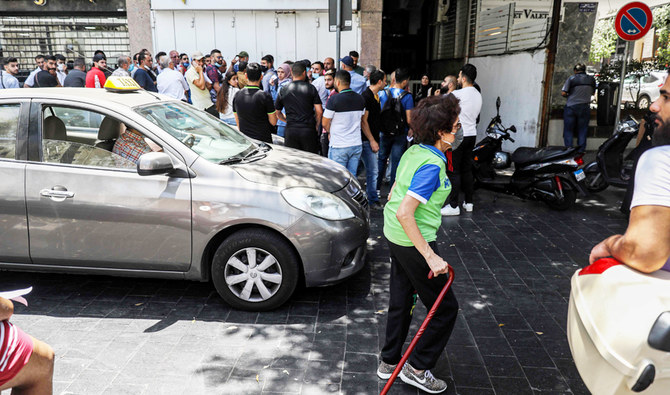

BEIRUT: The Central Bank of Lebanon plan of pumping US dollars to authorized money-changers has failed to reduce the exchange rate of 3,200 Lebanese pounds to $1.
By the end of the week the reality was that these US dollars did not reach the citizens who needed it but that the money went into the pockets of a third party.
Scenes of people, especially unemployed youth belonging to the poorer classes, queuing on a daily basis in front of money-changer shops outside Beirut, provided the evidence that the process was not related to buying US dollars for business deals or paying dues.
Although money-changers stipulated that citizens who wanted to buy US dollars should show their identity cards and other required documents to buy US dollars, the exchange rate of the Lebanese pound on the black market skyrocketed, passing 5,200 Lebanese pounds for $1.
A number of people who tried to buy US dollars from money-changers talked about financial transactions occurring without an exchange of dollars.
BACKGROUND
- Hundreds of people are bringing identity cards of their relatives to buy US dollars in their names and sell them later on the black market.
Samer Al-Husseini, a resident of Chtaura in the Bekaa valley, asked a money-changer for US dollars to pay for the tuition of his daughter who is studying abroad.
He told Arab News: “Some citizens were buying US dollars from the money-changers at the set exchange rate of 3,900 Lebanese pounds for $1 and selling it later on the black market. Other people who were piling the dollars at home started selling them in the black market and then buying dollars from licensed money-changers at a lower exchange rate.”
“Now hundreds of people are bringing the identity cards of their relatives and family members to buy US dollars in their names to sell them later in the black market to make a profit of 260,000 Lebanese pounds per $200, as they buy $200 at 780,000 Lebanese pounds and sell them in the black market for 1,040,000 Lebanese pounds at an exchange rate of Lebanese pounds for $1.”
Some licensed money-changers are asking the person who wants to buy US dollars if he would like to sell them back at the black market exchange rate and, on this person’s approval, the money-changer would give him the profit that he would get from selling the US dollars in the black market and keep the US dollars for himself. All that a person needs to do is to show his identity card, and the money-changer will keep the US currency that he received from the central bank reserves to use later.
HIGHLIGHT
Although money changers stipulated that citizens who wanted to buy US dollars should show their identity cards and other required documents to buy US dollars, the exchange rate of the Lebanese pound on the black market skyrocketed, passing 5,200 Lebanese pounds for $1.
This mechanism set by the central bank failed to decrease the exchange rate of the Lebanese pound and led to the spike of the US dollar on the black market.
Queues in front of money-changers offices were no longer seen on Saturday as the Syndicate of Money-Changers decided to stop selling US dollars based only on identity cards, and declared that it “will not support any violator for it is keen on making the process succeed.”
Head of the Syndicate of Money-Changers Mahmoud Mrad met Speaker of the Parliament Nabih Berri and proposed “ways to stop money speculations in the black market.” He stressed “the importance of the role of the security forces in suppressing the black market.”
“The violations that occurred are not that big. People who queued in front of money-changers had loans in US dollars that they wanted to pay off.”
Mrad, who has a money-changing shop in Ghobeiry in Beirut, said that most of his clients “are people who have to pay for their installments at the Qard Al-Hassan association.”
The association, which provides interest-free loans, asks borrowers to pay their dues in US dollars and does not accept payments in Lebanese pounds at the official exchange rate. It does not have contacts with banks due to US sanctions. Most of its branches are located in the southern suburb of Beirut and in southern Bekaa — known among Hezbollah supporters.
Secretary of the Syndicate of Money-Changers Mahmoud Halawi said that “all money-changers should be members of the syndicate, which has the right to monitor them.”


