

Britain opens terror probe into 'sickening' stabbing spree

1 / 2
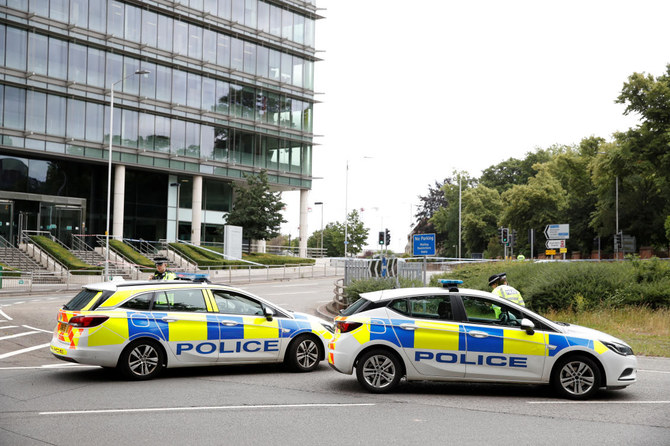
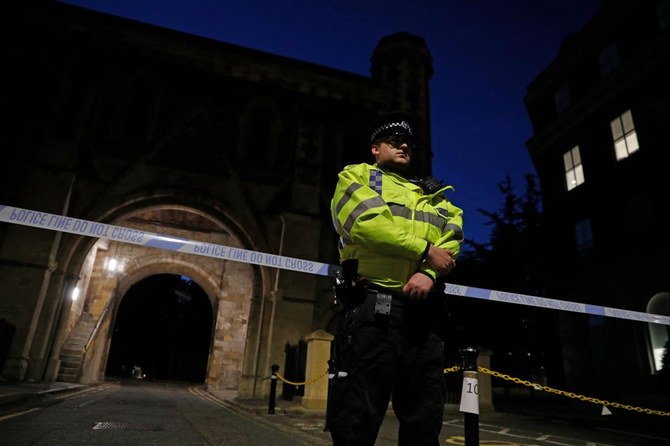
Police cordon off Forbury Gardens — a popular park situated next to the ruins of the 12th-century Reading Abbey. (Reuters)
2 / 2
Police cordon off Forbury Gardens — a popular park situated next to the ruins of the 12th-century Reading Abbey. (Reuters)
Short Url
Updated 21 June 2020
Follow

Britain opens terror probe into 'sickening' stabbing spree

  • Libyan Khairi Saadallah identified as the alleged lone attacker
  • Prime Minister Boris Johnson appalled by the attack, says lessons will be learned

READING, United Kingdom: A stabbing rampage that killed three people as they sat in a British park on a summer evening is being considered a terrorist attack, police said Sunday as a 25-year-old man who was believed to be the lone attacker was in custody.
Authorities said they were not looking for any other suspects and they did not raise Britain's official terrorism threat level from “substantial.”
Three people were killed and three others seriously wounded in the stabbing attack that came out of the blue Saturday in Forbury Gardens park in Reading, a town of 200,000 people 40 miles (64 kilometers) west of London.

“Motivation for this horrific act is far from certain," said Neil Basu, Britain’s top counterterrorism police officer, as police forensics officers combed the park for evidence.
Basu said “incredibly brave” unarmed officers from the Thames Valley Police force arrested a 25-year-old local man at the scene. The Thames Valley force later said counterterrorism detectives were taking over the investigation.
“There is no intelligence to suggest that there is any further danger to the public,” said Detective Chief Superintendent Ian Hunter.
Police have not identified the suspect, but Britain’s national news agency, Press Association, named him as Khairi Saadallah, a Libyan citizen who lived in Reading. A Reading man of that name who is the same age as the suspect was sentenced to two months in prison last year for assaulting an emergency worker.
Prime Minister Boris Johnson, who met security officials, police and senior ministers on Sunday for an update on the investigation, said he was “appalled and sickened” by the attack.
“(If) there are lessons that we need to learn” or legal changes needed to prevent such attacks, “then we will learn those lessons and we will not hesitate to take action where necessary,” Johnson said.
Police officers patrolled cordons on the roads leading to the park on Sunday, and blue-and-white tents were erected near the attack site. Overnight, heavily armed officers entered an apartment about a mile away, and a loud bang was heard.
Notes and bunches of flowers had been left Sunday by the police tape in tribute to the victims.
“There are no words that anyone can say to express how horrible and senseless this was,” one said. “Our prayers are with all the victims and their families and friends. #Readingstandsunited.”
Personal trainer Lawrence Wort said the park was full of groups sitting on the grass Saturday evening when “one lone person walked through, suddenly shouted some unintelligible words and went around a large group of around 10, trying to stab them.”
“He stabbed three of them severely in the neck and under the arms, and then turned and started running towards me, and we turned and started running,” Wort said.
The attack came hours after a Black Lives Matter demonstration at Forbury Gardens but police said there was no connection between the two.
Britain has been hit by several terror attacks in recent years, both by people inspired by the Islamic State group and by far-right extremists. Islamist-inspired attacks include a suicide bombing at an Ariana Grande concert in Manchester that killed 22 people in 2017 and two deadly vehicle and knife attacks in London the same year.
In several cases, attackers have been known to police. In November, a man who had been released after serving a prison sentence for a terrorism offense stabbed two people to death at a justice conference in London.
In February, a man recently released from prison after serving time for terrorism-related offenses strapped on a fake bomb and stabbed two people on a busy London street before being shot to death by police. No one else was killed.
Britain’s official terrorism threat level stands at “substantial,” the middle level on a five-rung scale, meaning an attack is likely.


Left homeless by blaze, Muslims in southernmost Philippines observe Ramadan as month of trial

Updated 23 February 2026
Follow

Left homeless by blaze, Muslims in southernmost Philippines observe Ramadan as month of trial

  • Thousands lost their homes when parts of Bongao in Tawi-Tawi were burnt to ashes
  • Many trying to fully observe the fasting month say they are grateful to be alive

Manila: As Annalexis Abdulla Dabbang was looking forward to observing the month of Ramadan with her family, just days before it began they lost everything when an enormous fire tore through whole neighborhoods of their city in the southernmost province of the Philippines.

Bongao is the capital of Tawi-Tawi, an island province, forming part of the country’s Muslim minority heartland in the Bangsamoro region. The city experienced its worst fire in years in early February, when flames swept through the coastal community, leaving more than 5,000 people homeless.

“We were swimming for our lives. We had to swim to escape from the fire ... We swam in darkness, and (even) the sea was already hot because of the fire,” Dabbang, a 27-year-old teacher, told Arab News.

“Everything we owned was gone in just a few hours — our home, our memories, the things we worked hard for, everything turned to ashes.”

Trying to save their 2-year-old daughter and themselves, she and her husband left everything behind — as did hundreds of other families that together with them have since taken shelter at the Mindanao State University gymnasium — one of the evacuation centers.

Unable to secure a tent, Dabbang’s family has been sleeping on the bleachers, sharing a single mat as their bed. When Ramadan arrived a few days after they moved to the makeshift shelter, they welcomed it in a different, more solemn way. There is no family privacy for suhoor, no room or means to welcome guests for iftar.

“Ramadan feels different now. It’s painful but at the same time more real. When we lost our home, we began to understand what sacrifice really means. When you sleep in an evacuation center, you understand hunger, discomfort in a deeper way,” Dabbang said.

“We don’t prepare special dishes. We prepare our hearts.”

While she and thousands of others have lost everything they have ever owned, she has not lost her faith.

“Our dreams may have turned to ashes, but our prayers are still alive,” she said.

“This Ramadan my prayers are more emotional than ever. I pray for strength, not just for myself, but for my family and for every neighbor who also lost their family home. I pray for healing from the trauma of fire. I pray that Allah will replace what we lost with something better. I pray for the chance to rebuild not just our house, but our sense of security.”

Juraij Dayan Hussin, a volunteer helping the Bongao fire victims, observed that many of them were traumatized and the need to cleanse the heart and mind during Ramadan was what kept many of them going, because they are “thankful that even though they lost their property, they are still alive.”

But the religious observance related to the fasting month is not easy in a cramped shelter.

“It’s hard for Muslims to perform their prayers when they do not have their proper attire because they usually have specific clothes for prayer,” he said. “Sanitation in the area is also an issue ... when you fast and when you pray, cleanliness is essential.”

For Abdulkail Jani, who is staying at a basketball court with his brother and more than 70 other families, this Ramadan will be spent apart from their parents, whom they managed to move to relatives.

“The month of Ramadan this year is a month of trial ... there will be a huge change from how we observed Ramadan in the past, but we will adjust to it and try to comfort ourselves and our family. The most important thing is that we can perform the fasting,” he told Arab News.

“Despite our situation now, despite everything, as long as we’re alive, we will observe Ramadan. We’ll try to observe it well, without missing anything.”
