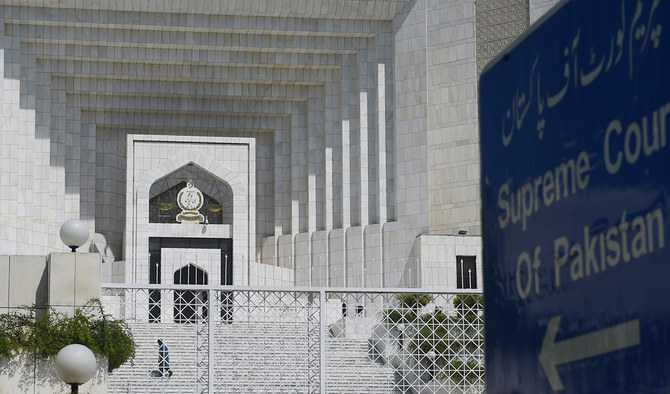
ISLAMABAD: Pakistan’s ruling party defended its controversial Assets Recovery Unit (ARU) on Saturday after opposition parties and the legal fraternity slammed the government’s accountability drive following the quashing of a presidential reference against senior judge, Justice Qazi Faez Isa, by the Supreme Court on Friday.
The legality of the ARU established by Prime Minister Imran Khan in 2018 has been repeatedly called into question for its sweeping powers and for targeting senior members of opposition parties.
The unit, formed without the backing of Parliament, was set up to repatriate illegal offshore assets and bring looted wealth back to Pakistan-- the linchpin of PM Khan’s election campaign.
“The ARU is a legal organization which will continue its work despite baseless allegations and propaganda by the opposition parties and a few others in the legal fraternity,” chief of ARU and the Prime Minister’s special assistant on accountability, Mirza Shahzad Akbar, told Arab News via telephone on Saturday.
Akbar said the ARU was established as per the government’s ‘rules of business’ and all its appointments and actions were validated by the federal cabinet.
“This is a coordinating unit which facilitates other public organizations to expedite the accountability process,” Akbar said.
On the Supreme Court’s remarks, he said all terms of reference of the unit were placed before the court for the satisfaction of the judges.
Accountability was the main agenda on the ruling party’s manifesto, Akbar added, and said the public had “given the mandate to Prime Minister Imran Khan to hold corrupts accountable.”
PM Khan rose to power in 2018 pledging accountability across the board, but critics have often termed the drive a politically motivated witch-hunt.
In the most recent criticism of the government’s initiative, senior lawyers once more raised questions on the legal status of the unit after the corruption case against Justice Isa was thrown out by a 10-judge full court.
“This government has made a mockery of justice and accountability with the questionable so-called assets recovery unit leading the drive,” Syed Amjad Shah, vice-chairman for Pakistan Bar Council, told Arab News.
“We are observing all the mala fide workings of the recovery unit and may challenge its very constitution in the Supreme Court in the coming days,” Shah said.
“The government’s whole accountability process is tainted as it is trying to implicate only the opposition members who have been criticizing its performance,” Senator Mushahidullah Khan, a senior Pakistan Muslim League-Nawaz (PML-N) lawmaker, told Arab News.
He added the ARU was “unconstitutional” as it was not approved by Parliament and was meant to influence other independent organizations like the National Accountability Bureau in the government’s favor.
“This body should be abolished immediately to restore the public’s confidence in other departments-- that they are working freely,” he said.
Echoing Mushahidullah’s viewpoint, a senior leader for Pakistan Peoples Party, Sehar Kamran, told Arab News the assets recovery unit had “failed to recover even a single rupee so far.”
“This unit is a political tool in the hands of the government for victimization of the opposition,” she said.


![]()

Government defends anti-corruption unit as opposition, lawyers slam accountability drive
Short Url
https://arab.news/j2kq2
Government defends anti-corruption unit as opposition, lawyers slam accountability drive
- Says Asset Recovery Unit is legal organization with all actions validated by federal cabinet
- Pakistan Bar Council may challenge constitutionality of unit in Supreme Court
Latest updates


© 2026 SAUDI RESEARCH & PUBLISHING COMPANY, All Rights Reserved And subject to Terms of Use Agreement.