Arab Israeli surfer keeps hopes alive at last Arab village on Israel’s Mediterranean coast

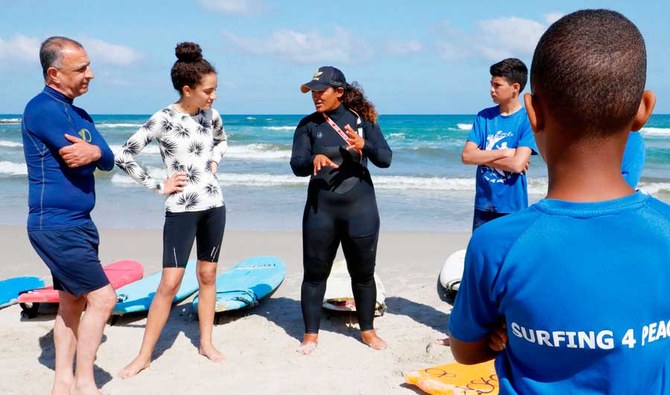
Arab-Israeli Hamama Jarban (C), 41, a lifeguard fisherman and surf teacher, gives surf lessons to teenagers and adults on June 12, 2020 on the beach in the coastal village of Jisr al-Zarqa, north of Tel Aviv. (AFP)
Short Url
Updated 20 June 2020
Follow

Arab Israeli surfer keeps hopes alive at last Arab village on Israel’s Mediterranean coast

  • Jarban received qualifications as a surfing and swimming instructor, as well as a lifeguard, from Israel’s leading sports training facility, the Wingate Institute

JISR AL-ZARQA: Standing barefoot on an Israeli beach, Hamama Jarban blew her whistle and watched her students race toward the water clutching their colorful surfboards.
Each weekend she welcomes enthusiastic would-be surfers to the shore, teaching them how to lie and then stand on their boards.
“I am a child of the sea, my father used to throw us in the water when we were little and tell us to swim,” she said.
Wearing a black wetsuit and cap, the 41-year-old’s surfing venture brings much needed income to Jisr Al-Zarqa, the only remaining Arab village on Israel’s Mediterraean coast and one of the poorest in the north.
Her father, together with her grandfather, also taught her how to fish, but Jisr Al-Zarqa is nowadays subject to environmental restrictions on fishing.
Arabs constitute around 20 percent of Israel’s 9 million-strong population and say they are discriminated against by the Jewish state.
Jarban received qualifications as a surfing and swimming instructor, as well as a lifeguard, from Israel’s leading sports training facility, the Wingate Institute.
Along with her brother Mohammed, she started teaching surfing 6 years ago to children and young adults from the village and elsewhere in northern Israel.
While most of the surfers are Israeli Arabs, Jarban said she once taught two Jewish girls on holiday from Jerusalem.
On one Saturday morning, some of the young recruits wore blue tops with the club’s “Surfing 4 Peace” logo across the back.
Thirteen-year-old Sari Ammash said he still finds it hard to balance on the surfboard, but has gained better control since starting lessons last year.
The beach sits in an idyllic spot, close to a forest and a river that the surfers must cross before starting their lesson.
Ream, a 21-year-old architecture student, travels more than 30 km for the lessons.
“I love sport, I used to play basketball, and now I enjoy training with Hamama,” she said.
Jarban also works as a lifeguard in summer and volunteers with the maritime rescue unit in Caesarea, a nearby upmarket coastal resort.
The contrast with her village — with its overcrowded housing and narrow streets — could not be starker.
Prime Minister Benjamin Netanyahu has a home in Caesarea.
To physically separate the two places, in 2002 a 5-meter-high dirt wall was erected, which Caesarea residents said was intended to shield them from the noise of the Muslim call to prayer, as well as village parties.

HIGHLIGHT

Arabs constitute around 20 percent of Israel’s 9 million-strong population and say they are discriminated against by the Jewish state.

The barrier runs for 1.5 kilometers (about a mile) and has been planted with flowers and trees by the resort town’s residents.
In Jisr Al-Zarqa, tin shacks line the shore, while fishing boats bob at anchor, left idle by a dispute over fishing rights.
The Israel Nature and Parks Authority gave the area environmental protection in 2010, restricting fishing and coastal construction.
Villagers say they were promised development and infrastructure in return, but this never came.
A spokeswoman from the parks authority said they have worked with the village council to invest funds and build a promenade, while stopping construction work on the protected land.
“People should dismantle any building that is not legal, we have inspectors to watch,” she told AFP.
Jarban has herself become embroiled in a dispute after building a wooden hut to store surfboards.
In a letter from the authority seen by AFP, she was ordered last month to demolish it or face legal action.
“We have suffered heavy losses,” Jarban said of her village.


35 have been killed and 1,200 held in Iran’s economic protests

People walk as shops are closed during protests in Tehran's centuries-old main bazaar, Iran, Tuesday, Jan. 6, 2026. (AP)
Updated 7 sec ago
Follow

35 have been killed and 1,200 held in Iran’s economic protests

  • Demonstrations show no sign of stopping
  • Govt acknowledges hardships, urges dialogue

DUBAI: The death toll in violence surrounding protests in Iran has risen to at least 35 people, activists said on Tuesday, as the demonstrations showed no signs of stopping.

The figure came from the US-based Human Rights Activists News Agency, which said more than 1,200 people have been detained in the protests, which have been ongoing for more than a week.
It said 29 protesters, four children and two members of Iran’s security forces have been killed. Demonstrations have reached over 250 locations in 27 of Iran’s 31 provinces,
The group, which relies on an activist network inside of Iran for its reporting, has been accurate in past unrest.
The semiofficial Fars news agency reported late on Monday that some 250 police officers and 45 members of the Guard’s all-volunteer Basij force have been hurt in the demonstrations.
 The authorities have acknowledged the economic hardships but accused networks linked to foreign powers of stoking the protests. 
On Tuesday, Iran’s police chief vowed to “deal with the last of these rioters.”
The shopkeepers’ protest continued on Tuesday in the bazaar, with about 150 people focusing on economic demands, Fars reported.
The protests have spread to some cities in western and southern Iran but do not match the scale of unrest that swept the nation in 2022-23 over the death of Mahsa Amini, who died in police custody for violating Iran’s dress code.
However, even though smaller, these protests have quickly expanded ‌from an economic ‌focus to broader frustrations, with some protesters chanting against the country’s clerical rulers.
The police chief, Ahmadreza Radan, was quoted on Tuesday by state media as saying they had drawn a distinction between protesters and rioters, the latter facing arrests on site or following identification by intelligence units.
“I pledge that we will deal with the last of these rioters. It is still time for those who were deceived by foreign services to identify themselves and draw on the Islamic Republic’s greatness,” Radan said.
Fars said ​Tuesday’s gathering of shopkeepers on Saadi street in Tehran ended without “expanding the police’s presence.”
Mohammad, 63, a jewelry shop owner in the bazaar, said there was a heavy presence of riot police and plainclothes security forces inside and around the area.
“They were forcing shopkeepers who were on strike to open their shops. I did not see it myself, but I heard there were clashes outside the bazaar and police fired tear gas,” he said by phone. 
Footage shared on Telegram on Tuesday appeared to show dozens of security forces on motorbikes patrolling the street and the unidentified person who took the clip can be heard saying the security forces had fired tear gas.
President Masoud Pezeshkian has promised reforms to help stabilize the monetary and banking systems and protect purchasing power.
The government has announced a subsidy reform, removing preferential currency exchange rates for importers in favor of direct transfers to Iranians to boost their purchasing ‌power for essential goods. The measure will come into force on Jan. 10.
The central bank chief was also replaced on Dec. 29.
The rial fell further to 1,489,500 on Tuesday, representing a 4 percent fall since the protests started.