Divers cut, plant coral off UAE coast to build reef

1 / 5
A diver inspects transplanted coral near Dibba Port in Fujairah, United Arab Emirates, June 15, 2020. Picture taken June 15, 2020. (Reuters)
2 / 5
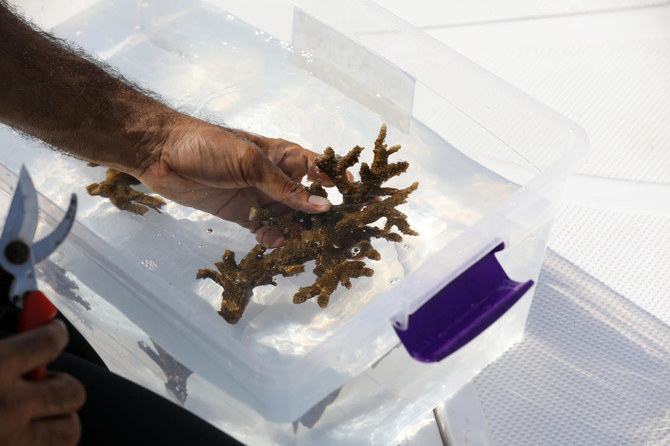
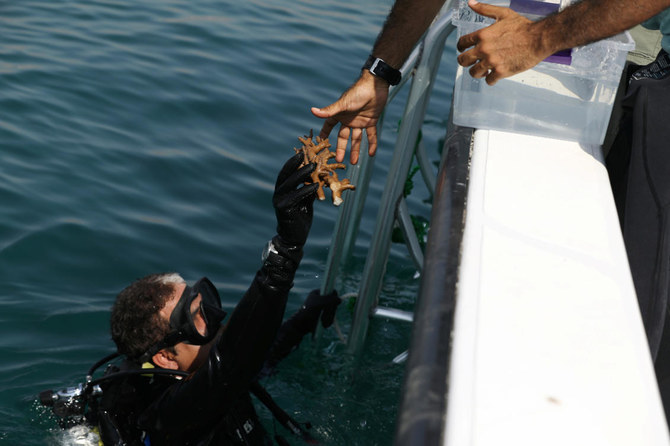
A diver harvests coral near Dibba Port in Fujairah, United Arab Emirates, June 15, 2020. Picture taken June 15, 2020. (Reuters)
3 / 5
A diver harvests coral near Dibba Port in Fujairah, United Arab Emirates, June 15, 2020. Picture taken June 15, 2020. (Reuters)
4 / 5
A diver harvests coral near Dibba Port in Fujairah, United Arab Emirates, June 15, 2020. Picture taken June 15, 2020. (Reuters)
5 / 5
A diver inspects transplanted coral near Dibba Port in Fujairah, United Arab Emirates, June 15, 2020. Picture taken June 15, 2020. (Reuters)
Short Url
Updated 18 June 2020
Follow

Divers cut, plant coral off UAE coast to build reef

  • Divers are building artificial reefs they hope will spur a resurgence in sea life degraded over the years
  • UAE reefs have suffered substantial degradation over the past two decades

FUJAIRAH: Off the east coast of the United Arab Emirates (UAE) coral freshly removed from a reef is cut into pieces and replanted by a group of divers in the waters below.
The divers, from the Fujairah Adventure Center, are building artificial reefs they hope will spur a resurgence in sea life degraded over the years by climate change and development.
The small team and other volunteers have planted more than 9,000 corals over about 600 square meters in the past year. Within five years, they hope to cover 300,000 square meters with 1.5 million corals.
“It’s a fertile environment for coral reefs, and this diversity has started spreading and has helped bring back sea life,” diver Saeed Al-Maamari told Reuters.
Reefs, developing over thousands of years, are crucial to the survival of many marine species, while also acting as a barrier against waves that can help reduce erosion.
As elsewhere, UAE reefs have suffered substantial degradation over the past two decades, mostly due to climate change but also because of land reclamation.
Artificial reefs can help restore reefs that become a habitat for marine life and help combat coral bleaching and other degradation caused by climate change.
But it could take 10-15 years until meaningful levels of coral begin to grow naturally on artificial reefs, marine biologist John Burt told Reuters.
“This is a program that is going to take a considerable amount of time before it is able to demonstrate efficacy in terms of rehabilitating a coral reef,” said the associate professor at New York University’s Abu Dhabi campus.
The project in Fujairah, one of the poorer parts of the oil-rich Gulf Arab state, has government support with technical expertise provided by the Ministry of Climate Change and Environment.
Fujairah is where most of the country’s few popular diving spots are located and officials hope the reef will help foster sustainable fisheries and eco-tourism.
“We’re recreating the coral reef environment and system, which will become colonized with fish and increase biodiversity and become a habitat for fish species that are threatened and become a nice environment for diving tourism,” said Ahmed Al-Za’abi, director of the ministry’s marine environment research department.


High-level Turkish team to visit Damascus on Monday for talks on SDF integration

Updated 22 December 2025
Follow

High-level Turkish team to visit Damascus on Monday for talks on SDF integration

  • The visit by Turkiye’s foreign and defense ministers and its intelligence chief comes amid efforts by Syrian, Kurdish and US officials to show some progress with the deal

ANKARA: A high-level Turkish delegation will visit Damascus on Monday to discuss bilateral ties and the implementation of a deal for integrating the Kurdish-led Syrian Democratic Forces (SDF) into ​Syria’s state apparatus, a Turkish Foreign Ministry source said.
The visit by Turkiye’s foreign and defense ministers and its intelligence chief comes amid efforts by Syrian, Kurdish and US officials to show some progress with the deal. But Ankara accuses the SDF of stalling ahead of a year-end deadline.
Turkiye views the US-backed SDF, which controls swathes ‌of northeastern Syria, as ‌a terrorist organization and has ‌warned of ⁠military ​action ‌if the group does not honor the agreement.
Last week Foreign Minister Hakan Fidan said Ankara hoped to avoid resorting to military action against the SDF but that its patience was running out.
The Foreign Ministry source said Fidan, Defense Minister Yasar Guler and the head of Turkiye’s MIT intelligence agency, Ibrahim Kalin, ⁠would attend the talks in Damascus, a year after the fall of ‌former President Bashar Assad.

TURKEY SAYS ITS ‍NATIONAL SECURITY IS AT ‍STAKE
The source said the integration deal “closely concerned Turkiye’s national ‍security priorities” and the delegation would discuss its implementation. Turkiye has said integration must ensure that the SDF’s chain of command is broken.
Sources have previously told Reuters that Damascus sent a proposal to ​the SDF expressing openness to reorganizing the group’s roughly 50,000 fighters into three main divisions and smaller ⁠brigades as long as it cedes some chains of command and opens its territory to other Syrian army units.
Turkiye sees the SDF as an extension of the outlawed Kurdistan Workers Party (PKK) militant group and says it too must disarm and dissolve itself, in line with a disarmament process now underway between the Turkish state and the PKK.
Ankara has conducted cross-border military operations against the SDF in the past. It accuses the group of wanting to circumvent the integration deal ‌and says this poses a threat to both Turkiye and the unity of Syria.