Iraq demands Turkey to ‘stop bombardment, withdraw forces’ from north

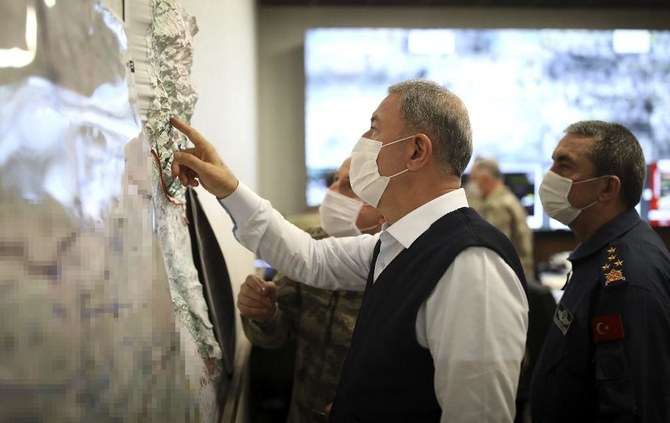
Turkish Minister of Defense Hulusi Akar looks at a map during the military operation ‘Claw-Tiger’, an air and ground offensive against Kurdish rebels in northern Iraq, on June 17, 2020. (Turkish Ministry of Defense Press Office via AFP)
Short Url
Updated 18 June 2020
Follow

Iraq demands Turkey to ‘stop bombardment, withdraw forces’ from north

  • Baghdad also summoned Iranian envoy Iraj Masjedi in protest over its shelling of Kurdish areas

BAGHDAB: Baghdad on Thursday demanded Ankara immediately halt its assault in northern Iraq, where Turkish special forces and helicopters have been targeting Kurdish rebel hideouts.

Turkey early Wednesday launched a cross-border operation into the mountainous regions of northern Iraq where the Kurdistan Workers’ Party (PKK), considered by Ankara to be a “terrorist” group, is thought to be hiding out.

Iraq’s foreign ministry summoned the Turkish ambassador on Thursday and handed him a “strongly-worded memorandum calling for a halt to such provocative actions.”

“We stress that Turkey must stop its bombardment and withdraw its attacking forces from Iraqi territory,” the ministry said in a statement.

“We affirm our categorical rejection of these violations.”

Iraq on Thursday also summoned Iran’s envoy Iraj Masjedi in protest over its shelling of Kurdish areas on Tuesday.

The foreign ministry statement urged Iran “respect Iraq’s sovereignty and stops these types of actions.”

“This ministry affirms Iraq is keen to maintain and develop the historical ties between the two countries, and also stresses its condemnation of these actions,” the ministry said.

Tehran has cultivated close political, military and economic ties with Iraqi leaders over decades, including with top Kurdish officials.

Iran, which has its own minority Kurdish population, has also been fighting Kurdish rebels who use neighboring Iraq as a base to mount attacks inside the country.

Its Revolutionary Guards last month mounted an operation against rebels in Iran’s western province of Kurdistan.

Thursday marked the second time in a week that Baghdad summoned Turkish ambassador Fatih Yildiz.

He was also called to the foreign ministry on Tuesday following Turkish bombardment in northern Iraq, also against PKK hideouts.

After that meeting, Yildiz said he had told Iraqi officials that if Baghdad did not take action against the rebels, Ankara would continue to “fight the PKK wherever it is.”

The PKK has fought an insurgency against the Turkish state since 1984, using the rugged mountains of neighboring northern Iraq as a rear base.

It has a tense relationship with the semi-autonomous Kurdish government in Iraq’s north (KRG), which see the PKK as a rival but have been unable to uproot it from the area.

Analysts say the Turkish operation, dubbed “Claw-Tiger,” could not have taken place without the KRG’s tacit approval.

There has been no comment from Iraq’s new Foreign Minister Fuad Hussein, himself a Kurd who is close to top KRG authorities.


First responders enter devastated Aleppo neighborhood after days of deadly fighting

Updated 12 January 2026
Follow

First responders enter devastated Aleppo neighborhood after days of deadly fighting

  • The US-backed SDF, which have played a key role in combating the Daesh group in large swaths of eastern Syria, are the largest force yet to be absorbed into Syria’s national army

ALEPPO, Syria: First responders on Sunday entered a contested neighborhood in Syria’ s northern city of Aleppo after days of deadly clashes between government forces and Kurdish-led forces. Syrian state media said the military was deployed in large numbers.
The clashes broke out Tuesday in the predominantly Kurdish neighborhoods of Sheikh Maqsoud, Achrafieh and Bani Zaid after the government and the Syrian Democratic Forces, the main Kurdish-led force in the country, failed to make progress on how to merge the SDF into the national army. Security forces captured Achrafieh and Bani Zaid.
The fighting between the two sides was the most intense since the fall of then-President Bashar Assad to insurgents in December 2024. At least 23 people were killed in five days of clashes and more than 140,000 were displaced amid shelling and drone strikes.
The US-backed SDF, which have played a key role in combating the Daesh group in large swaths of eastern Syria, are the largest force yet to be absorbed into Syria’s national army. Some of the factions that make up the army, however, were previously Turkish-backed insurgent groups that have a long history of clashing with Kurdish forces.
The Kurdish fighters have now evacuated from the Sheikh Maqsoud neighborhood to northeastern Syria, which is under the control of the SDF. However, they said in a statement they will continue to fight now that the wounded and civilians have been evacuated, in what they called a “partial ceasefire.”
The neighborhood appeared calm Sunday. The United Nations said it was trying to dispatch more convoys to the neighborhoods with food, fuel, blankets and other urgent supplies.
Government security forces brought journalists to tour the devastated area, showing them the damaged Khalid Al-Fajer Hospital and a military position belonging to the SDF’s security forces that government forces had targeted.
The SDF statement accused the government of targeting the hospital “dozens of times” before patients were evacuated. Damascus accused the Kurdish-led group of using the hospital and other civilian facilities as military positions.
On one street, Syrian Red Crescent first responders spoke to a resident surrounded by charred cars and badly damaged residential buildings.
Some residents told The Associated Press that SDF forces did not allow their cars through checkpoints to leave.
“We lived a night of horror. I still cannot believe that I am right here standing on my own two feet,” said Ahmad Shaikho. “So far the situation has been calm. There hasn’t been any gunfire.”
Syrian Civil Defense first responders have been disarming improvised mines that they say were left by the Kurdish forces as booby traps.
Residents who fled are not being allowed back into the neighborhood until all the mines are cleared. Some were reminded of the displacement during Syria’s long civil war.
“I want to go back to my home, I beg you,” said Hoda Alnasiri.