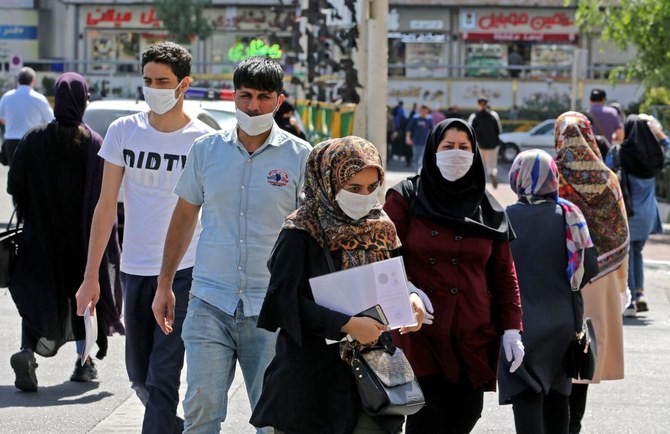
Iran reports over 100 coronavirus deaths for fourth day

Iran reported its first coronavirus cases on February 19, and it has since struggled to contain the outbreak. (AFP)
Short Url
Updated 17 June 2020
Follow

Iran reports over 100 coronavirus deaths for fourth day

  • This is Iran’s highest single-day death toll since April 11

TEHRAN: Iran on Wednesday reported more than 100 deaths from the coronavirus for a fourth straight day, saying that gatherings in high-risk provinces have led to a spike in infections.
“Holding gatherings such as weddings and funerals is one of the main causes of increased coronavirus infections in red provinces,” the highest level on Iran’s color-coded risk scale, said deputy health minister Iraj Harirchi.
“In one province, 120 people were infected at a single wedding,” the ISNA news agency quoted him as saying.
Health ministry spokeswoman Sima Sadat Lari said 120 new deaths in the past 24 hours took Iran’s overall toll to 9,158.
This is Iran’s highest single-day death toll since April 11.
Lari added that another 2,612 tested positive for COVID-19, bringing total confirmed cases to 195,051.
Iran reported its first coronavirus cases on February 19, and it has since struggled to contain the outbreak.
Official figures have shown a rising trajectory in new confirmed cases since early May, when Iran hit a near two-month low in daily recorded infections.
There has been skepticism at home and abroad about Iran’s official figures, with concerns the real toll could be much higher.


New poll shows only 6% of Arabs accept recognizing Israel

Updated 19 sec ago
Follow

New poll shows only 6% of Arabs accept recognizing Israel

  • Reasons ‘mainly linked to its colonial, racist, and expansionist nature’
  • More than 40,000 people in 15 Arab countries surveyed on wide range of issues

CHICAGO: Eighty-seven percent of citizens in the Arab world oppose recognition of Israel while only 6 percent accept it, according to a new survey by the Arab Center Washington DC.

The 2025 Arab Opinion Index, conducted nine times since 2011, surveyed more than 40,000 people in 15 Arab countries on a wide range of issues including politics, economy and identity. 

“An overwhelming majority … oppose recognition of Israel,” Tamara Kharroub, deputy executive director and senior fellow at the ACW, said during a live webinar on Tuesday attended by Arab News.

That finding has been consistent and within range in every poll conducted since 2014, according to the center’s polling data.

The 15 countries surveyed are Algeria, Egypt, Iraq, Jordan, Kuwait, Lebanon, Libya, Mauritania, Morocco, Palestine, Qatar, Saudi Arabia, Sudan, Syria and Tunisia. 

The highest rates of opposition to recognizing Israel were recorded in Libya (96 percent), Jordan (95 percent), Kuwait (94 percent) and Palestine (91 percent).

A conclusion cited in the poll said: “Those who opposed recognizing Israel cited various factors, mainly linked to its colonial, racist, and expansionist nature and its continued occupation of Palestinian territory. Cultural or religious explanations were largely absent.

“The reasons cited by respondents clearly indicated that their position on recognizing Israel is not likely to change as long as its colonial nature persists.”

Kharroub said the number that accept recognition of Israel “dropped by 2 percentage points in the 2025 Arab Opinion Index, compared to the 2022 survey.”

She added of those 6 percent, “half made such a move conditional on the formation of an independent Palestinian state.”

Yousef Munayyer, ACW’s head of the Palestine / Israel Program and senior fellow, said: “Israel continues to be widely perceived as a threat and not a partner. This is something that has only been escalated in recent years.”

He added: “Normalization lacks popular legitimacy, not just because of the lack of support for it among Arab public opinion, but also because the threat perception in the region has changed significantly over the last several years, and that’s perhaps one of the most important developments since the genocide in Gaza began.”

Seventy percent oppose a peace deal between Syria and Israel that does not include the return of the Syrian Golan Heights.

Other findings include the broader public view that despite different nationalities, 76 percent of respondents see the Arab world as being a “single nation” or an “Arab nation.”

The full survey report can be viewed at www.ArabCenterDC.org.