

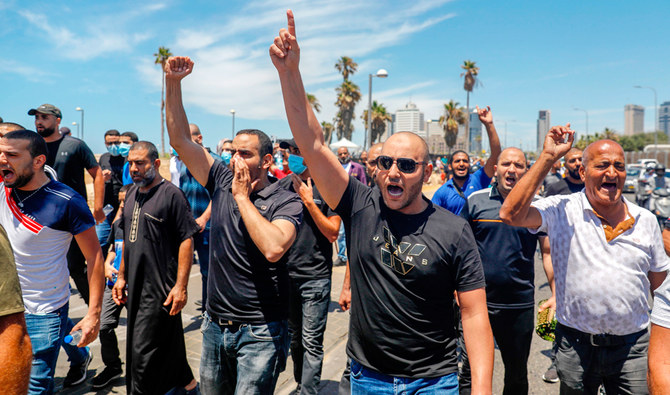
Protests continue over razing Jaffa Muslim Cemetery

Protesters take to the streets of the Israeli coastal city of Jaffa, south of Tel Aviv, following the Friday noon prayers, to protest against an Israeli decision to demolish an 18th century Muslim burial ground to build a new homeless shelter and commercial space on the site. (AFP)
Short Url
Updated 15 June 2020
Follow

Protests continue over razing Jaffa Muslim Cemetery

  • Municipality representatives quit the local coalition over the demolition order

AMMAN: Palestinians protested for the sixth day in a row in the port city of Jaffa against plans by the Tel Aviv/Jaffa municipality to destroy the Al-Isaaf Muslim cemetery, which dates back to Ottoman times. The Jaffa List, which has been in coalition with the ruling municipality, quit in protest.

Israeli bulldozers started the demolition of the cemetery on Monday, in preparation for building a new housing project. Al-Isaaf Cemetery includes hundreds of graves of Muslims who were laid there before the Israeli occupation of the city in 1948.
A large crowd performed Friday prayers and started a march condemning the Israeli decision to demolish the cemetery located in the north of the city of Yafa.
Sheikh Ekrima Sabri, the imam of Al-Aqsa Mosque, who is currently banned by the Israelis from entering Al-Aqsa, delivered the Friday sermon at the site of the cemetery, noting that exhuming tombs is prevented in Islam.
Sabri told the gathering that “defending cemeteries is defending lands, and defending the dead is defending a legitimate right.”
Knesset Member Sami Abu Shehadeh taped a statement that was posted on Facebook expressing support to the people of Jaffa and hailing the Jaffa List which had the courage to withdraw from the coalition with the municipality of Tel Aviv/Jaffa.

FASTFACTS

• Israeli bulldozers started the demolition of Al-Isaaf Cemetery on Monday, in preparation for building a new housing project.

• The cemetery includes hundreds of graves of Muslims who were laid there before the Israeli occupation of the city in 1948.

• A large crowd performed Friday prayers and started a march condemning the Israeli decision to demolish the cemetery located in the north of the city of Yafa.

Abu Shehadeh said that “protecting our holy sites in Jaffa is not only a right but a responsibility.” The destruction of the cemetery “violates the section in the coalition agreement in which the municipality undertakes to preserve what remains of our architectural and spiritual heritage and the markers of our culture and history.”
The statement ended by calling “upon all the people of Jaffa, from all sectors, to continue the struggle to preserve.”
Abed Al-Kader Abu-Shehade, a member of the Jaffa List, said that recent developments over the Muslim cemetery “reflect the municipality’s violation of the coalition agreement on that issue, its disregard of our reasonable demands and our efforts to reach a settlement.”
Hanna Issa, secretary-general of the Islamic-Christian Council for Jerusalem and the Holy Places, denounced the decision to destroy the cemetery.
He told Arab News that “destroying an old Islamic cemetery to build a shelter for the homeless is yet another sign of the Israelis going after anything that is holy to any religion except the Jewish ones.” Issa said that racism toward Palestinians in Israel was deeply ingrained in policy and practice.


Hamas seeks role for its police in Gaza

Updated 7 sec ago
Follow

Hamas seeks role for its police in Gaza

  • Letter from Hamas assures its 40,000 civil servants and security forces that it is working to incorporate them into the new government
CAIRO: Hamas is seeking to incorporate its 10,000 police officers into a new US-backed Palestinian administration for Gaza, sources say, a demand likely to be opposed by Israel as the militant group debates whether to surrender its ​arms.
Islamist group Hamas retains control of just under half of Gaza following an October ceasefire deal brokered by US President Donald Trump.
The agreement ties further Israeli troop withdrawals to Hamas giving up its weapons.
The 20-point plan to end the war, now in its second phase, calls for the governance of Gaza to be handed to the National Committee for the Administration of Gaza, a Palestinian technocratic body with US oversight that is meant to exclude Hamas.

In a letter to staff on Sunday, seen by Reuters, Gaza’s Hamas-run government urged its more than 40,000 civil servants and security personnel to cooperate with the NCAG but assured them it was working to incorporate them into the new government.
That would include the roughly 10,000-strong Hamas-run police force, four sources familiar with the matter said, a demand that ‌has not been previously ‌reported. Many of them have been patrolling Gaza as Hamas reasserts its grip in areas ‌under its ⁠control.
It ​was not ‌immediately clear whether Israel, which has adamantly rejected any Hamas involvement in Gaza’s future, would agree to the civil and security workers’ inclusion in the NCAG.
Israeli Prime Minister Benjamin Netanyahu’s office did not respond to a request for comment.

Sticking points

Hamas’ plans for its police force and workers point to wide gaps between Hamas and Israel, backed by the US, as Trump pushes ahead with his plans. Last week, Trump hosted a signing ceremony to establish his “Board of Peace” that will serve as a transitional administration to set the framework and coordinate funding for the redevelopment of Gaza. The framework includes a provision barring “foreign terrorist organizations” from participating in governance.
Hamas spokesperson Hazem Qassem told Reuters the group was prepared to hand over governance to the ⁠15-member NCAG and its chair, Ali Shaath, with immediate effect.
“We (have) full confidence that it will operate on the basis of benefiting from qualified personnel and not wasting the rights of anyone who ‌worked during the previous period,” Qassem said, referring to the inclusion of the 40,000 ‍personnel.
The four sources said Hamas is open to the NCAG restructuring ‍ministries and sending some workers into retirement. Mass dismissals risked chaos, the sources said.
Hamas and NCAG Chair Shaath have not yet ‍met in person to discuss governance, a Hamas official said. Shaath’s office did not respond to a request for comment.
Another issue was whether Sami Nasman, the former Palestinian Authority general assigned to oversee security under the NCAG, would be able to operate effectively, a Palestinian official said.
Nasman, originally from Gaza, moved to the occupied West Bank after Hamas routed Palestinian Authority forces from the enclave in 2007 following a brief civil war. A Hamas court in Gaza later sentenced him ​in absentia, accusing him of instigating chaos. Nasman denies this.

Neutralizing arms

Trump’s administration wants to see heavy weapons decommissioned immediately, with “personal arms registered and decommissioned by sector as (the) NCAG police become capable of guaranteeing personal security,” according to a ⁠document shared by the White House last week. A US official said on Tuesday that Hamas fighters would be granted some sort of amnesty.
The militant group is still believed to possess rockets, which several diplomats estimated to number in the hundreds. It is also estimated to possess thousands of light weapons, including rifles.
Hamas recently agreed to discuss disarmament with other Palestinian factions and with mediators, sources said. However, two Hamas officials told Reuters that neither Washington nor the mediators had presented the group with any detailed or concrete disarmament proposal.
A Palestinian official close to the disarmament talks said the US had approached Hamas to explore potential disarmament mechanisms involving parties including Israel, Qatar, Egypt and Turkiye.
“Hamas has spoken about the possibility of neutralising arms, which could be achieved if there is a truce, and it is ready for a long-term ceasefire — five years or a little longer,” the official said.
“But Hamas strongly believes that a serious political negotiation process must begin on Palestinian statehood, whereby weapons and fighters would come under the authority of the State of Palestine,” the official said.
Hamas is not the only militant group in the enclave to possess arms. A source in a Gaza faction allied with Hamas ‌said other groups were discussing disarmament but worried about being left defenseless.
In remarks to parliament on Monday, Netanyahu said that the next phase of the Gaza deal “is not reconstruction.”
Rather, he said, “the next phase is demilitarization of the Strip and disarming Hamas.”