PESHAWAR: Backed by religious leaders and tribal elders, police in northwestern Pakistan are spearheading a campaign to curb rates of honor killings in Kohistan-- a region notorious for the practice in Khyber Pakhtunkhwa province, the region’s top police officer said on Saturday.
According to Human Rights Watch, about 1,000 women are killed in Pakistan each year by family members over perceived damage to “honor.” This can involve fraternizing with men, eloping or any other breach of conservative values that govern women’s modesty in the country.
Earlier this year, when Deputy Inspector General (DIG) of Police Hazara region, Qazi Jamil-ur-Rehman, was posted as police chief for the region, he was surprised to discover a majority of the criminal cases on his roster were registered under ‘honor killings.’
In June, the police chief delegated three of his district level police officers to gather their manpower and reach out to some of the region’s most influential religious clerics and local elders-- who often have final say in meting out justice in the patriarchal tribal communities of Kohistan.
Wearing face masks and sitting a few feet apart in an attempt to stay in line with coronavirus protocols, these ‘corner meetings’ between police and clerics are slated to kick off into a full-fledged anti-honor killings’ campaign in the district next month-- and mosques will be the ultimate platform to get the word out.
“We are holding corner meetings with all stakeholders to build consensus against the practice. We are getting an overwhelming response,” Rehman told Arab News.
“Soon after securing the support of clerics and elders, senior police officers in Kohistan district will swing into action to eliminate honor killings in the region,” he said.
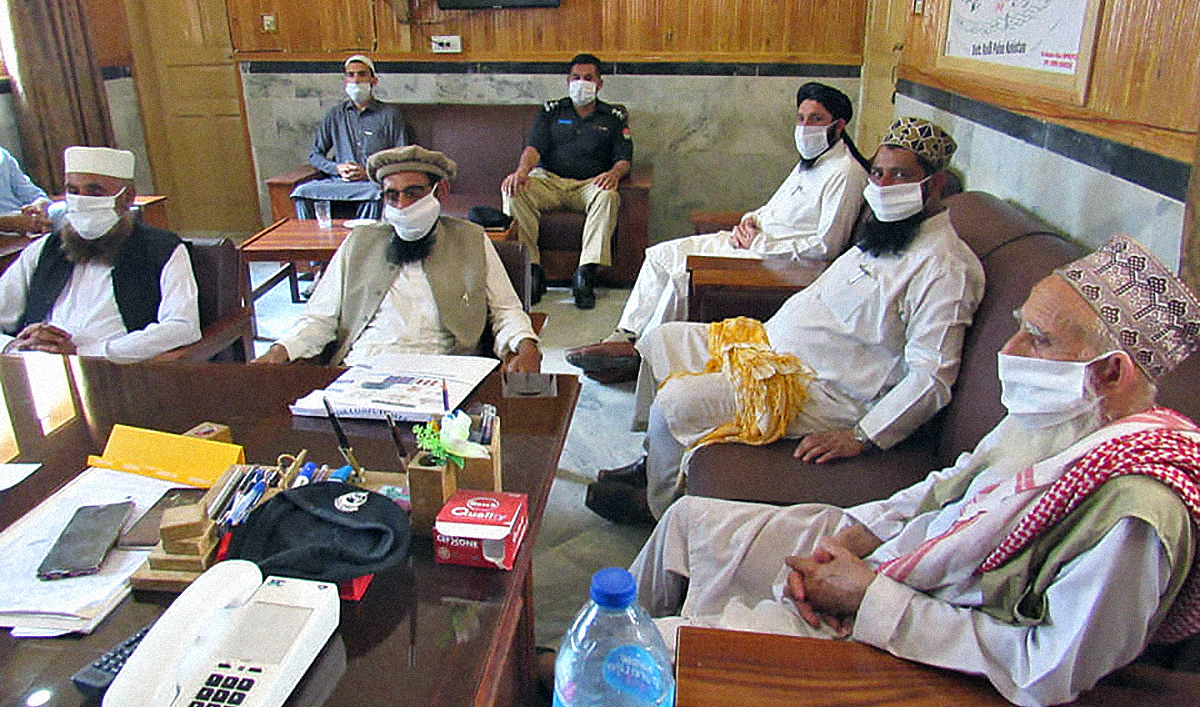
District Police Officer (DPO) Kohistan Muhammad Suleman meets with religious leaders, seeking their support for a police campaign against honor killings in Kohistan on June 9, 2020. (Photo courtesy: Kohistan police)
The plan so far is simple: Police officers will hold meetings with various social leaders for a month, following which mosques will include sermons against the practice of honor killings every Friday during weekly congregational prayers. This will be proceeded by an effective police crackdown on honor killings.
An influential religious leader in Kohistan district, Maulana Ahmad Ali, said he was fully on board with the police chief’s campaign.
“We will educate people from the pulpit of the mosque that killing anybody on mere suspicion is against the basic teachings of Islam,” Ali told Arab News.
“This is an un-Islamic and irrational trend,” he continued. “Honor related cases take place here, triggering a harsh response from the community without investigating or verifying ground realities.”
Kohistan has been notorious for its high rates of honor killings in the province, with one particularly high profile 2011 case that left five women and three men murdered in cold blood following a video of a man dancing at a wedding in front of women made rounds on the internet, in an apparent violation of local segregation customs.
According to the annual Human Rights Commission of Pakistan report released in April this year, women in the country continue to bear the brunt of society’s fixation with ‘honor,’ with legislation on the killings doing little to deter perpetrators so far.
Women’s rights experts say the enforcement of justice meted out is lax, with proceedings often drawn out while accused killers are freed on bail and cases fade away.
Huma Khan, a monitoring and evaluation coordinator at an acclaimed non-profit, Acid Survivors Foundation (ASF), said that despite the police’s commendable initiative in Kohistan, there remained a dire need for reform within the country’s criminal justice system.
“Since last February, almost 20 cases of honor killings have been reported to ASF,” Khan said.
District Police Officer for Lower Kohistan, Muhammad Suleman, told Arab News that his district had been haunted by the practice of honor killings for years, with 59 cases registered with police under the banner of honor in the last five years.
“I have had fruitful meetings with religious leaders who have assured us of their support. I have asked them to convey our anti-honor killings’ message at the grassroots level during Friday congregations,” Suleman said.
Human rights activists are also taking note of the police’s efforts in Kohistan’s remote northern towns.
Samar Minallah Khan, a documentary film-maker and activist, said the campaign was a source of encouragement for women in entirely male-dominated communities.
“The campaign should focus on changing the public mindset. The role of religious leaders and police will help banish these kinds of evils from society. I think, this campaign needs to be extended to the rest of the remote districts,” she said.
Under Kohistan’s ultra-conservative tribal norms, women are not permitted to venture outside of their homes without being chaperoned by a male relative. They are often denied their most basic rights of marriage and inheritance, and feuds are settled outside of courts.
Muhammad Zakaria, a local elder in Kohistan, said he was hopeful the police campaign would minimize rates of honor killings and religious leaders could stamp out the ‘evil practice.’
Currently, he added, many felt proud killing relatives for honor, and often promoted the murderous practice as a family duty.