LONDON: One of the most memorable episodes of one of the most popular British sitcoms of all-time has been withdrawn from a UK streaming service because of numerous racial slurs.
UKTV, a streaming service owned by the BBC, confirmed Friday that it was temporarily removing the 1975 Fawlty Towers episode “The Germans.”
The decision is part of a backlash against racism in the wake of the May 25 death of George Floyd, a black man who died after a white Minneapolis police officer pressed a knee to his neck.
That backlash has been most visibly seen in the protests against statues of slave traders and other historic figures associated with imperialism and racism.
In the episode, hotel owner Basil Fawlty is seen rocking back when a black man approaches him in the hospital where his wife Sybil is readying for an operation on an in-growing toenail, only to find out that he’s the doctor.
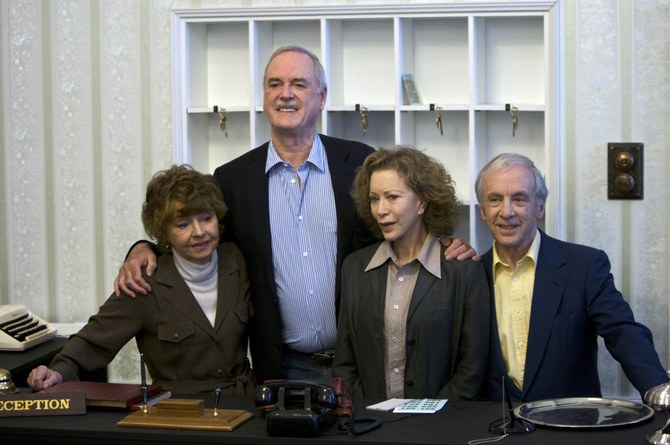
Fawlty, who is played by John Cleese of “Monty Python” fame, is also seen goose-stepping around while shouting “don’t mention the war” in front of a group of visiting Germans after a bout of concussion.
But what’s causing particular offense, is a scene involving one of the hotel’s long-time guests, an elderly major, who uses deeply offensive language about the West Indies and India cricket teams.
“The episode contains racial slurs so we are taking the episode down while we review it,” a spokesman for UKTV said. “We regularly review older content to ensure it meets audience expectations and are particularly aware of the impact of outdated language.”
The spokesman said the company wants to “take time” to consider options. Other shows on the service carry warnings or are edited.
The full episode is still being aired on Netflix and on Britbox, which is half-owned by the BBC, without any warnings or editing.
Cleese has criticized the decision, describing those who fail to see the episode is a critique of racism rather than an endorsement of it as “stupid.”
He told The Age, an Australian newspaper, from his home in Los Angeles, that the major “was an old fossil” from decades past and that the program was making fun of his views.
While questioning attempts to airbrush the past, Cleese expressed his support for the aims of the Black Lives Matter protest movement.
“At the moment there is a huge swell of anger and a really admirable feeling that we must make our society less discriminatory, and I think that part of it is very good,” he said.
The removal of the episode by UKTV follows the decision by HBO Max to temporarily remove the 1939 civil war epic “Gone With The Wind” because of its “racial depictions.”
The BBC has also withdrawn its popular sketch show “Little Britain” because “times have changed” since the comedy first aired in the early 2000s. The series has come under fire because of the use of blackface in some sketches.


Episode of UK sitcom Fawlty Towers pulled over racist slurs
https://arab.news/nz3xg
Episode of UK sitcom Fawlty Towers pulled over racist slurs

- UKTV, a streaming service owned by the BBC, confirmed Friday that it was temporarily removing the 1975 Fawlty Towers episode “The Germans”
- That backlash has been most visibly seen in the protests against statues of slave traders and other historic figures associated with imperialism and racism


OpenAI’s Altman says world ‘urgently’ needs AI regulation
- Sam Altman, head of ChatGPT maker OpenAI, told a global artificial intelligence conference on Thursday that the world “urgently” needs to regulate the fast-evolving technology
NEW DELHI: Sam Altman, head of ChatGPT maker OpenAI, told a global artificial intelligence conference on Thursday that the world “urgently” needs to regulate the fast-evolving technology.
An organization could be set up to coordinate these efforts, similar to the International Atomic Energy Agency (IAEA), he said.
Altman is one of a host of top tech CEOs in New Delhi for the AI Impact Summit, the fourth annual global meeting on how to handle advanced computing power.
“Democratization of AI is the best way to ensure humanity flourishes,” he said on stage, adding that “centralization of this technology in one company or country could lead to ruin.”
“This is not to suggest that we won’t need any regulation or safeguards,” Altman said.
“We obviously do, urgently, like we have for other powerful technologies.”
Many researchers and campaigners believe stronger action is needed to combat emerging issues, ranging from job disruption to sexualized deepfakes and AI-enabled online scams.
“We expect the world may need something like the IAEA for international coordination of AI,” with the ability to “rapidly respond to changing circumstances,” Altman said.
“The next few years will test global society as this technology continues to improve at a rapid pace. We can choose to either empower people or concentrate power,” he added.
“Technology always disrupts jobs; we always find new and better things to do.”
Generative AI chatbot ChatGPT has 100 million weekly users in India, more than a third of whom are students, he said.
Earlier on Thursday, OpenAI announced with Indian IT giant Tata Consultancy Services (TCS) a plan to build data center infrastructure in the South Asian country.