PARIS: The Paris Club of creditor nations have so far waived $1.1 billion euros of debt servicing payments due this year from some of the worlds poorest countries under a G20 deal and more relief is on the way soon, the group said on Wednesday.
The Paris Club said it had agreed to suspend interest and principal repayments from Chad, Ethiopia, Pakistan and Republic of Congo in the latest wave of countries given some financial leeway to help them focus on fighting the coronavirus pandemic.
The Group of 20 leading economies and the Paris Club, an informal group of state creditors coordinated by the French finance ministry, agreed in April to freeze debt payments of the 77 poorest countries this year.
The latest agreements bring to 12 the number of countries to receive debt relief under the deal, with a total of $1.1 billion in debt coming due this year deferred to 2022-2024, the Paris Club said.
“Another 18 are being processed and should be wrapped up quickly,” Paris Club president Odile Renaud-Basso told journalists on a conference call.
G20 creditors not members of the Paris Club, including China, are supposed to waive debt payments bilaterally on the same terms under the deal with the G20.
A decision on whether to extend the payment suspensions would most likely come at a G20 summit in November, though some countries might need an outright reduction of their debt burdens, Renaud-Basso said.
The countries potentially eligible under the deal have $36 billion falling due this year, with $13 billion owed to other governments, $9 billion to private creditors and $14 billion to multilateral lenders, according to World Bank data.


Pakistan among latest countries to get Paris Club debt relief

https://arab.news/bz96u
Pakistan among latest countries to get Paris Club debt relief

- Other countries to benefit from the arrangement include Chad, Ethiopia and Republic of Congo
- Paris Club president Odile Renaud-Basso says some countries might need an outright reduction of their debt burdens
Pakistan air chief highlights modernization as PAF marks seven years since India aerial clash
- Swift Retort was launched in 2019 after India attempted airstrikes following a Kashmir suicide bombing
- Air chief’s remarks come amid fierce clashes between Pakistan and Afghanistan over cross-border militancy
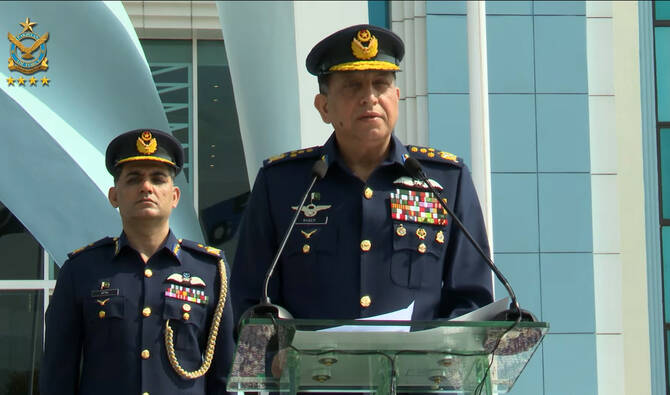
ISLAMABAD: Pakistan’s air chief said on Friday the country’s air force had undertaken “comprehensive modernization and indigenization” in recent years, as he addressed a ceremony at Air Headquarters to mark seven years since an aerial confrontation with India.
Operation Swift Retort was launched on Feb. 27, 2019, a day after India attempted airstrikes inside Pakistan following a suicide bombing in Indian-administered Kashmir that killed at least 40 Indian paramilitary troops.
Pakistan responded with aerial strikes across the Line of Control and shot down an Indian fighter jet in a subsequent dogfight, capturing one pilot who was later returned in what Islamabad called a gesture of de-escalation.
“PAF has pursued comprehensive modernization and indigenization to transition into a Next Generation Air Force,” Air Chief Marshal Zaheer Ahmed Baber Sidhu said, according to a statement circulated by the military’s media wing, the Inter-Services Public Relations.
He added that the force had recalibrated its operational doctrine and rapidly inducted advanced combat and support capabilities, including indigenously developed unmanned systems, electronic warfare, space and cyber assets, establishing what he described as a “home-grown multi-domain kill chain.”
Sidhu said Pakistan remained committed to peace but would respond decisively to violations of its sovereignty.
“Pakistan is a responsible country which desires peace with honor,” he continued.
The remarks come amid renewed security tensions on Pakistan’s western frontier.
Islamabad earlier this week launched airstrikes inside Afghanistan targeting what it described as hideouts of Tehreek-e-Taliban Pakistan (TTP) and Daesh militants. Afghan authorities condemned the strikes and subsequently launched their own military response that led to fierce clashes between the two sides overnight.
Pakistan has frequently accused Kabul of allowing militant groups to use Afghan territory to carry out cross-border attacks on Pakistani civilians and security forces, an allegation denied by Afghan officials.
Pakistani authorities said earlier in the day small drones launched from the Afghan side were intercepted and brought down by the country’s air defense systems.
Sidhu said the PAF would continue to maintain a vigilant yet responsible defense posture to safeguard national sovereignty.