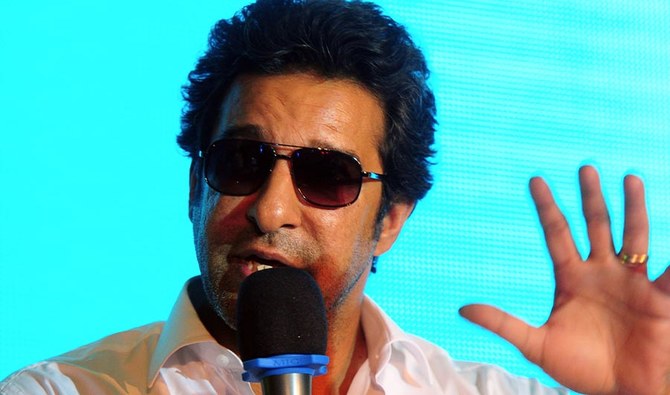
KARACHI: Legendary Pakistan paceman Wasim Akram warned Wednesday that bowlers would become “robots” after cricket officials temporarily banned shining the ball with saliva as a coronavirus precaution.
Bowlers traditionally get the ball to move or swing in the air by applying shine to one side using sweat or saliva.
The International Cricket Council, however, has temporarily banned the practice over virus transmission fears as teams prepare to return to the pitch in the coming weeks.
Players can still apply sweat to the ball.
“It will make bowlers robots, coming and bowling without swing,” Akram told AFP, saying they would have to be patient and wait for the ball to age naturally.
“It’s a quizzical situation for me as I grew up using saliva to shine the ball and to swing it,” he added.
“I am all for precautions in these tough times, so bowlers have to wait for the ball to get old and rough for them to get swing.
Sweat alone was unlikely to generate swing as in some countries it was too cold, said Akram.
“Sweat is just something of an add-on, a top-up. Too much use of sweat will leave the cricket ball too wet,” he said.
Akram, who took 414 Test and 502 one-day international wickets in a storied career, believes artificial substance could potentially help as he encouraged officials to keep searching for alternatives.
“I believe that they will need to find a reasonable solution. Artificial substances like vaseline could be used to swing the ball but how much of it?
“Let’s see, we have this England versus the West Indies series to judge how it goes, because I have never experienced this thing.”
International cricket resumes with England hosting the West Indies in a Test series later this month.
Akram said suggestions that limited ball-tampering be allowed should also be considered by officials.
“When can you tamper the ball? Right from the first over or after 20-25 overs? They will need to sit down and do brainstorming,” he added.
“The game is already tilted more in favor of the batsmen.”

Pakistan’s Akram warns saliva ban will make bowlers ‘robots’
https://arab.news/p8725
Pakistan’s Akram warns saliva ban will make bowlers ‘robots’
- Players can still apply sweat to the ball
- International Cricket Council has temporarily banned the practice over virus transmission fears
Dakar Rally Saudi Arabia 2026 countdown begins ahead of Jan. 3 start
- * Redesigned course introduces fresh challenges that will raise the intensity of competition
- * Event highlights Kingdom’s aims of becoming a global leader in motorsport, says Prince Khalid bin Sultan Al-Abdullah Al-Faisal, SAMF chairman
JEDDAH: The countdown for Dakar Rally Saudi Arabia 2026, one of the world’s toughest rally events, has begun with less than a month remaining before the seventh consecutive edition hosted in the Kingdom gets underway.
The rally will take place from Jan. 3-17 under the supervision of the Ministry of Sport. It will be organized by the Saudi Automobile and Motorcycle Federation and promoted by the Saudi Motorsport Company.
Global attention will be focused on the rally as competitors prepare for a gruelling test across Saudi Arabia’s vast and varied terrain.
The upcoming edition is set to be one of the most distinctive yet, featuring a new route that will give competitors the chance to experience the Kingdom’s natural beauty, varied landscapes and historic sites.
The redesigned course introduces fresh challenges that will raise the intensity of competition, adding excitement throughout every stage.
Prince Khalid bin Sultan Al-Abdullah Al-Faisal, chairman of the Saudi Automobile and Motorcycle Federation and the Saudi Motorsport Company, said: “The Dakar Rally is more than just a race; it is part of the Kingdom’s ambitious journey toward becoming a global leader in motorsport.”
This year’s rally marked a pivotal moment for Saudi motorsport when Yazeed Al-Rajhi became the first Saudi driver to claim the title in the cars category.
“It’s a milestone we are all proud of and hope to see repeated next year,” Prince Khalid said.
The SAMF chairman added: “What makes us especially proud this year is the rising number of Saudi drivers taking part, a clear indication of the success of our talent-development initiatives and next-generation programs. These achievements are the result of national efforts we all take pride in.”
Dakar Saudi Arabia 2026 will welcome 812 competitors representing 69 countries, competing with 433 vehicles across eight categories: Ultimate B, Ultimate, Stock, Challenger, Side-by-Side, Trucks, in addition to motorbikes and quad bikes. The rally will cover a total distance of 7,999 km, including 4,845 km of timed special stages.
Competition begins on Jan. 3, with a 23 km prologue stage in Yanbu, followed by stage 1 on Jan. 4 over 305 km starting and finishing in Yanbu.
Stage 2 will take place on Jan. 5 from Yanbu to AlUla (400 km), with stage 3 held in AlUla on Jan. 6 (422 km). Stage 4 follows on Jan. 7 from AlUla to the Marathon Camp (451 km).
Stage 5 runs on Jan. 8 from the Marathon Camp to Hail (372 km), and stage 6 on Jan. 9 from Hail to Riyadh (336 km).
Jan. 10 will be a rest day for the competitors in Riyadh.
Action continues Jan. 11 with stage 7 from Riyadh to Wadi Al-Dawasir (462 km), followed by stage 8 on Jan. 12 in Wadi Al-Dawasir (481 km). Stage 9 will run on Jan. 13 January toward the Marathon Camp (410 km). The rally moves on to stage 10 on Jan. 14 from the Marathon Camp to Bisha (421 km), then stage 11 on Jan. 15 from Bisha to Al-Hanakiyah (347 km).
Stage 12 follows on Jan. 16 January from Al-Hanakiyah to Yanbu (310 km), before the event concludes with the 13th and final stage in Yanbu on Jan. 17, covering 105 km.
All distances listed refer to timed special stages.


