

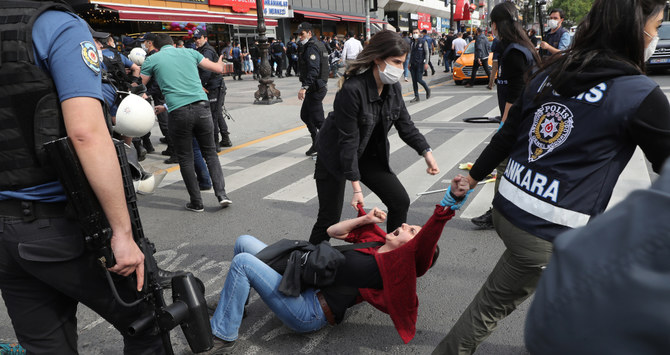
Two journalists arrested in Turkey over ‘military espionage’

Turkey is ranked as one the top jailers of journalists worldwide. (FILE/AFP)
Short Url
Updated 09 June 2020
Follow

Two journalists arrested in Turkey over ‘military espionage’

  • No details were disclosed about which nations they were spying for, or the alleged spying activities they were conducting.

JEDDAH: Two dissident Turkish journalists, Ismail Dukel and Muyesser Yildiz, had their digital materials seized and were detained over allegations of military espionage early on Monday.

The news came amid a new crackdown on media in Turkey, which is ranked as one the top jailers of journalists worldwide.

Yildiz, the Ankara bureau chief of the pro-opposition ODA TV news portal, and Dukel, the Ankara representative of TELE 1 TV channel, were taken into custody following investigations by the Ankara Prosecution Office.

No details were disclosed about which nations they were spying for, or the alleged spying activities they were conducting.

However, pro-government newspaper Sabah claimed that Yildiz spoke to a military personnel 29 times by her own phone — sparking debate about whether the phone callings of journalists are wiretapped.

“The Mafia is free outside, the gangs are outside, the harassers are outside, the scammers are outside, the killers are outside, the thieves are outside, but journalists and politicians are kept inside,” said Alpay Antmen, a lawmaker from the main opposition Republican People’s Party (CHP).

Three other journalists from ODA TV have been held since March over a report about the identity of two Turkish spies killed in Libya, despite their names being revealed in the Turkish parliament a week earlier.

“The arrest of a journalist who could have given his testimony upon invitation from a prosecutor doesn’t and shouldn’t exist in democracies,” said Merdan Yanardag, chief editor of TELE 1 TV, adding that the detentions were meant to threaten independent media in the country.

Yildiz, who was fined for a story she wrote in March, was a vocal critic of the government, which she accused of mishandling counterterrorism efforts.

Turkish Interior Minister Suleyman Soylu responded to her work, claiming she is “pro-PKK (Kurdistan Workers’ Party) terror group.”

He said: “What I am disappointed in is not your affection for the PKK, but the fact that you’re doing business with those in the state.”

The Parliamentary Assembly of the Council of Europe reported on May 22 that there were 95 journalists jailed in Turkey, more than in any country in the world.

Press in Arrest, a volunteer group monitoring investigations and trials of journalists, recently released its Press Freedom report for May.

“Although court hearings were postponed due to the coronavirus outbreak, prosecution of journalists and fines on critical news outlets continued in May,” the report said.

It added that debates about press freedom turned around the penalties imposed by the Radio and Television Supreme Council and Press Advertisement Institution, more than the criminal prosecution of journalists.

“However, having become the government’s instrument of oppression, the judiciary continued to prosecute journalists relentlessly,” the report added.

Advertisements are a significant source of income for opposition media. Cumhuriyet newspaper was recently deprived of publishing tender notices from the government for three months following a row with Turkish presidential communications chief Fahrettin Altun. The paper was accused of violating press ethics.

On June 4, the International Press Institute and 19 other international press freedom and freedom of expression groups sent a joint letter to Turkey’s advertisement agency to call for a fair distribution of public ads in local and national newspapers.


Grok faces more scrutiny over deepfakes as Irish regulator opens EU privacy investigation

Updated 17 February 2026
Follow

Grok faces more scrutiny over deepfakes as Irish regulator opens EU privacy investigation

  • The regulator says Grok has created and shared sexualized images of real people, including children. Researchers say some examples appear to involve minors
  • X also faces other probes in Europe over illegal content and user safety

LONDON: Elon Musk’s social media platform X faces a European Union privacy investigation after its Grok AI chatbot started spitting out nonconsensual deepfake images, Ireland’s data privacy regulator said Tuesday.
Ireland’s Data Protection Commission said it notified X on Monday that it was opening the inquiry under the 27-nation EU’s strict data privacy regulations, adding to the scrutiny X is facing in Europe and other parts of the world over Grok’s behavior.
Grok sparked a global backlash last month after it started granting requests from X users to undress people with its AI image generation and editing capabilities, including putting females in transparent bikinis or revealing clothing. Researchers said some images appeared to include children. The company later introduced some restrictions on Grok, though authorities in Europe weren’t satisfied.
The Irish watchdog said its investigation focuses on the apparent creation and posting on X of “potentially harmful” nonconsensual intimate or sexualized images containing or involving personal data from Europeans, including children.
X did not respond to a request for comment.
Grok was built by Musk’s artificial intelligence company xAI and is available through X, where its responses to user requests are publicly visible.
The watchdog said the investigation will seek to determine whether X complied with the EU data privacy rules known as GDPR, or the General Data Protection Regulation. Under the rules, the Irish regulator takes the lead on enforcing the bloc’s privacy rules because X’s European headquarters is in Dublin. Violations can result in hefty fines.
The regulator “has been engaging” with X since media reports started circulating weeks earlier about “the alleged ability of X users to prompt the @Grok account on X to generate sexualized images of real people, including children,” Deputy Commissioner Graham Doyle said in a press statement.
Spain’s government has ordered prosecutors to investigate X, Meta and TikTok for alleged crimes related to the creation and proliferation of AI-generated child sex abuse material on their platforms, Spanish Prime Minister Pedro Sánchez said on Tuesday.
“These platforms are attacking the mental health, dignity and rights of our sons and daughters,” Sánchez wrote on X.
Spain announced earlier this month that it was pursuing a ban on access to social media platforms for under-16s.
Earlier this month, French prosecutors raided X’s Paris offices and summoned Musk for questioning. Meanwhile, the data privacy and media regulators in Britain, which has left the EU, have opened their own investigations into X.
The platform is already facing a separate EU investigation from Brussels over whether it has been complying with the bloc’s digital rulebook for protecting social media users that requires platforms to curb the spread of illegal content such as child sexual abuse material.