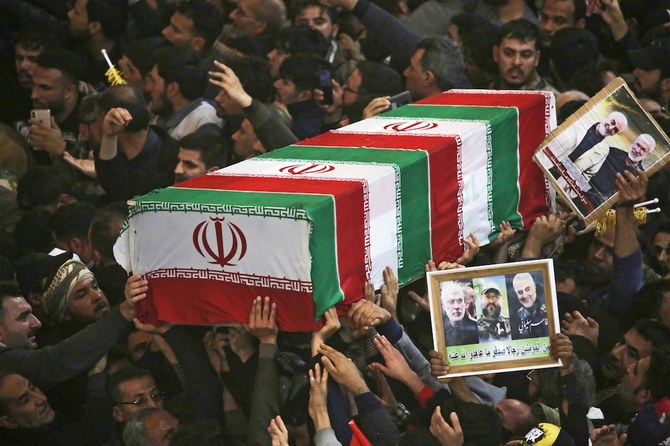

LONDON: Six months ago, a US missile brought to an end the 23-year military career of the Middle East’s most dangerous man: Qassem Soleimani, the “shadow commander.”
As head of the Quds Force, the Islamic Revolutionary Guards Corps’ (IRGC) expeditionary arm, Soleimani and his unit built a reputation for brutality in foreign theaters from Aleppo to Sanaa. The Quds’ network of proxies assassinated foreign politicians, laid siege to cities and fomented chaos across the Middle East.
In pursuit of the so-called Islamic Revolution, it seemed that Soleimani would stop at nothing.
But after six months without its infamous commander, evidence is mounting that the Quds Force’s power and corrosive influence may be in decline.
Prior to his death, Soleimani’s centrality to the military and foreign policy apparatus of the Islamic Republic could not be overstated, Dr Nima Mina, Professor of Iranian Studies at the School of Oriental and African Studies in London, told Arab News.
“Soleimani was the second most powerful man in Iran, you could say that about him,” he said. “But you definitely cannot say that about Esmail Qaani, his replacement.”
Supreme Leader Ali Khamenei prioritised a smooth transition when he named then-deputy Qaani as the new head of the Quds Force the day after Soleimani’s death. However, this came at a cost.
On his inauguration, Qaani promised to continue working toward Soleimani’s central goal: to remove the US presence from the region. But Qaani, historically an Afghanistan specialist, does not speak Arabic, and did not play a prominent role in the 1979 revolution.
His low profile and lack of experience in the Middle East immediately raised serious questions over his ability to follow in the footsteps of Soleimani.
Six months since his promotion, Mina says, those doubts have played out: “Iran’s strategy in the region hasn’t changed, but they are in a much weaker position to achieve their strategic goals.
“Soleimani acted like a pop star, posing for pictures wherever he went. Qaani’s behaviour is more professional,” he said. “But he doesn’t have Soleimani’s ability to bring together people and to attract new recruits.”
Qaani, Mina adds, may be competent and experienced in managing Afghanistan and Pakistan, but “he’s not an expert in the critical areas west of Iran that the Quds Force is engaged: Iraq, Syria, Lebanon, and Yemen. Qaani doesn’t even speak Arabic.”
The results, particularly in Syria and Iraq, have been tangible.
In May, Mina told Arab News, one of the most senior officers of the Quds Force’s Syrian deployment — Brigadier Asghar Pashapour — was killed by Israel.
Israel has ramped up its air campaign against Iran in the country, but “the (Iranian) regime hides these deaths from their own people, who only find out about them when the funerals take place.”
More than ever, Mina adds, Israel is acting against Tehran with impunity.
The IRGC’s men on the ground in the war-torn country, deprived of their charismatic commander, are losing morale. By monitoring social media channels, Mina said, it has become clear that “among young members of the Basij (IRGC militia) in Syria, the mood is very low; they’re pessimistic.”
In Iraq, Tehran’s influence appears more stretched than ever. The Quds Force has faced a series of setbacks almost unimaginable under Soleimani.
Two attempts to install an Iran-friendly prime minister ended with failure, mass protests and Iranian consulates going up in flames.
Iran has now been forced to reckon with a US-friendly human rights activist prime minister — a man rumored to have provided the US with intelligence that led to the killing of Soleimani.
Worse yet, Iran’s control over the powerful Iraqi militias, the Popular Mobilization Forces (PMF), shows signs of unravelling.
------
READ MORE: The strike on Iran’s Soleimani
------
Iraq’s UN envoy has affirmed that the new government’s priority is “restricting weapons to state hands” and consolidating Iraqi sovereignty.
In the Iran-Iraq war, Soleimani fought side by side with many of the men that would go on to become senior PMF leaders. The loss of these connections, coupled with a more assertive Iraqi government, threatens Iranian influence in their own backyard.
“In particular in Iraq,” Ali Alfoneh, Senior Fellow at the Arab Gulf States Institute in Washington, told Arab News, “the simultaneous killings of Major General Suleimani and (Iran-backed Kataib Hezbollah leader) Abu-Muhandis caused some trouble for the Quds Force.
“Qaani lacks Soleimani's deep personal relationship with PMF commanders to facilitate a smooth transition to a new leadership.
“Militia leaders had difficulties recognizing a peer as first among equals to succeed Abu-Muhandis as PMF chief.”
Opinion
This section contains relevant reference points, placed in (Opinion field)
Soleimani’s death, Alfoneh says, has resulted in greater, more visible rifts among factions within the PMF.
Units loyal to Iraqi Grand Ayatollah Sistani have been increasingly open in their challenges to the leadership of the Iran-backed successor to Abu-Muhandis, Abu Fadak.
Without Soleimani’s cult of personality and ties to the leaders of various PMF militias, Alfoneh suggests there is potential for Iraqi proxies to stray even further from their Iranian patrons in the future.
“In the longer term, should the Islamic Republic find it difficult to continue its financing, arming and providing logistical support to the militias, we may see defections,” Alfoneh told Arab News.
Despite the last six months of setbacks, however, Dr. Sanam Vakil, deputy director of the Middle East and North Africa Programme at Chatham House, cautioned that Iran “doesn’t walk away from its investments.”
“Iran’s influence through Soleimani had been based on the personal nature of relationships; this is where he was so important,” she told Arab News.
Iran is trying to adapt to these changes, changing its tactics in order to be more present and relevant.
Dr. Sanam Vakil, Deputy director of the Middle East and North Africa Program at Chatham House, UK
Now, Vakil says, they are attempting to mobilize a network of other senior figures — including Hezbollah Leader Hassan Nazrallah, Former Iranian Defence Minister Ali Shamkhani, as well as new Quds Force commander Esmail Qaani — to leverage influence in the post-Soleimani era.
This, Vakil explains, is part of a tactical shift taking place in how Iran manages its regional relationships without Soleimani.
“Soleimani could command and control,” she said.
“His personal connections provided an indisputable advantage. So over the past six months, the Islamic Republic’s relationships with its regional proxies have had to adjust and become more fluid.”
Vakil adds that Soleimani’s death forced some of these changes, but the coronavirus pandemic, the new Iraqi government and “changing dynamics on the ground in Lebanon and Syria” have also been instrumental.
“Iran is trying to adapt to these changes, changing its tactics in order to be more present and relevant,” Vakil said.
“We’re still waiting to see how this will play out.”
Soleimani’s death hurt Iran. It ushered in six months of foreign-policy failure, domestic strife during the coronavirus pandemic and a slow-motion economic collapse within Iran.
Without the “shadow commander,” the regime’s grip on its proxies and regional influence appear to be in retreat.
It would be premature, however, to count Tehran out completely.
------------