

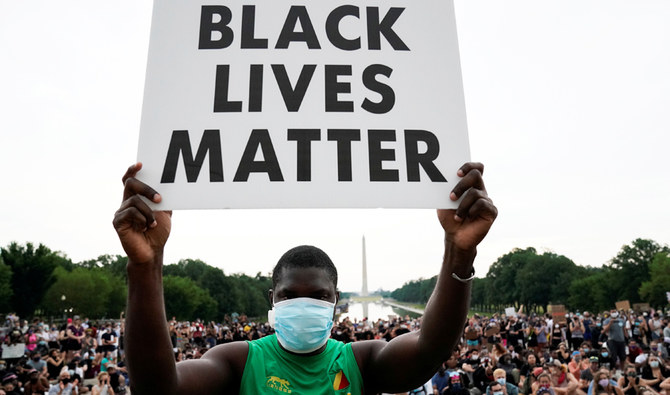

WASHINGTON: US protests sparked by George Floyd’s fatal encounter last month with Minneapolis police crossed a new threshold as weekend rallies demanding racial justice stretched from Washington, DC, to an east Texas town once a haven for the Ku Klux Klan.
They also inspired anti-racism protests around the globe, as demonstrators from Brisbane and Sydney in Australia to London, Paris and other European cities embraced the Black Lives Matter message.
In Washington, tens of thousands of people chanting “I can’t breathe” and “Hands up, don’t shoot” rallied at the Lincoln Memorial and marched to the White House on Saturday in the biggest protest yet during 12 days of demonstrations across the US since Floyd died.
A common message of the day was a determination to transform outrage generated by Floyd’s death into a broader movement seeking far-reaching reforms in the US criminal justice system as a whole.
“It feels like I get to be a part of history and a part of people who are trying to change the world for everyone,” said Jamilah Muahyman, a Washington resident protesting near the White House.
The gatherings in Washington and dozens of other US cities and towns — urban and rural alike — were also notable for a generally lower level of tension and discord than what was seen during much of the preceding week.
There were sporadic instances in some cities of protesters trying to block traffic. And police in riot gear used flash-bang grenades in a confrontation with demonstrators in Seattle.
But largely it was the most peaceful day of protests since video footage emerged on May 25 showing Floyd, an unarmed black man in handcuffs, lying face down on a Minneapolis street as a white police officer knelt on his neck.
The video sparked an outpouring of rage as protests in Minneapolis spread to other cities, punctuated by episodes of arson, looting and vandalism that authorities and activists blamed largely on outside agitators and criminals.
FASTFACT
A common message of the day was a determination to transform outrage generated by Floyd’s death into a broader movement seeking far-reaching reforms in the US criminal justice system as a whole.
Police had at times resorted to heavy-handed tactics as they sought to enforce curfews in some cities, which served to galvanize the demonstrators even further.
The intensity of protests over the past week began to ebb on Wednesday after prosecutors in Minneapolis had arrested all four police officers implicated in Floyd’s death. Derek Chauvin, the white officer seen pinning Floyd’s neck to the ground for nearly nine minutes as Floyd repeatedly groaned “I can’t breathe” was charged with second-degree murder.
Still anger in Minneapolis remained intense. The city’s mayor ran a gauntlet of angry, jeering protesters on Saturday after telling them he was opposed to their demands for de-funding the city police department.
Perhaps nowhere was the evolving, multi-racial dimension of the burgeoning movement in the country more evident than in the small, east Texas town of Vidor, one of hundreds of American communities once known as “sundown towns,” where black people were unwelcome after dark.
Several dozen white and black protesters carrying “Black Lives Matter” signs demonstrated in a place once notorious as a Ku Klux Klan stronghold, highlighting the scope of the calls for racial justice echoing across the country five months before the Nov. 3 US presidential election.
Elsewhere in the South, in Floyd’s birthplace of Raeford, North Carolina, hundreds lined up at a church to pay their respects during a public viewing of his body prior to a private memorial service for family members.
Floyd’s funeral is scheduled for Tuesday in Houston, where he lived before relocating to the Minneapolis area.
In New York, a large crowd of protesters crossed the Brooklyn Bridge into lower Manhattan on Saturday afternoon, marching up a largely deserted Broadway. Thousands of others gathered in Harlem to march downtown, about 100 blocks, to the city’s Washington Square Park.
Police officers were present but in smaller numbers than earlier in the week. They generally assumed a less aggressive posture, wearing patrol uniforms rather than body armor and helmets.
In another sign of easing tension, Maj. Gen. William Walker, commander of the D.C. National Guard, told CNN that the nearly 4,000 additional Guard troops deployed to the city from 11 states at the Pentagon’s request were likely to be withdrawn after the weekend.


