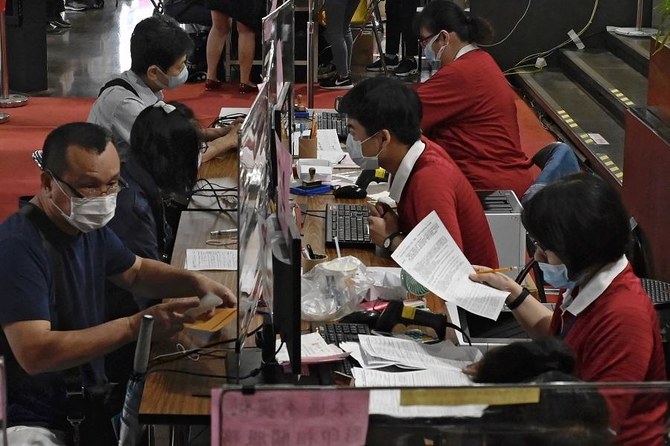
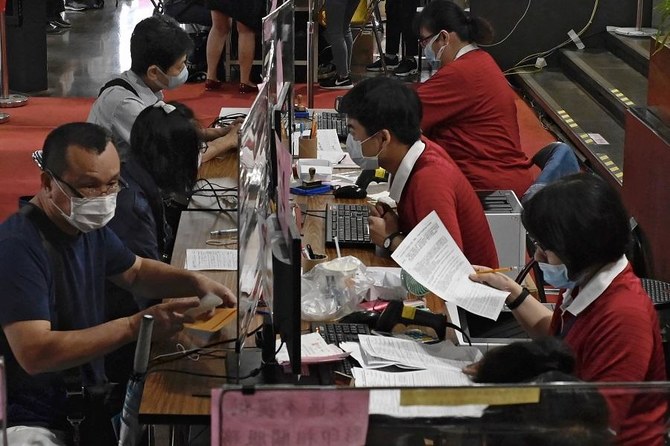
TAIPEI: Taiwan will further ease its restrictions related to control of the coronavirus, the government said on Sunday, as the island has kept the pandemic well in hand with only 6 active cases and no local transmission for 56 days.
Taiwan has never gone into total lockdown and life has continued largely as normal due to its early and effective prevention work and a first rate public health system, but has promoted social distancing and ensured broad public access to face masks.
Taiwan’s Central Epidemic Command Center said that it would lift restrictions limiting the number of people who could participate in “daily life and leisure events,” though people should continue to wear face masks if they were unable to socially distance.
The government has already begun moving in that direction, allowing a limited number of fans to attend sports matches previously played without spectators.
Food service on trains has also resumed.
However, border entry restrictions remain, with authorities wary of a second wave of infections coming in from countries where the pandemic is still raging, such as the United States and Britain.
Taiwan has reported 443 cases, the majority of which were in people who get infected overseas, and just seven deaths.

Taiwan to further ease coronavirus restrictions
Short Url
https://arab.news/96azw
Taiwan to further ease coronavirus restrictions
- Taiwan has never gone into total lockdown
- Taiwan has reported 443 cases, the majority of which were in people who get infected overseas
At least 170 civilians killed in Myanmar air strikes during election: UN
- At least 170 civilians were killed in more than 400 military air strikes conducted in Myanmar during nearly two months surrounding its widely-criticized elections, the United Nations said Friday
GENEVA: At least 170 civilians were killed in more than 400 military air strikes conducted in Myanmar during nearly two months surrounding its widely-criticized elections, the United Nations said Friday.
The UN rights office said “credible sources” had verified that at least “170 civilians were killed in some 408 military aerial attacks reported by open sources during the voting period — between December 2025 and January 2026.”
James Rodehaver, head of the rights office’s Myanmar team, warned that the actual numbers might be higher.
Speaking from Bangkok, he told reporters in Geneva that the verification covered a period from December to late last week, from the beginning of the election campaign and up until the three phases of voting were nearly complete.
But he warned that “because of the way in which communications are cut off and because of, frankly, the fear of individuals in some of these locations to speak to us, it sometimes takes a lot longer to get that information.”
His comments came amid global outrage over Myanmar’s month-long vote that democracy watchdogs dismissed as a rebranding of army rule, five years after a coup that ousted popular democratic figurehead Aung San Suu Kyi.
UN rights chief Volker Turk warned in a statement Friday that “the profound and widespread despair inflicted on the people of Myanmar” since the 2021 coup “has only deepened with the recent election staged by the military.”
He pointed out that “many people chose either to vote or not to vote purely out of fear, flatly at odds with their internationally guaranteed civil and political rights — and with ripple effects on their enjoyment of economic, social and cultural rights.”
“The conflict and insecurity continued unabated in large parts of the country. Opposition candidates and some ethnic groups were excluded,” he said.
His office pointed out that the elections were held in only 263 of 330 townships, and often exclusively in urban centers under military control, and limited in conflict areas.
“As a result, large segments of the population, especially the displaced and minorities, such as the ethnic Rohingya, were excluded,” it pointed out.
Turk decried that five years of military rule in Myanmar had been “characterised by repression of political dissent, mass arbitrary arrests, arbitrary conscription, widespread surveillance and limitation of civic space.”
“Now, the military is seeking to entrench its rule-by-violence after forcing people to the ballot box,” he said.
“This couldn’t be further from civilian rule.”
The UN rights office said “credible sources” had verified that at least “170 civilians were killed in some 408 military aerial attacks reported by open sources during the voting period — between December 2025 and January 2026.”
James Rodehaver, head of the rights office’s Myanmar team, warned that the actual numbers might be higher.
Speaking from Bangkok, he told reporters in Geneva that the verification covered a period from December to late last week, from the beginning of the election campaign and up until the three phases of voting were nearly complete.
But he warned that “because of the way in which communications are cut off and because of, frankly, the fear of individuals in some of these locations to speak to us, it sometimes takes a lot longer to get that information.”
His comments came amid global outrage over Myanmar’s month-long vote that democracy watchdogs dismissed as a rebranding of army rule, five years after a coup that ousted popular democratic figurehead Aung San Suu Kyi.
UN rights chief Volker Turk warned in a statement Friday that “the profound and widespread despair inflicted on the people of Myanmar” since the 2021 coup “has only deepened with the recent election staged by the military.”
He pointed out that “many people chose either to vote or not to vote purely out of fear, flatly at odds with their internationally guaranteed civil and political rights — and with ripple effects on their enjoyment of economic, social and cultural rights.”
“The conflict and insecurity continued unabated in large parts of the country. Opposition candidates and some ethnic groups were excluded,” he said.
His office pointed out that the elections were held in only 263 of 330 townships, and often exclusively in urban centers under military control, and limited in conflict areas.
“As a result, large segments of the population, especially the displaced and minorities, such as the ethnic Rohingya, were excluded,” it pointed out.
Turk decried that five years of military rule in Myanmar had been “characterised by repression of political dissent, mass arbitrary arrests, arbitrary conscription, widespread surveillance and limitation of civic space.”
“Now, the military is seeking to entrench its rule-by-violence after forcing people to the ballot box,” he said.
“This couldn’t be further from civilian rule.”
© 2026 SAUDI RESEARCH & PUBLISHING COMPANY, All Rights Reserved And subject to Terms of Use Agreement.