World rallies against Floyd’s death

1 / 5
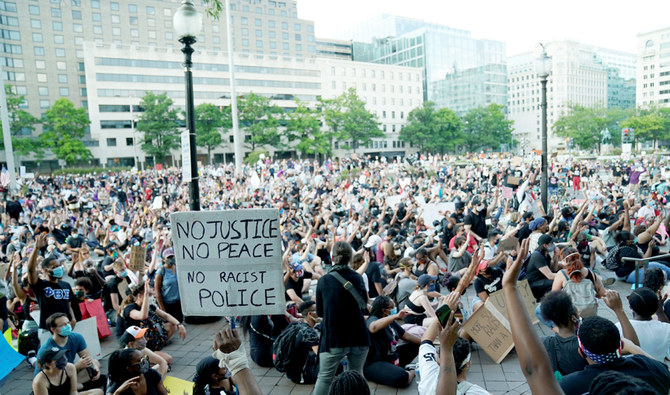
Demonstrators occupy outside the building housing the DC Mayor's Office, during a protest against racial inequality in the aftermath of the death in Minneapolis police custody of George Floyd, in Washington, U.S. June 6, 2020. (REUTERS)
2 / 5
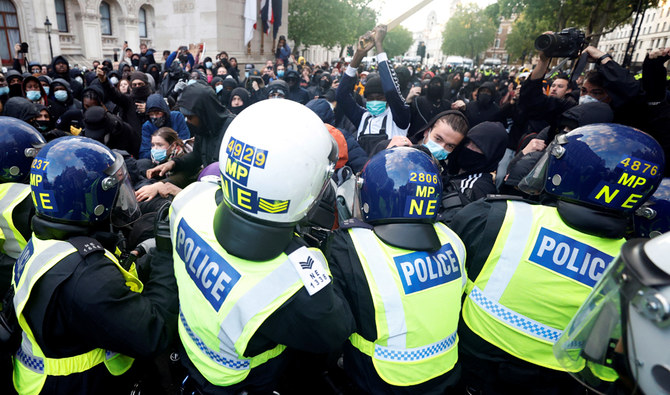
Demonstrators clash with police officers during a Black Lives Matter protest, following the death Minneapolis police custody of George Floyd, on Whitehall in London, Britain, June 6, 2020. (REUTERS)
3 / 5
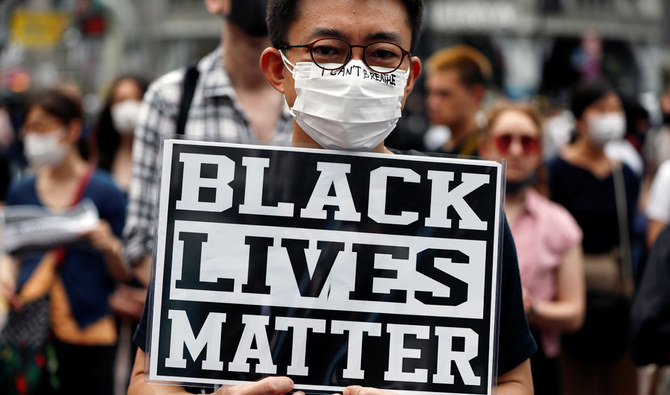
A demonstrator wearing a mask holds a placard during a Black Lives Matter protest, following the death of George Floyd who died in police custody in Minneapolis, at Shibuya shopping and amusement district in Tokyo, Japan, June 6, 2020. (REUTERS)
4 / 5
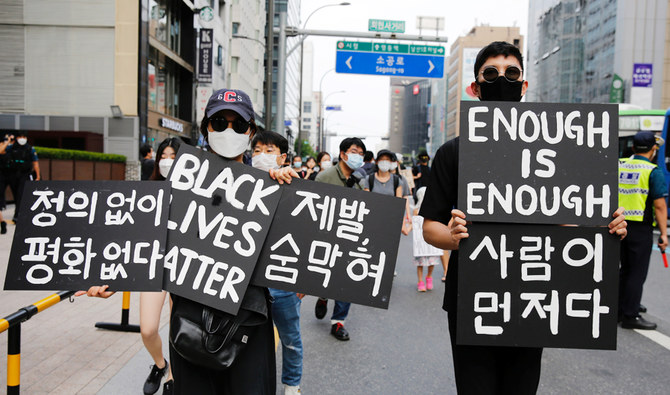
People march on the street in solidarity with protests against the death in Minneapolis police custody of George Floyd in Seoul, South Korea June 6, 2020. (REUTERS)
5 / 5
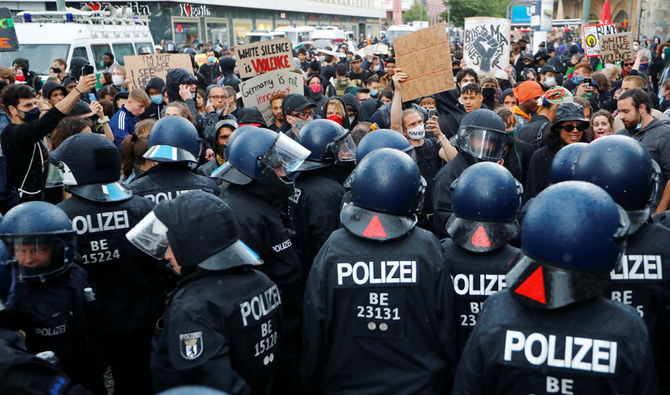
Police officers stand guard in front of demonstrators during a protest against police brutality and racial inequality in the aftermath of the death in Minneapolis police custody of George Floyd, in Berlin, Germany June 6, 2020. (REUTERS)
Short Url
Updated 07 June 2020
Follow

World rallies against Floyd’s death

  • Yet tens of thousands of Australians defied Prime Minister Scott Morrison’s call to “find a better way”

LONDON: Taking a knee, banging drums and ignoring social distancing measures, outraged protesters from Sydney to London on Saturday kicked off a weekend of global rallies against racism and police brutality.
The death at police hands of George Floyd, an unarmed black man in the US state of Minnesota, has brought tens of thousands out onto the streets during a pandemic that is ebbing in Asia and Europe but still spreading in other parts of the world.
“It is time to burn down institutional racism,” one speaker shouted through a megaphone at a hooting crowd of thousands outside the parliament building in London.
“Silence is violence,” the throng shouted back in the rain.
Officials around the world have been trying to balance understanding at people’s pent-up anger with warnings about the dangers of a disease that has officially claimed nearly 400,000 lives globally.
Yet tens of thousands of Australians defied Prime Minister Scott Morrison’s call to “find a better way.”


IAEA board meets over Ukraine nuclear safety concerns

Updated 4 sec ago
Follow

IAEA board meets over Ukraine nuclear safety concerns

  • The war in Ukraine “continues to pose the world’s biggest threat to nuclear safety,” Grossi said
  • The mission will assess 10 substations “crucial to nuclear safety,” according to Grossi

VIENNA: The UN nuclear watchdog’s board of governors on Friday discussed nuclear safety in Ukraine, with several countries expressing “growing concern” following Russian attacks on the power grid.
Energy supplies to Ukraine’s nuclear plants have been affected as Russia has pounded its neighbor’s power sector since the start of its 2022 invasion, prompting fears of a nuclear disaster.
The war in Ukraine “continues to pose the world’s biggest threat to nuclear safety,” Rafael Grossi, director general of the International Atomic Energy Agency (IAEA), said when opening the board meeting.
The extraordinary meeting that lasted four hours was called after 13 countries led by the Netherlands expressed in a letter seen by AFP a “growing concern about the severity and urgency of nuclear safety risks” following a series of attacks.
Ukrainian ambassador Yurii Vitrenko told reporters before the meeting that it was “high time” for the IAEA board to discuss the situation.
A weeks-long IAEA expert mission to Ukrainian substations and power plants is under way and expected to wrap up next month, Vitrenko said.
The mission will assess 10 substations “crucial to nuclear safety,” according to Grossi.
Russian Ambassador Mikhail Ulyanov dismissed the board’s gathering as “absolutely politically motivated,” adding there was “no real need to hold such a meeting today.”
Last week, Ukraine’s Chernobyl nuclear power plant temporarily lost all off-site power.
Europe’s biggest nuclear power plant, Zaporizhzhia, occupied by Russian forces since March 2022, has also been repeatedly affected by fighting.
Earlier this month, Russia and Ukraine agreed to a localized ceasefire to allow repairs on the last remaining backup power line supplying Zaporizhzhia.
The line was damaged and disconnected as a result of military activity in early January.
The Zaporizhzhia plant’s six reactors have been shut down since the occupation. But the site still needs electricity to maintain its cooling and security systems.
Moscow and Kyiv have repeatedly accused each other of risking a nuclear catastrophe by attacking the site.