

Crackdown on Turkish opposition accelerates: Sign of a snap election?

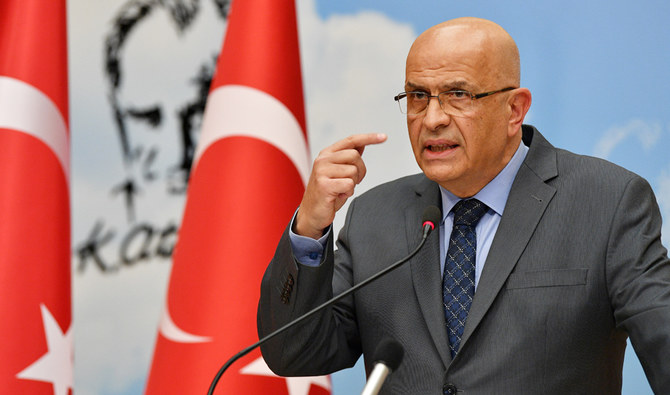
Enis Berberoglu, a member of the parliament from Turkey's main opposition Republican People's Party (CHP), speaks during a news conference in Ankara, Turkey, June 4, 2020. (REUTERS)
Short Url
Updated 06 June 2020
Follow

Crackdown on Turkish opposition accelerates: Sign of a snap election?

  • Opposition leaders chant slogans calling the ruling government fascist and ‘putschist’

ISTANBUL: Three opposition MPs in Turkey were expelled from office on Thursday night and detained on espionage and terrorism charges in a move many see as being designed to weaken opposition parties ahead of a likely snap election.

Enis Berberoglu, from the main opposition Republican People’s party (CHP), and Leyla Guven and Musa Farisiogullari from the pro-Kurdish Peoples’ Democratic Party (HDP) were all expelled, thus losing their parliamentary immunity. Berberoglu was arrested at his home in Istanbul during the night, while the two HDP MPs were arrested in the southeastern city of Diyarbakir.

Opposition MPs reportedly chanted slogans calling the ruling government fascist, “putschist,” and “the enemy of democracy.”

“This is yet another sign that the Islamist-nationalist coalition ruling President Recep Tayyip Erdogan’s presidency will harden its authoritarianism as it continues to lose democratic legitimacy,” Murat Somer, a political scientist from Koc University in Istanbul, told Arab News. “It tries to kill three birds with one stone.”

CHP MP Berberoglu, a journalist, was sentenced to five years and 10 months in prison in 2018 for providing another journalist with footage that appeared to show that the National Intelligence Agency was providing arms to Syrian rebels in 2014. His sentence was on hold because of his parliamentary immunity.

The HDP parliamentarians have been charged with “membership of a terrorist organization” because of their alleged links to the outlawed Kurdistan Workers’ Party (PKK). Earlier this week, the HDP asked for an official probe into the cost of Turkey’s involvement in the Libyan conflict and urged the government to focus on dealing with domestic issues.

The government’s increasing crackdown on opposition parties is a result of its waning power domestically — where it faces an unprecedented economic crisis and rising unemployment — Somer and others suggest.

FASTFACT

Enis Berberoglu, from the main opposition Republican People’s party (CHP), and Leyla Guven and Musa Farisogullari from the pro-Kurdish Peoples’ Democratic Party (HDP) were all expelled, thus losing their parliamentary immunity.

According to Somer, the latest arrests are not only an attempt to restrict democratic opposition by criminalizing it but also to drive a wedge between pro-Kurdish opposition parties and the rest. They are also a warning to potential dissidents inside the ruling Justice and Development Party (AKP).

“All this is yet another step in the ongoing struggle between those who want to consolidate an authoritarian presidential system and a still-divided yet dynamic opposition (aiming) to revive democracy,” he said.

The crackdown on the HDP is expected to push the pro-Kurdish party to adopt a more radical standpoint that could make any electoral alliance difficult to sell to CHP voters.

Alpay Antmen, an attorney and a CHP MP, said the arrests are intended to shift people’s focus away from Turkey’s economic turmoil and the fallout from the COVID-19 pandemic. Members of the main opposition party were about to launch a campaign across 19 of Turkey’s hardest-hit cities to listen to the views of local citizens.

“The ruling government tries to restrict the opposition parties’ efforts to reach out to the citizens and to help them recover (financially). But whatever they do, it gives us further enthusiasm for our nationwide projects,” Antmen told Arab News.

Director of Human Rights Watch Turkey Emma Sinclair-Webb also criticized the move, describing it as “another sign of the relentless assault on elected opposition parties,” and added that the three lawmakers had been subjected to “politically motivated trials in which legal activities were criminalized.”


US presses missile issue as new Iran talks to open in Geneva

Updated 59 min 9 sec ago
Follow

US presses missile issue as new Iran talks to open in Geneva

  • New round of negotiations in Geneva comes after the US carried out a massive military build-up in the region
  • The dispute between the countries mostly revolves around Iran’s nuclear program

GENEVA: The United States and Iran are set to hold indirect talks in Switzerland on Thursday aiming to strike a deal to avert fresh conflict and bring an end to weeks of threats.
The new round of negotiations in Geneva comes after the US carried out a massive military build-up in the region and President Donald Trump repeatedly threatened to strike Iran if a deal is not reached.
In his State of the Union address on Tuesday, Trump accused Iran of “pursuing sinister nuclear ambitions.”
He also claimed Tehran had “already developed missiles that can threaten Europe and our bases overseas, and they’re working to build missiles that will soon reach the United States of America.”
The Iranian foreign ministry called these claims “big lies.”
The maximum range of Iran’s missiles is 2,000 kilometers (1,200 miles) according to what Tehran has publicly disclosed. However the US Congressional Research Service estimates they top out at about 3,000 kilometers — less than a third of the distance to the continental United States.
The dispute between the countries mostly revolves around Iran’s nuclear program, which the West believes is aimed at building an atomic bomb but Tehran insists is peaceful.
However the US has also been pushing to discuss Iran’s ballistic missile program, as well as Tehran’s support for armed groups hostile toward Israel.
Secretary of State Marco Rubio warned that Iran must also negotiate on its missile program, calling Tehran’s refusal to discuss ballistic weapons “a big, big problem” on the eve of the talks.
He followed up by saying “the president wants diplomatic solutions.”
Iran has taken anything beyond the nuclear issue off the negotiating table and has demanded that the US sanctions crippling its economy be part of any agreement.
‘Neither war nor peace’
Iranian President Masoud Pezeshkian said on Wednesday he had a “favorable outlook for the negotiations” that could finally “move beyond this ‘neither war nor peace’ situation.”
Foreign Minister Abbas Araghchi, who is leading the Iranian delegation at the talks, has called them “a historic opportunity,” adding that a deal was “within reach.”
In a foreign ministry statement that followed a meeting with his Oman counterpart, Araghchi said the success of the US negotiations depend “on the seriousness of the other side and its avoidance of contradictory behavior and positions.”
The US will be represented by envoy Steve Witkoff and Jared Kushner, who is married to Trump’s daughter Ivanka.
The two countries held talks earlier this month in Oman, which is mediating the negotiations, then gathered for a second round in Geneva last week.
A previous attempt at negotiations collapsed when Israel launched surprise strikes on Iran last June, beginning a 12-day war that Washington briefly joined to bomb Iranian nuclear sites.
In January, fresh tensions between the US and Iran emerged after Tehran engaged in a bloody crackdown on widespread protests that have posed one of the greatest challenges to the Islamic republic since its inception.
Trump has threatened several times to intervene to “help” the Iranian people.
Emile Hokayem, senior fellow for Middle East security at the International Institute for Strategic Studies, said that “the region seems to expect a war at this point.”
In January, there was “a big push by a number of Middle Eastern states to convince the US not to” strike Iran.
“But there’s a lot of apprehension at this point, because the expectation is that this time” a war would be “bigger” than the one in June.
Tehran residents who spoke to AFP were divided as to whether there would be renewed conflict.
Homemaker Tayebeh noted that Trump had “said that war would be very bad for Iran.”
“There would be famine and people would suffer a lot. People are suffering now, but at least with war, our fate might be clear,” the 60-year-old said.