


DUBAI: Whoever came up with the fanciful notion of keeping sport and politics separate certainly never lived in the Middle East.
In a region where every aspect of life is shaped by socio-political factors, few sportsmen or women have ever publicly taken ideological stands. Quite literally, their livelihoods, their lives, depend on it.
Look west however, and the situation has for a long time been somewhat more complicated. Sporting figures, with a few easily identifiable exceptions, rarely needed, cared, or were encouraged to make political statements. Even from a position of privilege in societies that pride themselves on free speech.
Historically and in recent times, those who dared take a stand against social injustice were quickly made an example of by authorities.
But a new mood has emerged over the last week as the fallout from the death of African-American George Floyd in police custody in Minneapolis continues to be felt on US streets, and on global news and social media networks.
The seeds of the current wave of protests were sewn more than three years ago.
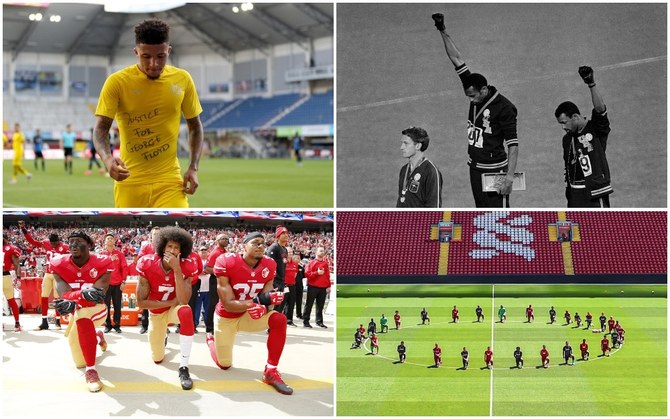
When San Francisco 49ers quarterback Colin Kaepernick famously took a knee during the national anthem to protest police brutality against African-Americans, the backlash was more suited to someone who had committed treason than taking a stand against racism.

His protest has proved prophetic, though not without severe personal cost.
For his troubles, Kaepernick was ostracized by the NFL (National Football League) and attacked by conservative media figures and US President Donald Trump himself.
“You have to stand proudly for the national anthem or you shouldn’t be playing, you shouldn’t be there, maybe you shouldn’t be in the country,” said Trump in 2018 after the NFL warned that it would fine any player who followed Kaepernick’s example.
Last year, American soccer superstar Megan Rapinoe echoed Kaepernick’s actions while leading the US Women’s National Team to World Cup glory, again attracting criticism from the likes of Trump and British media figure Piers Morgan.
These remained isolated cases. By and large, athletes, perhaps hoping to avoid similar fates, preferred to keep their heads down, or stuck in the sand as some might say.
Now it is apparent that many athletes will no longer stay silent.
The first to make a stand was German football club Schalke’s US international Weston McKennie who on Saturday wore an armband during the Bundesliga match against Werder Bremen that read, “Justice for George.”

The following day, Marcus Thuram, son of French World Cup winner Lilian, took a knee after scoring for Borussia Monchengladbach against Union Berlin, also in the Bundesliga.
Completing the trio of memorable images was British football player Jadon Sancho who, on the day he scored his first ever professional hat-trick for Borussia Dortmund against Paderborn, lifted his top to reveal a T-shirt sporting the message, “Justice for George Floyd.” For this he received a yellow card, but that did not stop Moroccan team-mate Achraf Hakimi revealing an identical message at full time.
They might have faced sanctions from the German FA, but none of them will be punished. Their actions show that the days when athletes could be silenced with threats of fines or suspensions would seem to be over. Sports are only a small part of life, and players, and seemingly, some sports institutions, are no longer willing to turn their heads.

The outspoken British racing driver Lewis Hamilton has already criticized Formula 1 for its silence over the Floyd-inspired demonstrations and the #BlackLivesMatter campaign.
“I see those of you who are staying silent, some of you the biggest of stars, yet you stay silent in the midst of injustice. Not a sign from anybody in my industry which of course is a white-dominated sport,” the six-time champion posted on his Instagram account.

Former US basketball player Michael Jordan, recently portrayed in the documentary “The Last Dance” as something of an apolitical, self-serving figure, has broken his silence too.
“I stand with those who are calling out the ingrained racism and violence toward people of color in our country. We have had enough,” he said.
In England, many Premier League footballers, arguably the most scrutinized athletes on the planet, have also made their voices heard.
The entire Liverpool squad, led by the likes of Gini Wijnaldum and Virgil van Dijk, took the knee during training, an image that was widely circulated on social media. Chelsea’s players followed suit, lining up in a formation that spelled the letter H, for humanity.

Manchester United’s account also posted an anti-“hatred” message, while their brilliant young striker Marcus Rashford, who had already helped raise more than £20 million ($25.1 million) to feed children during the coronavirus disease (COVID-19) lockdown, tweeted a message that said: “People are hurting and we need answers. Black lives matter. Black culture matters. Black communities matter. We matter.”
In Italy, former Manchester United and current Inter Milan winger Ashley Young simply posted a screen shot of the words, “Black Lives Matter.” The message was clear, players were no longer tolerating sitting on the fence or hiding behind hollow, if not outright offensive, slogans such as “All Lives Matter.”
In the past, such high-profile activism among athletes was rare, and often brought nothing but trouble, or even ruin, on those who were brave enough to stand up to societal ills.
At the peak of his powers, American boxing great Muhammad Ali lost three years of his career for his conscientious objection to serving in the US Army during the Vietnam War. Sportingly and financially he suffered grave consequences, not to mention having his reputation tarnished by a rabidly nationalistic media. Kaepernick, no doubt, can identify.
Perhaps the most iconic image of activism remains that of Tommie Smith and John Carlos at the 1968 Mexico Olympics giving the symbol of black power as the US national anthem played minutes after they had claimed gold and bronze in the 200 meters race. Both were expelled from the Games, but their legacy is as relevant as ever.
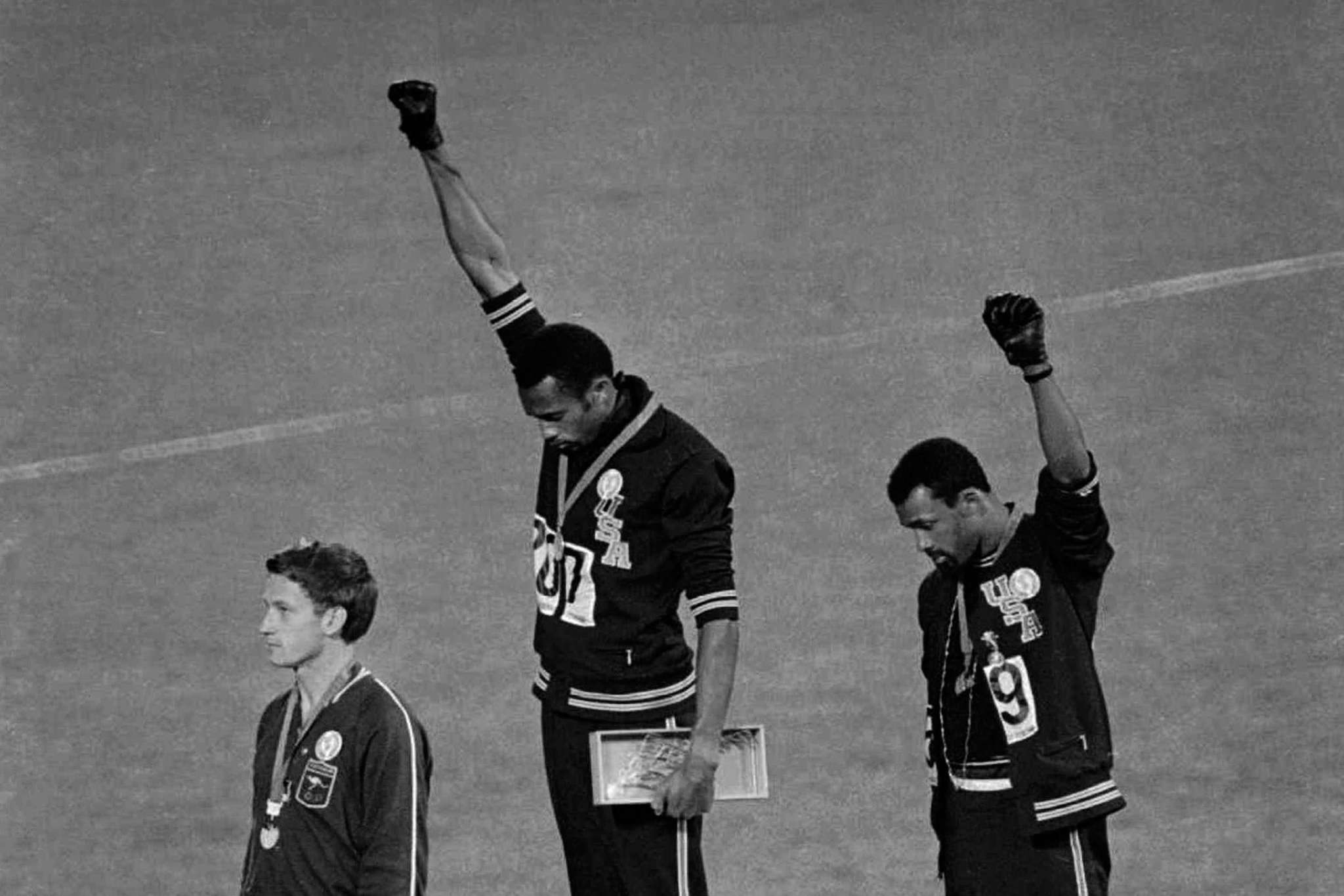
The raised fist salute is now commonly seen among peaceful demonstrators across American cities.
In more recent times, footballers would often lift their shirts to show messages of support for various causes, in the way that Sancho did at the weekend. Almost always, it would lead to censure by FIFA or its member associations.
In 1997, Liverpool forward Robbie Fowler displayed a message of support for sacked dock workers in his hometown, leading to a fine of £900 by UEFA.
After scoring against Deportivo La Coruna in a Copa del Rey match in January 2009, Mali striker Freddie Kanoute revealed a message that simply said “Palestine” in several languages, as Gaza was attacked by Israel. He received a $4,000 fine.
A year earlier, Egypt and Al-Ahly captain Mohamed Aboutrika was booked during a match against Sudan for displaying the words “Sympathize with Gaza,” but was eventually spared punishment by the Confederation of African Football (CAF).
While it was individuals that could be counted on to show solidarity with social causes, it now seems that the tide has turned among official sporting federations, teams, media outlets and advertisers too, all keen to be on the right side of history.
FIFA’s Twitter account briefly posted a photo of Sancho with his message of protest clearly showing, only for it to be deleted later.
And Nike, having commendably stood by Kaepernick with a striking advert in 2018, this week released a short anti-racism message that said, with a nod to its own slogan: “For once, don’t do it.”
All over the world, other brands and social media accounts have been falling over themselves to push the #BlackLivesMatter narrative. This is a welcome development only if it does herald genuine change, and, crucially, is an inclusive message.
But some of the motives should be treated with extreme caution, if not skepticism. Now that these previously silent voices have been seen to take a moral stand, it will be interesting to see whether they maintain their newly found principles or pull them back whenever it suits their purposes.
Whether it is a passing phase remains to be seen.
Will sporting organizations now back their athletes’ right to take the knee and support #BlackLiveMatter indefinitely? Are protests for causes in places such as Syria, Iraq, Palestine, Libya, or Sudan a step too far? And will female voices against gender inequality be tolerated? Where will the line be drawn?
History has not been kind to sportspeople that have raised their voices against injustice.
But now that the genie is out of the bottle, it should be almost unthinkable for authorities and brands to continue pushing the line that sport and politics do not mix; to return to an unenlightened time when their star athletes, the lifeblood of their industries, can be bullied into silence.
But do not bet against them trying just yet.


