

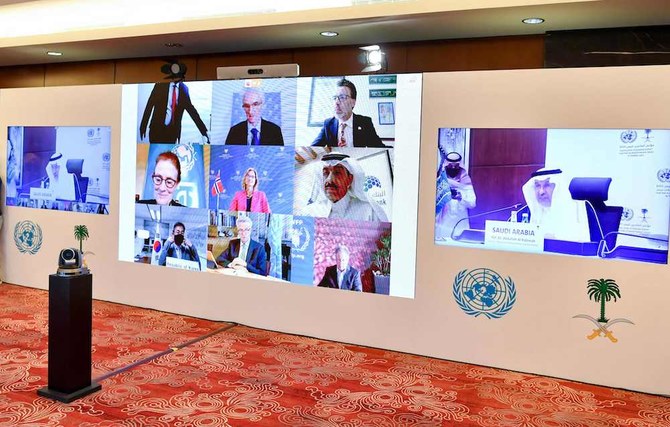

NEW YORK: International donors on Tuesday pledged $1.35 billion of aid for Yemen, during a virtual humanitarian event organized by Saudi Arabia, in partnership with the United Nations
Time is of the essence in the efforts to help the people of Yemen, the donors were reminded at the end of the conference.
“When the pledges are paid literally means the difference between life and death for countless Yemeni people,” said UN under-secretary-general for humanitarian affairs Mark Lowcock, who co-chaired the event with Abdullah Al-Rabeeah, the supervisor general of Saudi Arabia's King Salman Humanitarian Aid and Relief Center.
“I reiterate the plea the secretary-general made to all those who made pledges to pay them straightaway, because pledges on their own achieve nothing.”
Lowcock also called on countries that had not yet pledged to do so as soon as possible, and added that the UN will continue its fundraising efforts. “This is not the end,” he said.
The event followed a call by UN aid workers in Yemen for more than $2.4 billion to fund emergency aid, including medical supplies, food and shelter, at a time when the coronavirus pandemic is making what was already a dire situation even worse.
Humanitarian organizations need the funding to shore up their operations in Yemen, where 75 percent of UN programs have had to close or been scaled down because of lack of money.
There are many reasons for the dwindling funds, but one of the main issues has been obstruction by the Houthi rebels who control the capital, Sanaa, and other territories. The United States, one of the largest donors, decreased its aid to Yemen this year blaming the decision on interference by the Houthis.
In his opening statement at the conference, UN Secretary-General Antonio Guterres warned that aid workers face a race against time in Yemen.
“Unless we secure significant funding, more than 30 out of 41 major United Nations programs in Yemen will close in the next few weeks,” he said
He also thanked Saudi Arabia for its “continued commitment to the humanitarian aid to the people of Yemen.”
The Kingdom pledged $500 million during the conference’s opening ceremony.
Melissa Fleming, the UN’s under-secretary-general for global communications, who moderated a question-and-answer session after the conference, described Saudi Arabia as “the largest funder of the humanitarian response in Yemen in recent years.”
Yemeni Prime Minister Maeen Abdulmalik Saeed thanked the Kingdom for its contribution and its role in Yemen in recent years. Describing the humanitarian crisis in his country, he said “a macabre tragedy is imminent.”
Prince Faisal bin Farhan, the Saudi minister of foreign affairs, reiterated the Kingdom’s “firm commitment to alleviating the human suffering of the brotherly Yemeni people.”
He also passed on King Salman and Crown Prince Mohammed bin Salman’s “deep appreciation to the United Nations for its efforts in providing humanitarian work through its agencies operating around the world, and in Yemen in particular.”
He added: “The Kingdom has provided humanitarian aid to Yemen since the beginning of the crisis, totaling more than 16 billion, nine hundred and forty million US dollars.”
Prince Faisal called on the international community to honor its financial promises to Yemen. The people of the country are looking forward to an effective resolution that will help them face the humanitarian, military, security and economic-development challenges they face “due to the inhuman practices and violations by Iranian-backed Houthi militias….blocking out humanitarian aid, looting relief convoys, and impeding its access to all Yemeni lands,” he added
The prince also highlighted the refusal by the Houthis to accept any political solution to the crisis in Yemen based on international resolutions and the Stockholm Agreement “and thus, the Houthi denial of all efforts and initiatives for a ceasefire, and the UN Envoy for Yemen’s invitation to engage in direct negotiations between all Yemeni parties.”
-------
READ MORE: Saudi Arabia to organize virtual donors conference for Yemen in partnership with UN
Saudi Arabia’s donor conference ‘embodies Kingdom's support’ of Yemen
Donors seek to raise $2.4 billion for Yemen
--------
The pledging event brought together representatives of more than 125 UN member states, international organizations, UN agencies, NGOs and civil-society groups to raise funds to meet the humanitarian needs of the Yemeni people.
The Office for the Coordination of Humanitarian Affairs, the UN’s humanitarian agency, echoed the pleas for those who pledged to “actually pay early because the operation in Yemen is severely, severely underfunded. We are running out of time.”
“COVID-19 has created new needs there, but (it) is just the latest challenge in an already deteriorating situation,” Al-Rabeeah said during a press conference after the event. The UN has accused the Houthi rebels of underreporting the number of coronavirus cases.
“I leave this conference with a positive attitude,” Al-Rabeeah added. “Even though the pledging did not reach last year’s numbers it is a very good response, taking into account the various factors at play, from COVID-19 and the economic crisis resulting from it to the reticence of some donors due to violations of humanitarian aid.”
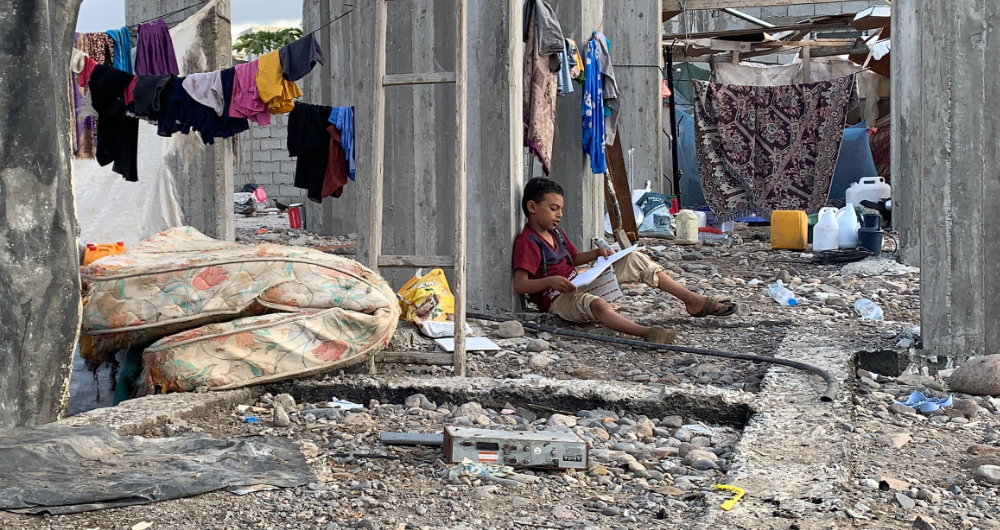
A child reads at a camp for Yemenis displaced by conflict in the Khor Maksar district in Aden. (AFP)
He vowed that the Kingdom will continue to advocate for a political solution to the war in Yemen, to support the country, and to work hard to assist in its battle against Covid-19.
“If we continue to advocate these points, then we are not far from reaching a better future for Yemen,” he said.
Lowcock thanked Al-Rabeeah for the Saudi collaboration on a conference that highlighted the “wide issues that are adulterating the human response in Yemen, and restrictions by parties in Yemen which made our work there harder.”
He again urged donors to pay promptly, “otherwise, the life-saving programs will simply close. Those who have not pledged, it is important that they stand up and play a role.”
He said UN fundraising efforts will continue, adding: “We cannot be satisfied with what where we got today. What’s needed in Yemen is peace but in the meantime we have to keep people alive.”
Al-Rabeeah noted that although only about half the money being sought was raised, it is enough to maintain “the momentum of humanitarian work in Yemen.”
He said: “It is important to keep the work going. (There needs to be) determination, on the part of the UN and donor countries, that we will do what it takes to protect those donations.
“We hope that the hindrances to humanitarian workers, and to the aid itself, will be limited and minimized. It is about time for those who violate international law to stop, and to allow the international community to do the humanitarian work.
“We should not shy away from bringing those violations to light, and to the attention of international community. We should also make it clear at the Security Council that those violations are happening on this or that side.
“Enough selling the lives of the Yemeni people for political motives,” added Al-Rabeeah.
PLEDGES (IN $):
Austria: 1.1m
Belgium (1): 5.52m
Bulgaria (1): 55,000
Canada (1): 29.03m
Cyprus: 55,000
Czech Republic: 737,000
Denmark: 3.41m
European Commission: 78.21m
Finland: 3.31m
France: 9.60m
Germany (1): 137.97m
Greece: 33,000
Iceland: 200,000
Ireland (1): 5.52m
Italy: 5.79m
Japan: 41.20m
Korea, Rep. of (1): 18.50m
Lithuania (1): 110,000
Luxembourg (1): 2.04m
Malaysia: 100,000
Malta (1): 33,000
Netherlands (1): 17.00m
Norway (1): 17.78m
Russia: 4m
Saudi Arabia: 500m
Slovenia (2): 93,000
Sweden (1): 30.84m
Switzerland (1,2): 12.40m
United Kingdom (1): 196.56m
United States: 225m
(1) Made announcement to the Yemen Humanitarian Fund
(2) Made multi-year announcement


