

Syrian artists memorialize George Floyd in war-torn country

Short Url
Updated 02 June 2020
Follow

Syrian artists memorialize George Floyd in war-torn country

DUBAI: In the past few weeks, people across the world have been protesting against police brutality and to honor George Floyd, Breonna Taylor, Ahmaud Arbery and others who have lost their lives at the hands of police.

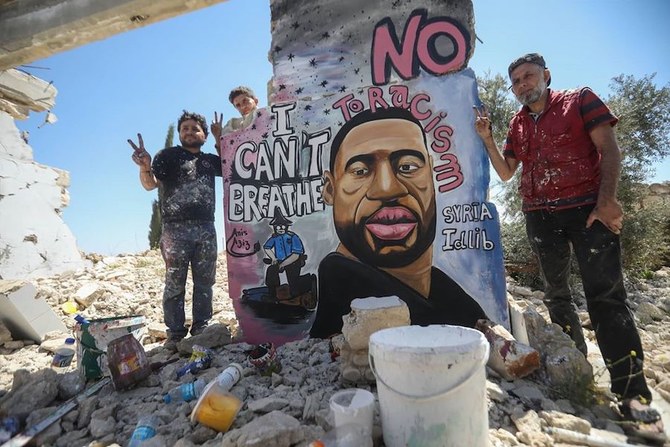
Syrian artists Aziz Asmar and Anis Hamdoun decided to show solidarity to the protestors and Black Lives Matter movement  by painting a powerful mural of Floyd against the backdrop of Idlib’s ruins. 


A post shared by Ghaith Alsayed (@ghaith.alsayed) on

The mural depicted a portrait of Floyd, who died after a Minneapolis police officer kneeled on his neck for nearly nine minutes, alongside the words “I can’t breathe” and “No to racism.”

Asmar said Floyd’s death “by suffocation” reminded him of Syrian civilians “killed by suffocation after the Syrian regime hit them with chemical weapons,” according to a local news report.

The artists said they painted the mural to “to call for peace and love” worldwide.

The pictures instantly went viral on social media and Twitter users praised the artists for choosing to paint the mural of Floyd in Syria, which has been facing a humanitarian crisis for years.

“It truly warms my heart to see Syrians supporting BLM even with everything they’re going through in Syria!” wrote one user on Twitter. “Syrian artists Aziz Asmar and Anis Hamdoun in the town of Binnish in Idlib!”

From Syria to Spain, murals memorializing Floyd have cropped up in cities across the globe. In the occupied Westbank, Palestinian artist Walid Ayyoud painted a portrait of Floyd wearing a keffiyeh and in front of the Palestinian flag on the Apartheid Wall.


Mini op-ed: We need a ‘potluck’ culture of reading

Updated 10 March 2026
Follow

Mini op-ed: We need a ‘potluck’ culture of reading

DUBAI: The number of times we hear, “My kids don’t read,” “I don’t have the time,” or “Do people even read anymore?” is alarming.

With newspapers declared dead and YouTube summaries or ChatGPT reviews becoming the main course of words, I often wonder: have those asking these questions considered the role they play?

Each of us — school representatives, librarians, parents, educators, children, and even occasional readers — must ask whether we are helping create a culture where reaching for a book feels as natural as reaching for a smartphone.

Even the smallest effort counts. I think of a reading culture as a potluck where everyone brings something small, and together it becomes a wholesome meal. If you do not know where to begin, look around.

Purva Grover is an author, poet, playwright, stage director, TEDx speaker, and creative entrepreneur. (Supplied)

The UAE is rich in public libraries including in Sharjah and Dubai, such as the Mohammed Bin Rashid Library, which is proof that access is not the issue. 

Meanwhile, Saudi Arabia is embedding reading into its national identity under Vision 2030 through digital libraries, major book fairs, and daily school reading.

Not a reader? Events such as the Emirates Airline Festival of Literature or the Sharjah International Book Fair offer easy entry points for conversation, community and curiosity.

They are built on cultural blocks that subtly encourage even non-readers into reading spaces. You could even start a reading club. I run one in Dubai called The Reading Village and have seen its quiet magic.

Culture is built by saying yes. And no to pirated PDFs on WhatsApp, as well as unchecked screen habits.

Tiny habits can help build an environment where reading becomes as much a part of our lives as scrolling on Netflix to decide what to binge-watch next.

Purva Grover is an author, poet, playwright, stage director, TEDx speaker, and creative entrepreneur. She is the founder of The Reading Village, a Dubai-based community.