

Turkey’s Libya gas moves could upset Egypt, say experts

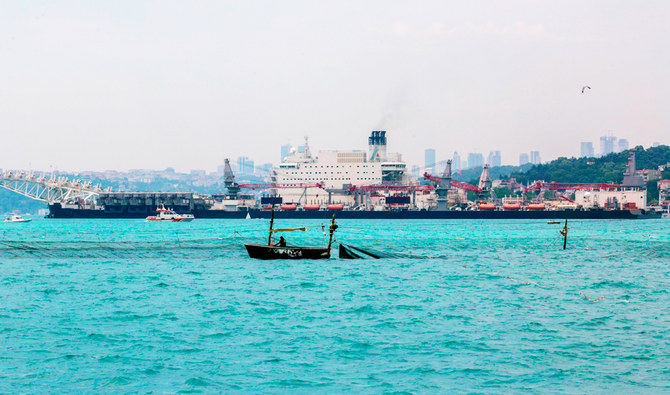
The Pioneering Spirit vessel, which will carry out construction of the offshore section of the Turkish Stream natural gas pipeline, sails on the Bosphorus on May 31,2017 in Istanbul, on the way to Anapa, on the northern Black Sea coast in Russia. (AFP)
Short Url
Updated 02 June 2020
Follow

Turkey’s Libya gas moves could upset Egypt, say experts

  • Spats over natural resources in Eastern Mediterranean

CAIRO: Turkey will start exploring Libya’s coast for gas within three months, the country’s Energy and Natural Resources Minister Fatih Donmez said, with experts saying the move will create tension with Egypt.

A dispute has been ongoing for several years between Turkey and Greece, Cyprus and Egypt regarding the ownership of natural resources in the Eastern Mediterranean.

The Turkish Petroleum Company has submitted an application to Libya’s Government of National Accord (GNA) for permission to excavate in the Eastern Mediterranean.

The move could escalate the tension between Ankara and Cairo that was caused by President Recep Tayyip Erdogan’s support for the Muslim Brotherhood following the 2013 revolution in Egypt that overthrew a Brotherhood-affiliated president. It eventually led to public enmity between Erdogan and Egyptian President Abdel-Fattah El-Sisi.

Political expert Tariq Abboud said Turkey was suffering from a severe economic crisis and was relying on reconstruction projects and future investments in the country to fix the problem.

The Eastern Mediterranean is a coveted region because it contains a large amount of natural gas estimated at more than 100 trillion cubic meters and Ankara wanted a share of that, according to Abboud.

Ankara also wants to seize the value of compensation of suspended projects in Libya, estimated at hundreds of millions of dollars.

“This is in addition to Turkey benefiting from supplying Libya with weapons, despite UN Security Council resolution 1970 of March 2011 which calls on all member states of the world body to prevent the sale or supply of weapons and related items to Libya,” he told Arab News.

“In addition, they also introduced Resolution 2420, which allows member states to inspect ships heading to or coming from Libya in order to prevent the entry of weapons into the country. But the reality is a completely different matter, as Greece stopped a ship heading to Libya from Turkey carrying explosive materials.”

Energy expert Mohammed El-Wardany said Turkey had been angered by the East Mediterranean agreement EastMed which was reached between Greece, Cyprus and Israel. The deal aims to secure energy supplies in Europe through a 2,000 km pipeline.

El-Wardany believed that Turkey saw the accord as an obstacle to its own attempts to expand control over the Eastern Mediterranean.

“It can be said that the Turkish-Libyan alliance came in response to that agreement,” he told Arab News.

“Turkey’s announcement that it will start exploration at this time is understandable. Turkey now consumes enormous amounts of energy annually, does not have sufficient resources, and imports the equivalent of $50 billion on an annual basis. Despite the excavations carried out by Ankara, the region's marine areas have no gas or oil fields. This led it to send ships to explore for gas off the coast of Cyprus, which Nicosia considered a provocation and illegal.”

Political analyst Jamal Shakra said that a direct confrontation between the two countries was unlikely, but that Egypt would move with its allies in the region to prevent Turkey from stealing what it had “no right to in the region.”


Ceasefire with Kurdish-led force extended for another 15 days, Syrian army says

Updated 25 January 2026
Follow

Ceasefire with Kurdish-led force extended for another 15 days, Syrian army says

  • The defense ministry said the extension was in support of an operation by US forces to transfer accused Daesh militants to Iraq
  • The Kurdish-led Syrian Democratic Forces confirmed the ceasefire extension

RAQQA, Syria: Hours after the expiration of a four-day truce between the Syrian government and Kurdish-led fighters Saturday, Syria’s defense ministry announced the ceasefire had been extended by another 15 days.
The defense ministry said in a statement that the extension was in support of an operation by US forces to transfer accused Daesh militants who had been held in prisons in northeastern Syria to detention centers in Iraq.
The Kurdish-led Syrian Democratic Forces confirmed the ceasefire extension.
“Our forces affirm their commitment to the agreement and their dedication to respecting it, which contributes to de-escalation, the protection of civilians, and the creation of the necessary conditions for stability,” the group said in a statement.
Over the past three weeks, there have been intense clashes between government forces and the SDF, in which the SDF lost large parts of the area they once controlled.
Earlier in the day, the Kurdish-led force called on the international community to prevent any escalation.
The end of the truce came as government forces have been sending reinforcements to Syria’s northeast.
Syria’s interim government signed an agreement last March with the SDF for it to hand over territory and to eventually merge its fighters with government forces. In early January, a new round of talks failed to make progress over the merger, leading to renewed fighting between the two sides.
A new version of the accord was signed last weekend, and a four-day ceasefire was declared Tuesday. Part of the new deal is that SDF members will have to merge into the army and police forces as individuals.
The SDF said in a statement Saturday that military buildups and logistical movements by government forces have been observed, “clearly indicating an intent to escalate and push the region toward a new confrontation.” The SDF said it will continue to abide by the truce.
On Saturday, state TV said authorities on Saturday released 126 boys under the age of 18 who were held at the Al-Aqtan prison near the northern city of Raqqa that was taken by government forces Friday. The teenagers were taken to the city of Raqqa where they were handed over to their families, the TV station said.
The prison is also home to some of the 9,000 members of the Daesh group who are held in northeastern Syria. Most of them remain held in jails run by the SDF. Government forces have so far taken control of two prisons while the rest are still run by the SDF.
Earlier this week, the US military said that some 7,000 Daesh detainees will be transferred to detention centers in neighboring Iraq.
On Wednesday, the US military said that 150 prisoners have been taken to Iraq.