

US firms awake to ‘sad day’ in Hong Kong as Trump cuts ties

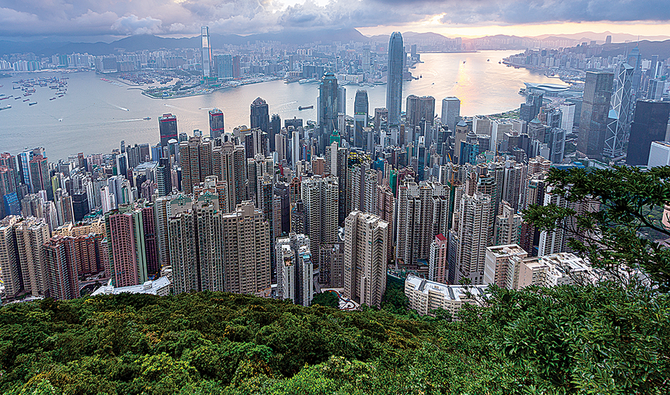
US President Donald Trump accused Beijing of breaking its word over Hong Kong’s autonomy, and described China’s national security legislation as a ‘tragedy for the world.’ (Shutterstock)
Short Url
Updated 31 May 2020
Follow

US firms awake to ‘sad day’ in Hong Kong as Trump cuts ties

  • President moves to strip finance hub of economic privileges in wake of tough new Chinese security laws

HONG KONG: The American Chamber of Commerce in Hong Kong said on Saturday it was a sad day for the global financial center, hours after US President Donald Trump moved toward stripping the city of its special treatment in a bid to punish China.

In some of his toughest rhetoric yet, Trump said Beijing had broken its word over Hong Kong’s high degree of autonomy by proposing new national security legislation and the territory no longer warranted US economic privileges.

“We will take action to revoke Hong Kong’s preferential treatment as a separate customs and travel territory from the rest of China,” Trump said, adding that Washington would also impose sanctions on individuals seen as responsible for “smothering — absolutely smothering — Hong Kong’s freedom.”

Speaking at the White House, Trump said China’s move on Hong Kong was a tragedy for the world.

But Trump gave no timetable for the moves, leaving Hong Kong residents, businesses and officials to ponder just how far his administration will go. “This is an emotional moment for Americans in Hong Kong and it will take companies and families a while to digest the ramifications,” AmCham President Tara Joseph said in a statement.

“Many of us have deep ties to this city and with Hong Kong people. We love Hong Kong and it’s a sad day,” she said, adding the chamber would continue to work with its members to maintain Hong Kong’s status as a vital business center.

China’s parliament this week approved a decision to create laws for Hong Kong to curb sedition, secession, terrorism and foreign interference. Mainland security and intelligence agents may be stationed in the city for the first time — moves critics say puts the city’s extensive freedoms at risk.

Trump did not name any sanctions targets but said the announcement would “affect the full range of agreements we have with Hong Kong,” including the US-Hong Kong extradition treaty to export controls on dual-use technologies and more “with few exceptions.”

China’s Global Times, which is published by the People’s Daily, the official newspaper of China’s ruling Communist Party, said Trump’s decision was a “recklessly arbitrary” step.

The Hong Kong government, which has a long history of working ties with US counterparts distinct from Beijing, has yet to respond, although it warned on Thursday the move could be a double edged sword.

More than 1,300 US firms have offices in Hong Kong and provide about 100,000 jobs. In the past decade, the US trade surplus with Hong Kong has been the biggest among all its trading partners, totaling $297 billion from 2009 to 2018.

Britain, meanwhile, is prepared to offer extended visa rights and a pathway to citizenship for almost 3 million Hong Kong residents in response to China’s push to impose national security legislation in the former British colony.


Aramco’s 13% rally helps Saudi stocks post second weekly gain

Updated 12 March 2026
Follow

Aramco’s 13% rally helps Saudi stocks post second weekly gain

RIYADH: Saudi Aramco extended its year-to-date rally to nearly 13 percent on Thursday, helping the Kingdom’s benchmark stock index secure a second straight weekly gain despite a weaker final trading session.  

Saudi Aramco shares, which carry the heaviest weighting on the Saudi Exchange, closed at SR26.86 ($7.16), leaving the stock 12.72 percent higher since the start of 2026. The stock also remained 3.09 percent above last week’s close, even after falling 1.1 percent in Thursday’s session.

The rise in energy shares came as escalating tensions in the Middle East pushed oil prices above $100 a barrel, after attacks on tankers in the Gulf and the Strait of Hormuz heightened concerns over supply disruptions.

The Tadawul All Share Index maintained its weekly uptrend, rising nearly 1.07 percent week on week to close at 10,778.32, despite falling 0.45 percent in Thursday’s session. Compared with the first trading day of the year, the index has gained 4.01 percent.

Total trading turnover on the benchmark index reached SR5.05 billion at Thursday’s close, with 88 stocks advancing and 176 declining.

Aramco’s performance continued to anchor sentiment after the company reported adjusted net income of $104.7 billion for 2025 earlier this week, while net profit fell 12.1 percent year on year to $93.39 billion, compared with $106.25 billion in 2024, as lower crude prices weighed on earnings despite higher sales volumes across oil, gas and refined products.

On a March 10 earnings call, Aramco CEO Amin Nasser warned that prolonged disruption in the Strait of Hormuz could have severe implications for global energy markets. Roughly 20 percent of the world’s oil normally passes through the waterway each day, but shipments have been largely blocked.

“There would be catastrophic consequences for the world’s oil markets and the longer the disruption goes on ... the more drastic the consequences for the global economy,” he said.

“While we have faced disruptions in the past, this one by far is the biggest crisis the region’s oil and gas industry has faced.”

Saudi equities showed mixed performance in Thursday’s session. The MSCI Tadawul Index fell 5.99 points, or 0.40 percent, to close at 1,476.76.

The Kingdom’s parallel market Nomu gained 132.47 points, or 0.6 percent, to close at 22,370.4, with 38 stocks advancing and 34 declining.

On March 11, the International Energy Agency announced the release of 400 million barrels of oil from its reserves, the largest such move in its history. As part of that, the US said it would release 172 million barrels starting next week.