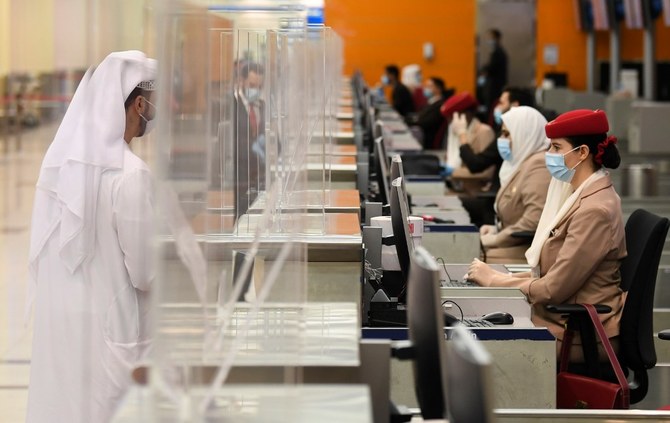
Emirates opens bookings for some Arab destinations starting July

The destinations include Saudi Arabia, Kuwait, Bahrain, Oman, Iraq and others. (File/AFP)
Short Url
Updated 30 May 2020
Follow

Emirates opens bookings for some Arab destinations starting July

  • Coronavirus travel regulations remain and a number of countries have not yet revealed when they would reopen
  • The airline implemented precautionary measures from May 21

DUBAI: Emirates has opened online bookings for 12 Arab countries for flights starting on July 1.
The destinations include Saudi Arabia, Kuwait, Bahrain, Oman, Iraq, Egypt, Algeria and Tunisia, but bookings are still subject to change, local media said.
“Currently some of our flights are available for booking starting  July 1; however, the situation still  remains dynamic and these flight services could be subject to change, We aim to provide our customers with as much notice as possible should there be any changes,” an Emirates spokesperson told weekly magazine Arabian Business.
However, coronavirus travel regulations remain and a number of countries have not yet revealed when they would reopen.
The airline implemented precautionary measures from May 21 as regular scheduled flights to some destinations resumed.
These measures introduced include complimentary hygiene kits for all passengers, staggered boarding – carried out on a row-by-row basis – with all flights over one-and-a-half hours having a cabin service assistant, who will ensure the toilets are cleaned every 45 minutes.
Other measures include a series of precautions for transit passengers in Dubai, ensuring strict social distancing and requiring passengers and crew to wear masks and gloves at all times.


Iraqi lawmakers to elect president Tuesday, PM appointment next

Updated 25 January 2026
Follow

Iraqi lawmakers to elect president Tuesday, PM appointment next

  • Parliamentary speaker Haibat Al-Halbussi announced on Sunday that the new parliament will convene on Tuesday to elect a president

BAGHDAD: Iraq’s parliament will meet on Tuesday to elect the country’s new president, who will then appoint a prime minister expected to be Nouri Al-Maliki after he was endorsed by the largest Shiite bloc.
By convention, a Shiite Muslim holds the post of prime minister, the parliament speaker is Sunni and the largely ceremonial presidency goes to a Kurd.
Parliamentary speaker Haibat Al-Halbussi announced on Sunday that the new parliament will convene on Tuesday to elect a president, according to the official INA press agency.
The president will then have 15 days to appoint a prime minister, who is usually nominated by the largest Shiite bloc formed through post-election alliances.
On Saturday, the Coordination Framework alliance — whose Shiiite factions have varying links to Iran — endorsed former prime minister and powerbroker Al-Maliki as the country’s next premier.
The alliance, to which Al-Maliki belongs, spoke of his “political and administrative experience and his record in running the state.”
Kurdish parties have yet to agree on a presidential candidate, who must be endorsed by other blocs and win a two-thirds majority in parliament.
The presidency is usually held by the Patriotic Union of Kurdistan (PUK). This year, the rival Kurdistan Democratic Party (KDP) named its own candidate: Foreign Minister Fuad Hussein.
Although Maliki’s endorsement effectively guarantees him the post, forming a new government remains a daunting challenge that could drag on for months and still fail.
The designated premier has one month to form a government and present it to parliament for a vote of confidence.
The 75-year-old Maliki, a shrewd politician, is set to return to power at a time of seismic changes in the Middle East, as Tehran’s regional influence wanes and tensions with Washington rise.
Government formation in Iraq must balance internal political dynamics and power-sharing among major parties, all under the continued influence of Iraq’s two main allies: Iran and the United States.
A close Iran ally, Al-Maliki will be expected to address Washington’s longstanding demand that Baghdad dismantle Tehran-backed factions, many of which are designated terrorist groups by the US.
Last month, Iraqi officials and diplomats told AFP that Washington demanded the eventual government exclude Iran-backed armed groups, even though most of them hold seats in parliament, and have seen their political and financial clout increase.
But Iraq is struggling with weak economic growth and cannot risk punitive measures by the US, which has already sanctioned several Iraqi entities, accusing them of helping Tehran evade sanctions.