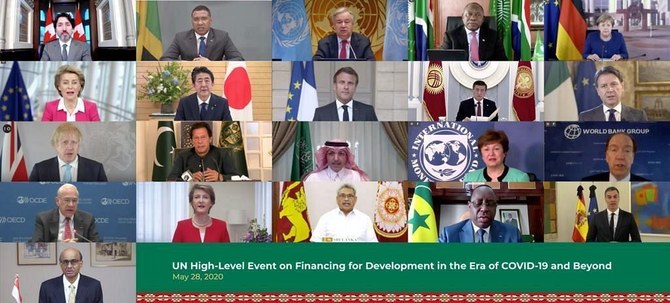
DUBAI: Saudi G20 presidency, represented by the Kingdom’s minister of finance, joined the UN meeting titled “Financing for Development in the Era of COVID-19 and Beyond,” state news agency SPA reported.
Heads of states and international organizations, representatives from NGOs and the private sector discussed six topics mainly, global liquidity and financial stability, debt vulnerability, private sector creditors engagement, external finance and remittances for inclusive growth, illicit financial flows and recovering better for sustainability and growth.
“The Kingdom of Saudi Arabia, including in its capacity as the G20 President, remains committed to work with others to address what is, first and foremost, a human tragedy, and its global health, economic and social impacts, including on the most vulnerable,” Mohammed Al-Jadaan said during the meeting.
The minister highlighted the G20’s response to the challenges in the health, economic and social sectors created by the coronavirus pandemic.
“As the president of the G20 in 2020, the Kingdom of Saudi Arabia immediately took concrete steps to drive and coordinate international response, with the aim of developing collective actions to address the global challenges presented by the COVID-19 pandemic,” he added.
The meeting was co-chaired by UN head Secretary-General António Guterres, Jamaican Prime Minister Andrew Holness and Canadian Prime Minister Justin Trudeau.
It launched a collective effort to create proposals which will help overcome challenges in the six areas mentioned earlier, which will be presented during a political forum in July and at the General Assembly in September, SPA added.
Meanwhile, the G20 International Financial Architecture (IFA) working group held an extraordinary meeting to assess the Debt Service Suspension Initiative (DSSI).
The initiative, which could provide around $14 billion in immediate and critical liquidity relief through official bilateral creditors for the poorest nations, received 36 applications during the first month.
The DSSI “would help vulnerable countries strengthen their fight against the pandemic. This amount could increase significantly if additional creditors, including multilateral development banks and private sector creditors, join the initiative” Saudi G20 Presidency Policy Lead of the IFA Bandr Alhomaly said.
Experts from the International Monetary Fund, World Bank, Institute of International Finance, Paris Club Secretariat and various regional development banks joined the meeting.
The group will host another extraordinary meeting on June 23 to further examine the DSSI implementation efforts, ahead of the Finance Ministers and Central Bank Governors meeting in July.

Saudi G20 presidency joins UN meeting on development financing amid COVID-19 pandemic
https://arab.news/gebhh
Saudi G20 presidency joins UN meeting on development financing amid COVID-19 pandemic
- Heads of states and international organizations, representatives from NGOs and the private sector joined the UN meeting
- The G20 International Financial Architecture (IFA) working group also held a meeting
Saudi Arabia scales AI in national education
- Kingdom accelerates plan to lead the region in digital skills
RIYADH: As Saudi Arabia accelerates toward the goals of Vision 2030, the Kingdom is positioning technology, particularly artificial intelligence, as a cornerstone of its education reform strategy.
By embedding AI across the national curriculum, policymakers aim to equip more than 6 million general education students with future-ready skills by 2025.
To achieve this, government bodies and private sector leaders have aligned efforts to integrate AI education into classrooms across the country.
A collaborative initiative launched in 2025 brings together the National Centre for Curriculum, the Ministry of Education, the Ministry of Communications and Information Technology, and the Saudi Data and Artificial Intelligence Authority. The initiative is designed not only to teach students how to use AI tools, but to enable them to learn through AI-driven platforms. Teachers, too, are central to the transformation.
At the International Conference on Data and AI Capacity Building organized by SDAIA, participating entities outlined their progress and future ambitions, underscoring Saudi Arabia’s drive to become a global hub for AI-enabled education.
Offering a public sector perspective, Bedour Alrayes, deputy CEO of the Human Capability Development Program under Vision 2030, highlighted the importance of embedding AI into learning pathways early and systematically. “It’s not about how they learn AI, it’s about how they practice it,” Alrayes told Arab News.
DID YOU KNOW?
• Saudi Arabia plans to equip over 6 million students with AI skills nationwide.
• IBM has trained 500,000 in AI — targeting 1 million Saudis by 2030.
AI tools are being used not only to teach students but to help teachers design lessons.
She described a structured model that begins in elementary school. “When we talk about K-12, we start by enabling digital curriculum from the fourth grade, also AI curriculum in schools. We enable teachers to know how to use AI tools, and we have gamification tools where they use AI, including after-school activities and customized learning journeys,” she said.
Alrayes stressed the importance of maintaining a balance between technological advancement and human engagement, describing the approach as a “human-centric partnership” between people and AI. The strategy spans the full education continuum — from K-12 to university — and extends into lifelong learning and professional development, ensuring Saudi citizens remain competitive in a rapidly evolving global economy.
SDAIA has further strengthened this ecosystem with the introduction of the Saudi Academic Framework for AI Qualifications, a national benchmark guiding the development, evaluation and accreditation of AI programs in higher education. The framework has drawn interest from international technology firms eager to contribute to the Kingdom’s transformation.
Justina Nixon-Saintil, IBM’s vice president and chief impact officer, pointed to growing demand for AI capabilities in the local market.
“We launched our AI skilling programs just a few years ago, and as of last year we had already skilled 500,000 people,” she told Arab News.
“What I love is that there’s such demand here. People are eager to learn, eager to grow and eager to take advantage of AI skills. It’s also because it’s being led by the government, corporations and universities; everyone is aligned with Vision 2030 and they want to make sure their citizens are ready to take advantage of those opportunities.”
IBM collaborates with leading institutions including King Saud University and Princess Nourah University, delivering AI education and certification programs to faculty and students alike.
Nixon-Saintil underscored the necessity of close coordination between industry and academia.
“We do not implement any programs without input from the private sector. When we look at the training pathways and hands-on projects, we partner with the private sector to understand what skills they’re looking for and how jobs are evolving, because they are changing very quickly,” she said.
Reflecting the scale of ambition, she revealed IBM’s goal of equipping 1 million Saudis with AI skills by 2030.
Private sector innovators are also contributing to classroom transformation. Alex West, founder and CEO of Manifest XR, described how the company’s AI-powered tools are helping educators create dynamic learning content.
“The AI tools that we provide can produce content for teachers based on simple text prompts. They can upload documentation and create videos, assessments, quizzes and an entire course for students to then learn from. We provide structured training programs around how you can safely introduce AI technology, and we provide certificates for teachers,” he said.
West emphasized the urgency of narrowing the gap between workforce demands and the pace of educational adaptation.
“I think educators, if they want to stay ahead and remain competitive, should be introducing this technology so that their students can be prepared for industry work placements and the 2030 vision. In the next few years, things are going to look even more different. The Kingdom wants this technology everywhere and wants to improve the quality of learning. We allow this to scale not only for high-end international schools, but this can be used in any schools across the country, even in resource-deprived areas.”
Anees Ahmad, regional manager at Spectrum Networks, echoed that commitment to nationwide transformation.
“As part of Vision 2030 of the Kingdom, we are here to cater to all government, semi-government and enterprise customers in fulfilling the requirements of the transformation,” he told Arab News.


