

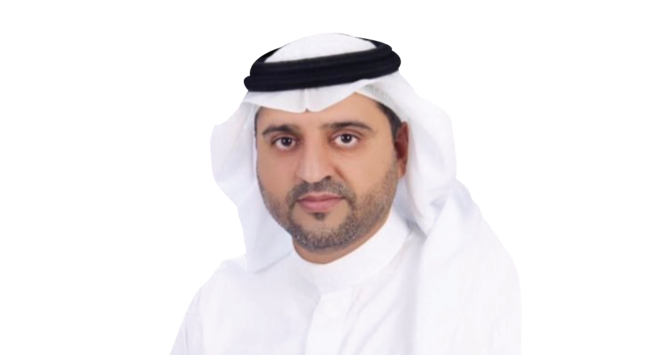
Dr. Abdullah bin Ali Alaaraj, dean of the Makkah College of Technology

Dr. Abdullah bin Ali Alaaraj
Short Url
Updated 28 May 2020
Follow

Dr. Abdullah bin Ali Alaaraj, dean of the Makkah College of Technology

Dr. Abdullah bin Ali Alaaraj has been the dean of the Makkah College of Technology (MCT) since 2018. He is also an adviser to the president of Umm Al-Qura University (UQU) and a columnist at the Makkah daily newspaper.

In 1990, Alaaraj attended UQU, where he attained a bachelor’s degree in English with a focus on education. In 2004, he was awarded a master’s degree in TESOL studies from the University of Queensland, Australia. In 2013, Alaaraj gained a Ph.D. in applied linguistics from the University of Essex, the UK.

Alaaraj worked as an English language instructor in a number of government and private intermediate and secondary schools for nearly six years. After that he moved to the MCT to teach general English and English for mechanical, electrical, economic and computing purposes.

From 2002 to 2003, Alaaraj chaired the English language center at MCT where he set future plans for learning and teaching development.

For three years beginning from 2005, Alaaraj supervised all the teaching units of the Technical and Vocational Training Corporation (TVTC) in the Makkah region. 

Alaaraj, who has worked as a freelance journalist during his professional career, was an English language trainer in a number of education institutions including King Abdul Aziz University and the Arab Open University.

He has attended many conferences and academic assemblies in the US and the UK, where he presented papers on applied linguistics at renowned universities such as the University of London, the University of Warwick and the Canterbury Christ Church University. Alaaraj’s Twitter handle is @dralaaraj.


Iranian ambassador thanks Saudi for not allowing territory to be used during war

Updated 43 min 55 sec ago
Follow

Iranian ambassador thanks Saudi for not allowing territory to be used during war

  • Alireza Enayati tells AFP Iran appreciates Kingdom's pledge not to allow its 'airspace, waters, or territory' to be used in US attacks
  • Envoy also denies that his country hit the US embassy in Riyadh this week with drones

RIYADH: Iran’s ambassador to Saudi Arabia Alireza Enayati said on Thursday his country remained appreciative of Saudi Arabia’s pledge to not allow its airspace or territory to be used during the ongoing war with the US and Israel.
“We appreciate what we have repeatedly heard from Saudi Arabia — that it does not allow its airspace, waters, or territory to be used against the Islamic Republic of Iran,” he told AFP.
Before the outbreak of war, Riyadh had thrown its support behind diplomatic efforts to diffuse tensions between Tehran and Washington and vowed that its airspace would not be allowed to be used for attacks against Iran.
Enayati also categorically denied that his country hit the US embassy in Riyadh this week, after Saudi officials said Iran targeted the compound with drones.
Saudi Arabia has repeatedly accused Tehran of launching missile salvos and drone attacks at its territory and warned that the kingdom reserved the right to defend itself, including by retaliating.
Iran had earlier denied attacking the sprawling Ras Tanura refinery — one of the largest in the Middle East — which Riyadh had also accused Tehran of targeting twice with drones.
Enayati added to the denial, saying Iran also had no hand in the targeting of the US embassy that triggered a fire at the compound.
“We confirmed that Iran has no role in the attack on the US embassy in Riyadh,” the ambassador told AFP.
“If the operations command in Tehran attacks somewhere, it takes responsibility for it.”
The war in the Middle East has engulfed the otherwise stable Gulf region as Iran retaliates over US and Israeli strikes that killed its supreme leader, launching strikes at Israel, the wider region and beyond.
At least 13 people have been killed in the Gulf, including seven civilians, since Iran began its attacks on Saturday.
Enayati, however, denied that Iran was waging a regional war as retaliation for the attacks on his country by the US and Israel.
“This is not a regional war and it is not our war. It was imposed on the region,” he told AFP.