
ANKARA: Turkey’s plans to restrict imports and increase tariffs on some products signal a return to a closed economy for the country, experts claim.
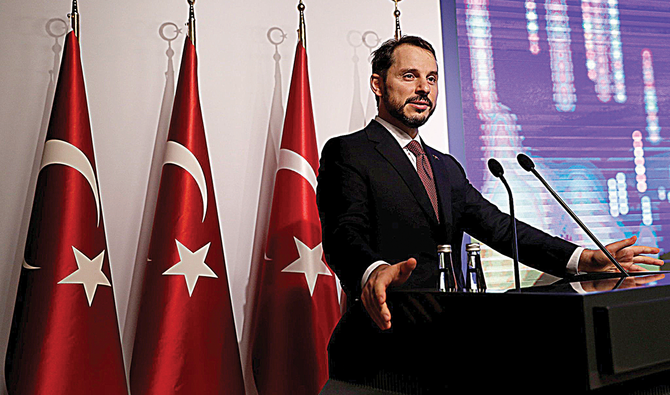
Finance Minister Berat Albayrak said that the government will introduce stricter measures for the import of goods apart from strategic items or those Turkey is unable to produce by itself.
“Imports will be very difficult from now on. Except for what we cannot produce domestically, imports will not be as easy as before,” Albayrak said last week, according to the state-owned Anadolu news agency.
Some experts said that the sudden move toward a closed economy could discourage foreign direct investment amid growing unpredictability in the country in the wake of the coronavirus pandemic.
Turkey increased customs taxes by 30 percent during the outbreak, and said it will add customs taxes to about 800 products, particularly those used by the automotive industry.
On Sunday, Ankara levied up to 14 percent additional duties on some types of steel imports.
A 300 percent jump in import taxes on Iranian watermelons since May 15 has been criticized by a deputy from the pro-Kurdish People’s Democratic Party (HDP), who said that traders are abandoning goods rather than carrying them across the border.
“This points to a new direction in Turkey’s trade policy,” Sinan Ulgen, a former diplomat and chairman of Istanbul’s Center for Economics and Foreign Policy Studies think tank, told Arab News.
Turkey has been in a customs union with the EU since 1996 and is the sixth main trade partner for the bloc with trade worth €138 billion ($150 billion).
The EU represents about 40 percent of Turkey’s global trade, with thousands of European companies operating in the country providing about three quarters of its much-needed foreign direct investment.
Ulgen said the latest announcement by Albayrak is a departure from the common external tariff of the EU — a core condition for the functioning of the customs union.
“What this measure could do is essentially create a trade diversion whereby these products now start to enter Turkey from the EU as opposed to be directly imported. As a result, Turkey would lose all tariff revenues because the EU would get the tariff revenues on these products,” he said.
Ulgen also warned that the government’s decision is likely to affect foreign companies in Turkey and threaten foreign direct investment.
“One key criterion to attract such investment is to have a predictable policy framework,” he said.
Aydin Sezer, an expert on trade policy, said that Ankara’s overnight move is designed to encourage local production at the expense of domestic traders.
“However, this decision will affect domestic producers that import raw materials and intermediate goods. It will make it expensive to import from third countries and will prevent the outflow of foreign currency,” he told Arab News.
Countries that are hurt by sudden protectionist measures could retaliate, he said.
Turkey’s trade has been hit by the pandemic, with imports in April dropping by 28 percent to almost $12.9 billion, and the foreign trade deficit standing at $3.4 billion.