

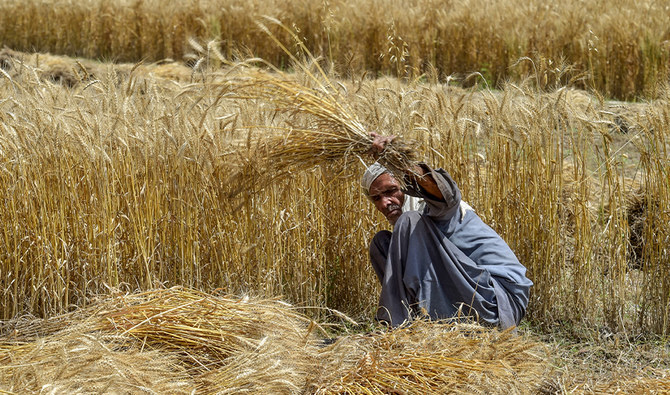

PIRA FATEHAL, Pakistan: Gul Muhammad was expecting a decent wheat harvest this year - until torrential rains and freak hailstorms in March destroyed the crops on his farm, leaving him with no income and no way to feed his family of 10.
"I've never seen such a hailstorm before. I had only heard about such calamities from my forefathers," said Muhammad, 55, as he stood among the crushed stalks in his two-hectare (5-acre) field in Pira Fatehal, a village in Pakistan's Punjab province.
With the crop their only source of income, "I don't know how we will get by now," he told the Thomson Reuters Foundation.
A pattern of unusually heavy rain, hail and wind are driving Pakistan toward a food security crisis, climate experts say, with growing wheat shortages causing flour prices to skyrocket as a booming population pushes up demand.
Last year, storms late in the growing season left the national wheat harvest more than a million tonnes below the government's target of 25.5 million tonnes, according to a report by the country's Senate Standing Committee on National Food Security.
Storms have both damaged crops in their path and created ideal conditions for plant-killing diseases, such as humidity-linked wheat rust, said Muhammad Riaz, director general of the Pakistan Meteorological Department.
Surveying a devastated field near Muhammad's farm in Pira Fatehal, Abdul Basit, a field assistant with Punjab's agriculture department, said recent storms had ruined more than half of the crops in the village.
"This is an arid area where farmers wait a whole year to harvest a single crop, and if that is destroyed they have no alternative to feed their families," Basit told the Thomson Reuters Foundation.
LESS WHEAT, MORE PEOPLE
More than a third of Pakistan's population of more than 200 million faces food insecurity, according to the World Food Programme.
Rapid population growth is exacerbating stress on the country's wheat supply, said Syed Muzafar Hussain Shah, chairman of the senate committee on food security.
"The country's wheat consumption is rising every year with the population increase but the crop's per-hectare yield has not increased over the years," he noted.
Pakistan's population growth rate of 2.4% is the highest in South Asia and almost double the rate of other countries in the region, according to data from the U.N. Development Programme (UNDP).
By 2028, the country's demand for wheat is expected to shoot up by about 7 million tonnes, to more than 34 million tonnes, Shah said.
A government report published in April said the country's looming wheat crisis was the result of a range of factors, including more erratic weather and mismanagement of exports.
The Ministry of National Food Security allowed large wheat exports in 2018 and early 2019, based on an expected bumper crop in 2019, the report found.
But that crop damaged by rain and hailstorms, the country was left without the surplus it had counted on, the report said.
To try to grow the 27 million tonnes of wheat Pakistanis are estimated to need in 2020-2021, the government plans to provide farmers with high-yielding seeds, said Javed Humayun, a spokesman for the food ministry.
Riaz at the meteorological department agreed hardier seeds are the best way to help farmers adapt to Pakistan's rapid climate shifts.
"There is a need to introduce climate-resilient seeds which give more yield in low temperatures and in a shorter time," he said.
BITTER CHAFF
But Mian Umair Masood, secretary general of Pakistan Kissan Ittehad, a farmers' organisation, said the priority should be paying farmers for the crops they have lost in the storms.
"The government so far has no policy to compensate those farmers whose wheat fields have been destroyed," he said, adding that the group has made repeated demands for compensation.
Farmers said the Punjab provincial government has not addressed the issue of compensation for crops ruined earlier this year.
Muhammad Khalid, assistant director of Punjab's agriculture department in Chakwal district, told the Thomson Reuters Foundation he had recommended the provincial government pay local farmers to cover their losses.
Economist Kaiser Bengali said Punjab province produces over 75% of the country's wheat, and low production there could create serious shortages in the country's other provinces.
The worry, he said, is that Punjab will hold onto whatever wheat its farmers can grow to make sure its own people are fed.
"This will (send) the message that other provinces have to arrange the food staple on their own," he said, adding that none of the other provinces had the resources to grow enough wheat for themselves or the cash to import it.
In Pira Fatehal, farmer Muhammad said he had only 160 kilogrammes (350 pounds) of wheat in his grain silo - enough to last two months.
He already had taken a loan from a friend to buy wheat to feed his family, he lamented.
The storms caused so much damage, he said, that he would not even be able to save the husks from his battered crops to use as fodder for the goat, cows, and calves.
"Now this chaff will be bitter," Muhammad said, as he looked over his field of ruined, rain-soaked wheat. "My animals won't even eat it."


