

Washington accuses Beijing of blocking US flights to China

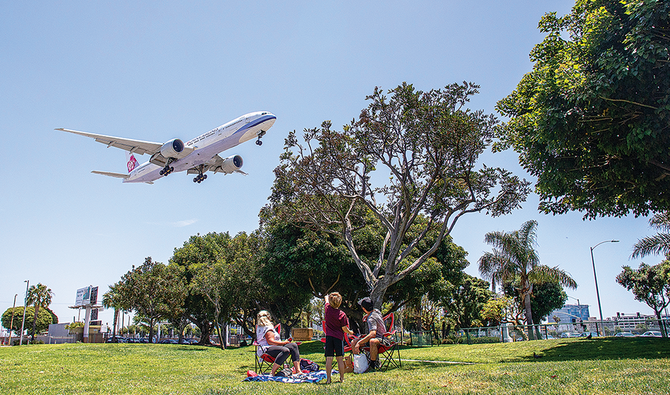
A China Airlines plane lands in Los Angeles on Friday. The US government has accused the Chinese government of stopping US airlines flights to China. (AFP)
Short Url
Updated 24 May 2020
Follow

Washington accuses Beijing of blocking US flights to China

  • The administration of President Donald Trump stopped short of imposing restrictions on Chinese air carriers

WASHINGTON: The US government has accused the Chinese government of making it impossible for US airlines to resume service to China and ordered four Chinese air carriers to file flight schedules with the US government.

The administration of President Donald Trump stopped short of imposing restrictions on Chinese air carriers but said that talks with China had failed to produce an agreement.

The US Transportation Department, which is trying to persuade China to allow the resumption of US passenger airline service there, earlier this week briefly delayed a few Chinese charter flights for not complying with notice requirements.

In an order posted on a US government website, the department noted Delta Air Lines and United Airlines want to resume flights to China in June, even as Chinese carriers have continued US flights during the COVID-19 pandemic.

The order said that Air China, China Eastern Airlines Corp, China Southern Airlines Co, Hainan Airlines Holding Co. and their subsidiaries must file schedules and other details of flights by May 27. The department warned it could find Chinese flights “contrary to applicable law or adversely affect the public interest.”

United declined to comment. The other US and Chinese carriers, the Civil Aviation Authority of China (CAAC) and China’s foreign ministry did not immediately respond to requests for comment.

The department said it it has “protested this situation to the Chinese authorities, repeatedly objecting to China’s failure to let US carriers fully exercise their rights and to the denial to US carriers of their right to compete on a fair and equal basis with Chinese carriers” and called the situation “critical.”

On Jan. 31, the US government barred from entry most non-US citizens who had been in China within the previous 14 days but did not impose any restrictions on Chinese flights. Major US carriers voluntarily decided to halt all passenger flights to China in February.

Delta and United are flying cargo flights to China. Delta had requested approval for a daily flight to Shanghai Pudong airport from Detroit and Seattle, while United had asked to fly daily to Shanghai Pudong from San Francisco and Newark airport near New York and between San Francisco and Beijing.

The number of weekly scheduled combination flights operated between the two countries by US and Chinese carriers fell from 325 in January to 20, by just the four Chinese carriers, in mid-February, before the carriers increased them to 34 in mid-March, the US order said.

The CAAC in late March said that Chinese airlines could maintain just one weekly passenger flight on one route to any given country and that carriers could fly no more than the number of flights they were flying on March 12, according to the US order.


Free trade negotiations between GCC, India mark new phase of partnership, says sec-gen

Updated 24 February 2026
Follow

Free trade negotiations between GCC, India mark new phase of partnership, says sec-gen

RIYADH: The Gulf Cooperation Council’s secretary-general affirmed that the negotiations for a free trade agreement between the GCC and India, and the signing of the joint statement, represents a new phase of strategic partnership.

Jasem Mohamed Al-Budaiwi said that this contributes to enhancing close cooperation and strengthening economic and trade ties, according to the Saudi Press Agency.

This came during the signing ceremony of the joint statement on launching the free trade agreement negotiations between the Al-Budaiwi and India’s Minister of Commerce and Industry, Piyush Goyal, which took place in New Delhi, on Tuesday.

During the signing ceremony, Al-Budaiwi said that the Terms of Reference, signed on Feb. 5, provide a comprehensive and clear framework for these negotiations. The two nations agreed to discuss enhancing cooperation in vital strategic areas, including trade in goods, customs procedures, and services.

Additionally, the framework covers Sanitary and Phytosanitary measures, intellectual property rights, cooperation on Micro, Small, and Medium Enterprises, along with other topics of mutual interest. This reflects the comprehensive nature of the agreement and its ability to keep pace with the future economy.

Al-Budaiwi expressed hope that these negotiations would lead to a comprehensive and ambitious free trade agreement that works to remove customs and non-customs barriers, enhance the flow of quality investments in both directions, and achieve further liberalization in trade and investment cooperation between the GCC and India for mutual benefit. 

This would provide a stimulating economic environment and an investment climate that opens broad horizons for the business sector, supports supply chains, and accelerates the pace of economic growth in line with the ambitious developmental visions of the GCC states. 

The top official affirmed the full readiness of the General Secretariat to host the first round of negotiations at its headquarters in Riyadh during the second half of this year.

The two sides held a meeting during which they reviewed the existing cooperation relations between the GCC and India and discussed ways to develop and elevate them to broader horizons, serving mutual interests and enhancing opportunities for strategic partnership between the two sides, particularly in the economic, investment, and trade fields.

They praised the role undertaken by the negotiating teams from both sides, appreciating the efforts contributing to reaching a comprehensive agreement that enhances economic integration and supports the smooth flow of trade between the two nations.