Boris Johnson resists calls to sack adviser for coronavirus lockdown breach

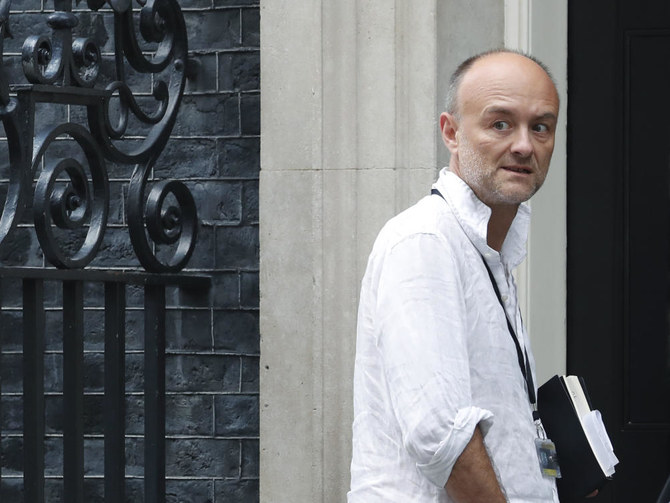
Dominic Cummings masterminded the 2016 campaign to leave the European Union during the Brexit referendum. (AP file photo)
Short Url
Updated 23 May 2020
Follow

Boris Johnson resists calls to sack adviser for coronavirus lockdown breach

  • Dominic Cummings masterminded the 2016 campaign to leave the EU during the Brexit referendum

LONDON: British Prime Minister Boris Johnson resisted calls on Saturday from opposition parties to sack adviser Dominic Cummings after he traveled 400 kilometers while his wife showed COVID-19 symptoms so that their son could be looked after by his family.
Cummings, who masterminded the 2016 campaign to leave the European Union during the Brexit referendum, traveled to Durham in northern England in late March, when a strict lockdown was already in place.
Johnson’s office said his adviser made the journey to ensure his young son could be properly cared for as his wife was ill with COVID-19 and there was a “high likelihood” that Cummings would himself become unwell.
“His sister and nieces had volunteered to help so he went to a house near to but separate from his extended family in case their help was needed,” a Downing Street spokesman said.
“His actions were in line with coronavirus guidelines,” the spokesman said. “Mr. Cummings believes he behaved reasonably and legally.”
One of Johnson’s most senior ministers, Michael Gove, said of the situation: “Caring for your wife and child is not a crime.”
But opposition parties called for Johnson to sack Cummings.
“Dominic Cummings should have done the right thing, he should have resigned but now that he hasn’t, Boris Johnson must show leadership and he must remove him from office immediately,” the Scottish National Party’s parliamentary leader, Ian Blackford, said.
The Labour Party said there should not be one rule for politicians and another rule for the British people. The Liberal Democrats said that if Cummings broke the guidelines, he should resign.
British guidelines say people should stay at home and refrain from visiting family members unless they need essential items such as food or medication.
Other prominent figures have resigned after having broken lockdown rules.
Epidemiologist Neil Ferguson quit as a member of the UK government’s scientific advisory group after was visited at home by his girlfriend. Scotland’s chief medical officer, Catherine Calderwood, also stepped down after she was caught making two trips to her second home.


Canada PM Carney says can’t rule out military participation in Iran war

Updated 05 March 2026
Follow

Canada PM Carney says can’t rule out military participation in Iran war

  • Carney had said the US-Israeli strikes on Iran were “inconsistent with international law”
  • However, he supports the efforts to stop Iran from obtaining a nuclear weapon

CANBERRA, Australia: Canadian Prime Minister Mark Carney said Thursday that he couldn’t rule out his country’s military participation in the escalating war in the Middle East.
Carney’s visit to Australia this week has been overshadowed by expanding war in the Middle East, sparked by a massive US-Israeli strike on Iran that killed its supreme leader, Ayatollah Ali Khamenei.
Speaking alongside local counterpart Anthony Albanese in Canberra, Carney was asked whether there was a situation in which Canada would get involved.
“One can never categorically rule out participation,” he said, while stressing the question was a “hypothetical” one.
“We will stand by our allies,” said Carney, adding that “we will always defend Canadians.”
Carney had said the US-Israeli strikes on Iran were “inconsistent with international law.”
However, he supports the efforts to stop Iran from obtaining a nuclear weapon — a position that Canada takes “with regret” as it represented “another example of the failure of the international order.”
The Canadian leader reiterated on Thursday his call for a “de-escalation” of the conflict.
Carney’s trip is part of a multi-country tour of the Asia-Pacific aimed at reducing reliance on the United States — a hedge against what he has described as a fading US-led global order.
The Australia leg of the tour is aimed at bringing in investment and deepening ties with a like-minded “middle power” partner.

‘Middle power’ rallying cry

On Thursday morning he issued a rallying cry in Australia’s parliament to “middle powers,” urging them to work together in an increasingly hegemonic world order.
Nations like Australia and Canada faced a stark choice — work together to help write the “new rules” of the global order or have great powers do it for them, he said.
“In this brave new world, middle powers cannot simply build higher walls and retreat behind them. We must work together,” he said.
“Great powers can compel, but compulsion comes with costs, both reputational and financial,” the former central banker added.
“Middle powers like Australia and Canada hold this rare convening power because others know we mean what we say and we will match our values with our actions.”
The Canadian leader also said the two countries would together as “strategic collaborators” to pool their vast combined rare earth mineral resources.
And he detailed renewed cooperation in areas from defense to artificial intelligence.
“We know we must work with others who share our values to build solid capabilities,” he told parliament.
Otherwise, he warned, they risked being “caught between the hyperscalers and the hegemons.”
The Canadian leader has frequently clashed with US President Donald Trump, who has repeatedly threatened to annex Canada and slapped swingeing tariffs on the country.
In a speech to political and financial elites at the World Economic Forum in January, Carney warned the US?led global system of governance was enduring “a rupture.”